
Tanya Ivanova-Sullivan receives grant to study language and identity among Ukrainian diaspora
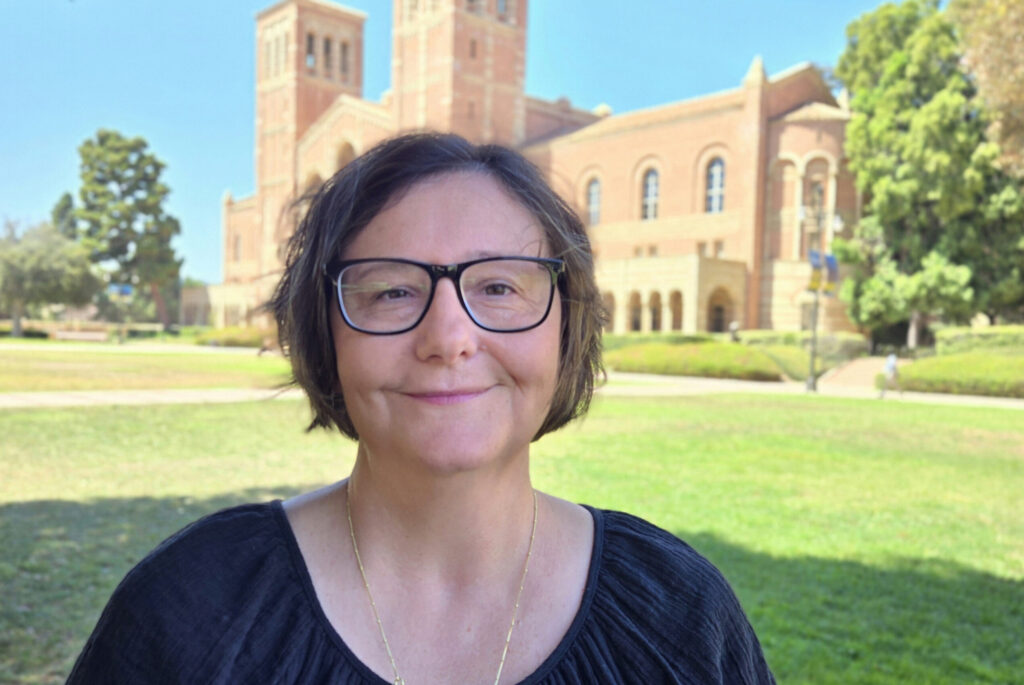
Sean Brenner/UCLA Humanities
Tanya Ivanova-Sullivan is collaborating on the study with scholars from Germany, Israel and Norway.
| October 13, 2026
A project led by Tanya Ivanova-Sullivan is examining a universal but complex set of questions facing Ukrainian citizens displaced by war. Those questions focus on how Ukrainians’ use of language has adapted to their new surroundings.
The research is one of six UCLA projects to receive a Global Research Award for 2026. The research grants are presented annually by the UCLA Global Advisors Council, which also presents Global Education Awards to faculty and departments for internationally focused teaching and curricula. (Read about all of the 2026 grantees on the UCLA Global website.)
Since Russia’s full-scale invasion of Ukraine in 2022, millions of Ukrainians have fled to other nations. And among the myriad issues they face are those related to language, for example how and when they choose to speak Ukrainian; Russian, which is also spoken in Ukraine; and the societal language of their new homes.
Ivanova-Sullivan, an associate professor of Slavic linguistics, is collaborating with scholars from Germany, Israel and Norway on the study.
“We’re looking at languages and how languages define people’s identities, and what multilingual speakers themselves think about these issues,” Ivanova-Sullivan said.
Through sociolinguistic surveys and psycholinguistic experiments involving 80 participants across the four countries, the researchers will explore questions like how and when refugees continue to use their native languages, the extent to which they adopt the primary languages of their new locations and how they switch among two, three or more languages — sometimes within the same conversation.
Ivanova-Sullivan said that practice, called “code-switching,” had once been seen as an indication that multilingual speakers weren’t very proficient in one language or another.
“But that’s not necessarily the case,” she said. “Code-switching can actually reflect speakers’ fluency in two or more languages and their ability to use them flexibly, in a sense, to juggle between languages. They might realize that there’s a more precise word in one language or the other and switch between them for that reason or because a particular language better suits the social context or the people involved in the conversation.”
The researchers intend to share their findings with educational institutions, policymakers and non-governmental organizations to help them adapt classroom teaching and other school programs that respect refugees’ specific needs and identity markers.
Ivanova-Sullivan is the project’s principal investigator. She said it’s fitting that the research is led by UCLA given the campus’s infrastructure for studying such questions — the campus is home to the National Heritage Language Resource Center, of which she is associate director — and the support heritage language research has received from both the UCLA College Division of Humanities and the UCLA International Institute.