
UCLA Humanities receives $220,000 grant
The ‘Race in the Global Past through Native Lenses’ project is led by professors Zrinka Stahuljak and Shannon Speed
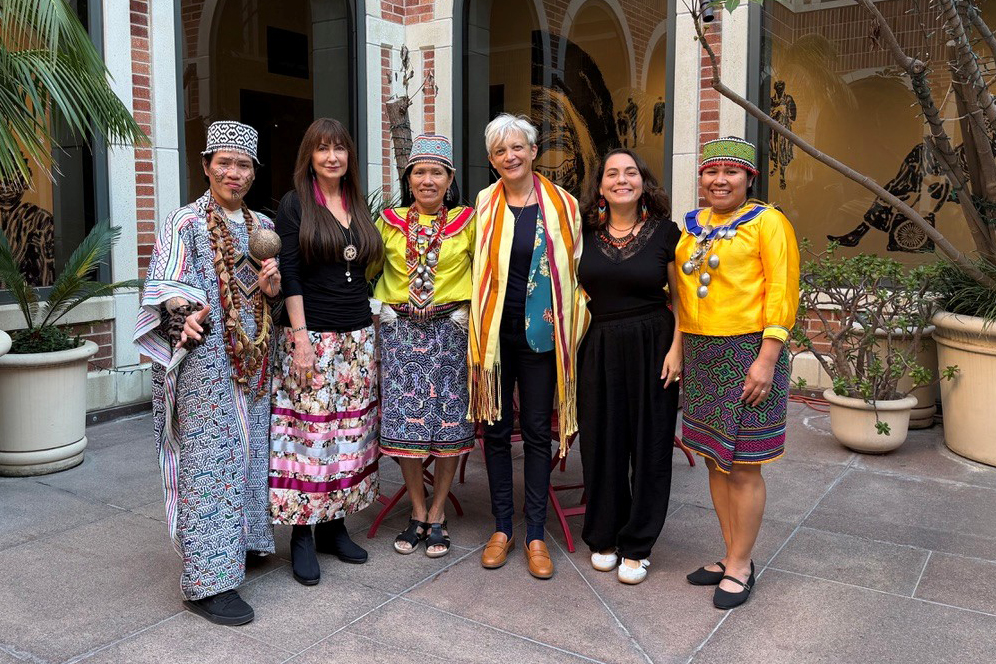
Alba Menéndez Pereda
Erick (Ronin) Arias Silvano, Shannon Speed, Olinda Silvano, Zrinka Stahuljak, Solsiré Cusicanqui and Sadith Esther Silvano Inuma at the Fowler Museum. The Shipibo-Konibo artists will be on hand at the Fowler on Nov. 6 to unveil a large-scale mural by Silvano.
| November 5, 2026
A multifaceted UCLA project called Race in the Global Past through Native Lenses, which focuses on how diverse ways of knowing and being in the world became associated with race and were subsequently marginalized throughout history and around the world, has received a $220,000 grant from the Mellon Foundation.
The project’s principal investigator is Zrinka Stahuljak, professor of comparative literature and of European languages and transcultural studies, and the director of the UCLA CMRS Center for Early Global Studies. The co-principal investigator is Shannon Speed, UCLA’s Paula Gunn Allen Chair and professor of American Indian studies, anthropology and gender studies, and the Helen and Morgan Chu Chair and Director of the American Indian Studies Centers.
The new, two-year grant is for $220,000 and will sustain the project through the end of 2028. In this stage, the project’s goal is to continue co-creating knowledges with Native and Indigenous communities and embed the grant’s epistemological outcomes institutionally.
The project began in 2023 with an initial $1 million grant. Since then, it has convened 10 workshops, bringing together partners from Los Angeles Native and Indigenous communities, and communities of the Pacific Rim, with UCLA faculty, postdoctoral scholars, graduate students and staff.
In the new phase, the project will support an exhibition at the Fowler Museum at UCLA that will bring together the workshops, collaborations and central themes explored throughout the project’s three years, examining how museums and universities can recognize, incorporate and share diverse systems of knowledge. The grant project will be capped with a workshop on the comparison of medieval and Indigenous knowledges, organized between California Native and Indigenous associations and associations of Native and non-Native medievalists.
In addition, Stahuljak is being mentored through a UCLA Center for Community Engagement program, with the aim of developing a community-engaged undergraduate course called “Indigenous and European Knowledges: Words and Stories.” As part of the planned course, students would have the opportunity to visit various local community partners.
The project also brought community knowledge holders from the Indigenous Zapotec Los Angeles-based community and the Gabrielino-Tongva Native tribes to UCLA classes — including large-lecture general education classes and upper-division undergraduate and graduate seminars in the humanities and social sciences.
“I am very proud that the grant project has had a social impact beyond the university, in communities and broader publics, connecting Southern California Native communities with Indigenous partners in Peru, New Zealand and French Polynesia,” Stahuljak said.
“The integration of Indigenous knowledges institutionally through alternative and co-curated methods enhances the profound transformation of the Fowler Museum under director Silvia Forni’s leadership, and it continues the transformation of the CMRS Center for Early Global Studies under my directorship by partnering epistemologically with Native and Indigenous communities. These are huge transformational changes in institutional terms that the grant has enabled in this partnership of UCLA Native and non-Native faculty and Native and Indigenous communities of the Pacific Rim.”
Another success from the initial grant period was UC Davis’ hiring of Daniel Gámez to a tenure-track faculty position in ethnic studies. Gámez had previously been a UC Presidential Postdoctoral Fellow affiliated with the Mellon-funded project. Gámez has said that he will carry forward the project’s commitment to connecting scholarship with community and placing Indigenous histories in global and comparative perspective.
“I am grateful to the Mellon Foundation for recognizing the ongoing importance of this Indigenous community engaged project,” Speed said. “I’m looking forward to continuing the work of putting Indigenous perspectives in dialogue with Western ones and working toward paradigm transformation.”
To mark the beginning of the grant renewal, on Nov. 6, the Fowler Museum will unveil “Paths of Memory, Paths of Healing,” a large-scale mural by Olinda Silvano that was produced during the first grant cycle. Silvano is a Shipibo-Konibo artist and cultural leader who lives and works in the Amazonian community of Cantagallo, in Lima, Peru. Silvano and other Shipibo-Konibo artists will be on hand for the exhibition’s opening reception to discuss how kené, their art form, expresses connection, memory and healing through painting and song.
The mural will remain on display at the Fowler for 10 years in an exhibition curated by Solsiré Cusicanqui, the Mellon postdoctoral fellow at the CMRS Center for Early Global Studies.