
Humanities Division launches Global Languages Ambassadors program, applications open through Nov. 30
Thinking about applying? Previous participants share their experience
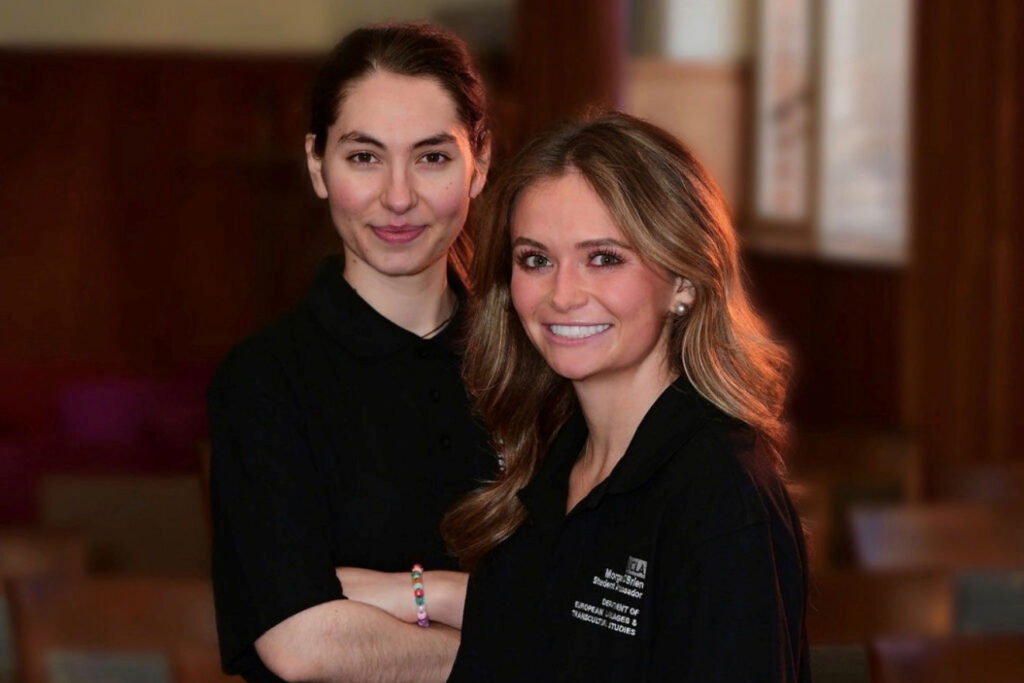
Rich Schmitt Photography
Third-year students Zoe French (left) and Morgan O’Brien were language ambassadors last year in a pilot program offered by the Department of European Languages and Transcultural Studies.
| November 4, 2026
A new Humanities Division program is designed to provide UCLA language students with professional development, experiential learning and leadership experience, as well as course credit.
The Global Languages Ambassadors program is accepting applications for its 2027 cohort through Nov. 30. (Visit this page to apply.) The program is open to declared language majors or minors who have completed at least one year of study in their respective language at UCLA or another institution.
Five students will be chosen to participate in the program, which will take place during the upcoming winter and spring quarters. Ambassadors will enroll in a four-credit-per-quarter upper-division seminar supervised by Nina Bjekovic, director of language programs and strategic initiatives in the Department of European Languages and Transcultural Studies, or ELTS. Students will also contribute to outreach initiatives for UCLA language programs, and to projects that promote multilingualism and highlight the value of language study. The program is designed to offer practical experience in communication, collaboration, project management and public engagement.
“The Global Languages Ambassadors program gives students the opportunity to take their education beyond the classroom, gain meaningful professional experience and play an active role in promoting language study at UCLA,” Bjekovic said. “With the 2028 Olympics approaching, we’re also excited about opportunities to engage with the international community coming to Los Angeles.”
The new program is an expansion of a similar language ambassadors initiative operated by ELTS during the 2025–26 academic year. As a guide for students interested in applying for the 2027 program, we spoke with Zoe French, a third-year student majoring in Russian language and literature and minoring in French, and Morgan O’Brien, a third-year student majoring in German and minoring in global health, who served as ELTS languages ambassadors last year.
What was the most rewarding aspect of your experience as a language ambassador?
Zoe French: Getting to know faculty, staff and students in the ELTS department. Fostering these relationships not only gave me lifelong mentors and friends, but also introduced me to incredibly intelligent, well-spoken and kind people who truly care about my journey at UCLA. Additionally, I was given the tools and experience to develop essential professional skills, including editing and designing website pages, creating brand guides and writing and performing speeches, all of which I know will help me in the future.
Morgan O’Brien: I am often asked why someone hoping to pursue an M.D./M.B.A. would major in a language. Being the program’s first ambassador let me answer that question with my own experience — translating original German paleontology articles into English for a research lab at the New York Institute of Technology College of Osteopathic Medicine, my global health fieldwork in Peru and my current internship at a French medtech startup in Nice, France. I want to be a physician and healthcare entrepreneur who can communicate across languages and cultures, because that is a core part of high-quality care.
How did the experience help you in terms of your language skills or cultural awareness?
French: I am learning French, Greek and Russian at UCLA, and I truly enjoy all three. This internship was invaluable in helping me connect the three languages through a human lens — by viewing language not simply as a personal or professional skill, but a skill of connection which will help me develop as a human being by empathizing with those that I am able to speak with and by seeing the world through their eyes.
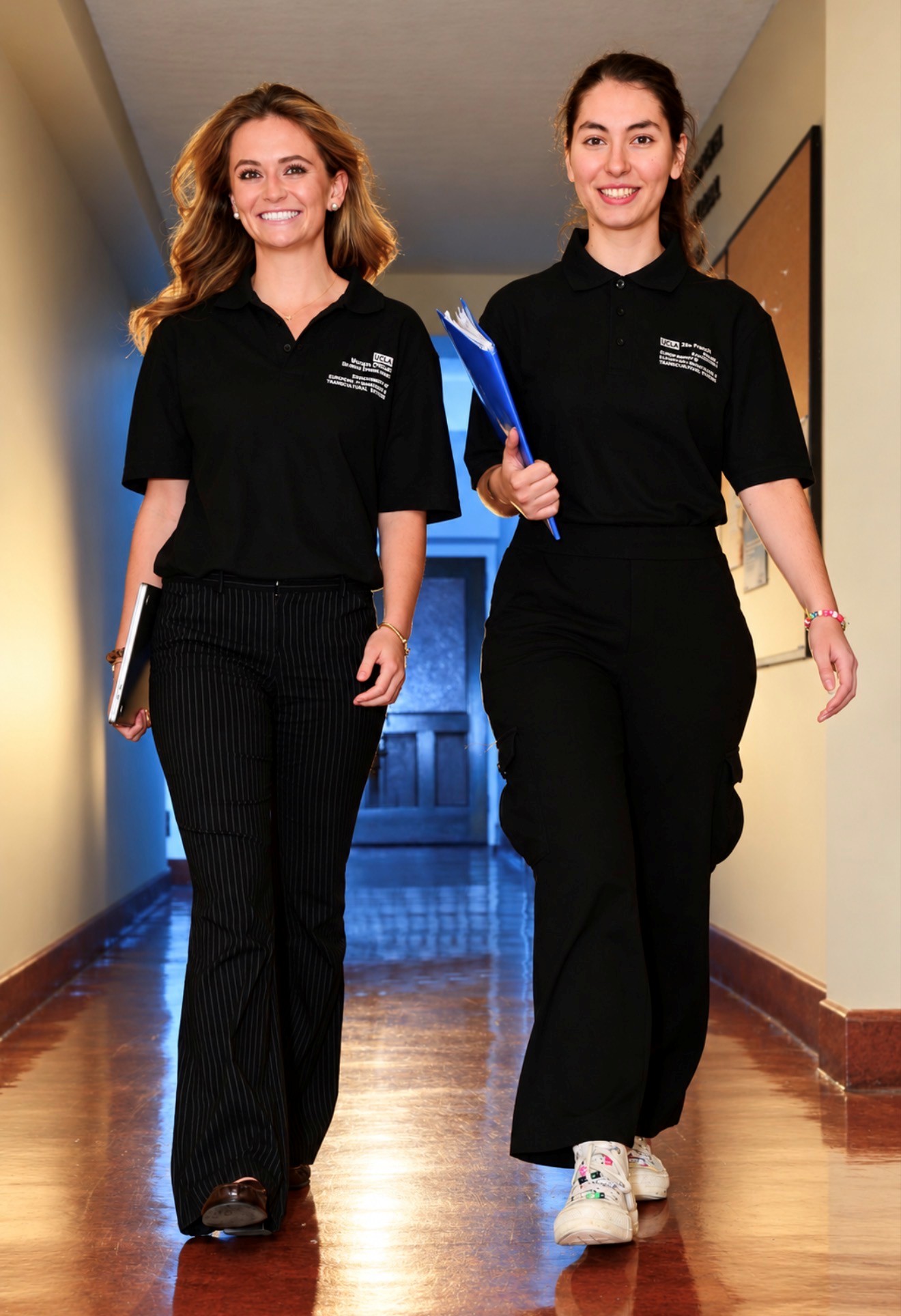
Morgan O’Brien and Zoe French
O’Brien: I grew up bilingual in German, but being an ambassador pushed me to think about language as more than a skill I already had; it made me reflect on how much culture is carried in language. The role also gave me opportunities I would not have had otherwise and made me a more confident, culturally aware communicator. Now, during my semester in France, the skills I built as an ambassador — especially adapting how I communicate to different audiences and approaching unfamiliar cultural norms with curiosity instead of hesitation — are helping me every day. I am grateful to carry them with me wherever I go.
What would you say to students who are considering applying for the Global Languages Ambassadors program this year?
French: That it is an opportunity unlike anything else. Not only do you develop your language and communication skills, but you will leave knowing compassionate individuals — faculty, staff and students — who will support you on your academic and life journey and who truly want to help you get to wherever you are going.
O’Brien: Apply — even if your goals are in another field or you think of yourself as a science student more than a humanities student. Some of the most valuable conversations I had during the program were with STEM and pre-health students who did not realize a language could strengthen their path instead of competing with it. The ambassadorship helps you understand why language matters on a global scale. It also connects you with faculty, study abroad opportunities and scholarships you might otherwise miss.
You do not need to be fluent in another language to apply. You only need to be curious and willing to share your experience as well as open to hearing about the experiences of other students.