
The write stuff
Kwame Granderson discovered his passion for the written word at UCLA. Now he’s passing that on in a most meaningful way
Martha Galvan
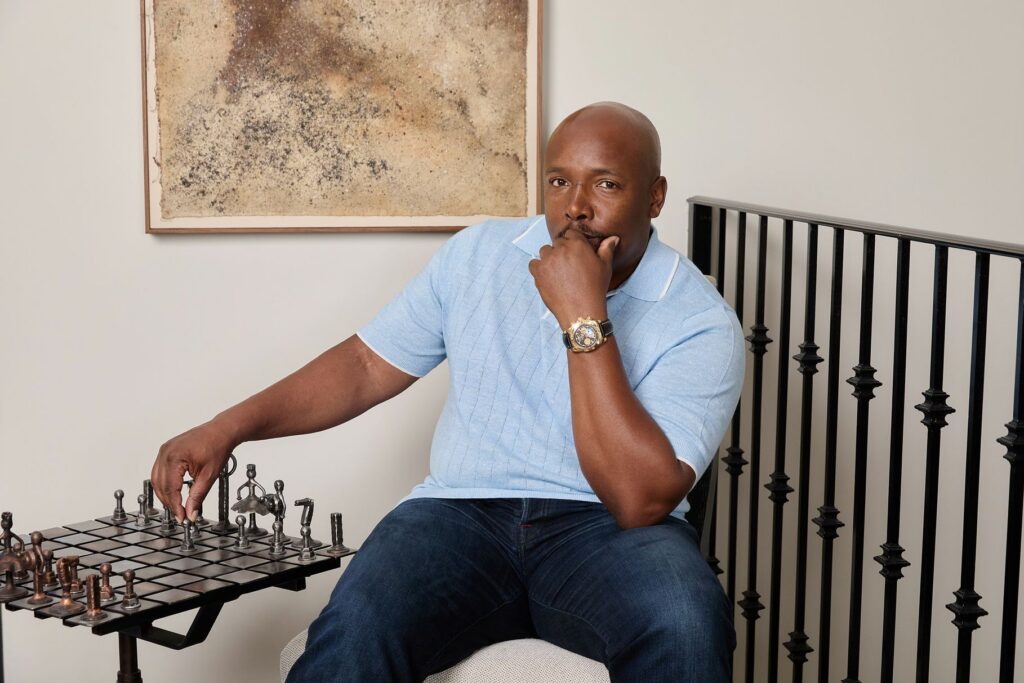
Kwame Granderson at home. The chess set next to him was made from recycled car parts by an artist in San Miguel de Allende, Mexico.
| October 7, 2026
Superheroes aren’t the only ones with origin stories, so here’s my best guess at the moment Kwame Granderson became Kwame Granderson: Minutes before his Beverly Hills High School graduation ceremony in 1988, he and the three other top students in his class assembled for a photo shoot for a valedictory article in the Beverly Hills Courier.
The school’s journalism teacher was on hand to take the pictures. He photographed the other three students’ portraits first, as the 16-year-old Granderson waited with his parents, both immigrants of Caribbean ancestry who had sold everything they owned to finance their move to the States.
“When he got to me,” Granderson ’92 says of the photographer, “he said, ‘I’ve run out of film.’ My father was like, ‘Yeah, that’s not OK.’ I said, ‘I took your class, and I happen to know you have a whole storage room full of film. What are we talking about?’”
I ask Granderson if the other top students looked different than him.
“Yes,” he says. “So, the Beverly Hills Courier — if you go back and research it, you’ll see three pictures and then an empty box with my name. And that pissed me off. And it really pissed my father off. So, when I got to UCLA, I showed up mad. It might have been the best thing that could have happened to me, because at that point, I was like, ‘OK, now it’s on.”
That moment was not the first, nor the last, time somebody treated Granderson like an invisible man. (Stand by for a story about Harvard Law.) All of those efforts failed. Granderson never did.
At 55, he looks a decade younger. We’re sitting on a deck above the golf course at the MountainGate Country Club, at the base of the Santa Monica Mountains. (Granderson’s sport, for the record, is not golf, but tennis.) Granderson’s wearing a couple layers of white Prada on top, jeans, and Louboutin high-tops with red soles. There are just a few sprigs of white in his goatee.
He is a man of intriguing contradictions: soft-spoken but unsparing with the truth, unassuming but frank about his achievements — maybe because he’s been underestimated so often. For me, the most refreshing dichotomy is that he’s an attorney, real estate investor and fund manager who oversees a $250 million portfolio of affordable housing across the Midwest — yet what he’s really passionate about is the power of writing to transform one’s life.
In May, Granderson made a $6 million commitment to UCLA’s Undergraduate Writing Center that will fund it in perpetuity. The donation is a godsend at a time when federal funding for institutions around the country has become, let’s say, complicated.
Watch a UCLA Magazine video about Kwame Granderson’s generous gift to endow the Undergraduate Writing Center. (Click this link for an audio-described version of the video.)
It’s also a full-circle moment. The summer before his senior year at UCLA, a 19-year-old Granderson wrote a canny, fantastically pragmatic book called Write to the Top: Learn to Write Like Your Best Professor (not officially published until 2025, and now updated for the AI tsunami engulfing us). He says he was not a naturally gifted writer, and that he wrote the book to help other students crack the code on critical thinking and academic writing like he did so they could excel like he did — and advocate for themselves forever after.
“I think of Kwame as quiet fire,” says Angela Deaver Campbell, the assistant dean and executive director of UCLA’s Center for Scholarships and Scholar Enrichment. “He’s always been a humanist. He wants to make an impact on the world, but he does it so quietly that you don’t even notice it until it’s, like, bam, in your face.”
Deaver Campbell gave Granderson his first real job after graduation, that of helping her launch the scholarship center. Along with his undergrad honors counselor, Toi Turner, Deaver Campbell is one of the people whose early advocacy Granderson says he remains most grateful for. On a Zoom call, Deaver Campbell excitedly shows me a photo of the cake the center’s staff presented him with when he left the job. Written on the cake in purple frosting: “Best wishes Kwame for future success.”
“Which, obviously,” Deaver Campbell says, “he’s had a lot of.”
From the Caribbean to England to Westwood
“To understand my story,” Granderson tells me, “my parents’ story helps.”
Following World War II, his maternal and paternal grandmothers emigrated to the U.K. from Jamaica and Trinidad, respectively. At that time, England promised people from the Caribbean the right to live and work in the country in return for help rebuilding it, literally and economically. Granderson was born in London in 1971 and named after a man his father admired, Kwame Nkrumah, the first president of the newly liberated Ghana.
His mother, Marlene, had a sharp mind for math. His father, Jerry, read deeply about education and history. (When Granderson was growing up, Jerry had a massive portrait of Angela Davis on the wall.)
Both of his parents, he says, grew up in abusive households. His father believed in working tirelessly and not drawing attention to yourself; his mother’s mantra went something like this, he says: “I don’t care what obstacle is in front of you, you just keep fighting. Even if every statistical analysis says that you should not be able to achieve, that doesn’t matter.” Granderson pauses. “Now, the downside of my mother is that she can be what I imagine Tiger Woods’ father to be like, meaning that she’s so relentlessly driven that there were many instances where she could have broken me with how hard she pushed.”
Neither parent had had much formal education, and social mobility was a nonstarter in class-conscious England. The family emigrated to New York City in 1977, where they experienced a period of what Granderson calls “housing insecurity.” Jerry worked in a meat factory washing blood off the walls so they could afford an apartment. But he always viewed California as the promised land. When Kwame was 7, the family moved west and settled in East L.A., with Crips on one side of them and Bloods on the other.
“The decision was, ‘We’re gonna pour all our resources into this kid and get him as educated as we can and cross our fingers,’” Granderson says.
His father opened a TV repair shop in Los Angeles. His mother worked at a Century 21 real estate office, which would later help launch Granderson’s own career. Though the city was alien to them, his parents found ways to strategize for their son. “This is gonna sound ridiculous,” Granderson says, “but the only reason I went to Beverly Hills High was that my mother was at the hairdresser, and she asked people in the hair salon what was the fanciest school.” She drove by BHHS and saw that it was stately and green. “She was like, ‘He has to go there. I don’t care what we have to do.’”
What they did was rent an apartment within the Beverly Hills Unified School District boundaries. But socially, Granderson existed on the fringes of BHHS. Outside school, he spent “an insane amount of hours” street dancing, specifically popping and locking. He discovered that he was a good choreographer, assembled a crew, and traveled around doing battle and speaking in Black slang. His father saw red flags. He told his son that he seemed determined to be a thug, that the kids he hung around with would end up dead or in prison. (“It turned out he was right,” Granderson says.)
When BHHS urged Granderson to play football, his father vetoed it fast: “His thing was, ‘In football, you’re going to take a lot of shots to the head, and your brain is your most valuable asset. We are here for your brain. Period. End of paragraph.’”
At 16, Granderson made a clean break from that part of his life.
At UCLA, a love of writing is born
Because he had skipped a grade early on, Granderson arrived at UCLA as a 17-year-old, first-generation college student with a mandate from his parents to get an A in every course. On the rare occasions when he struggled, he would call his mother. She’d ask him if he remembered what they had sacrificed to give him a future, then hang up without saying goodbye. Steely as that sounds, Granderson cared deeply about his family — he now had a sister, Lyeah ’13, fourteen years younger — and he vowed to make their financial security his permanent responsibility.
At UCLA, he majored in English, and if he was awake, he was studying. I ask him if he ever had fun. He offers a statistical analysis: “In four years, I went to one basketball game and one football game just to say that I attended. So the answer is almost zero. I recall going to a couple of parties. I had a girlfriend at the time that I’m still in touch with.” Granderson waits as a server sets down our lunch. “I was pretty intense,” he says.
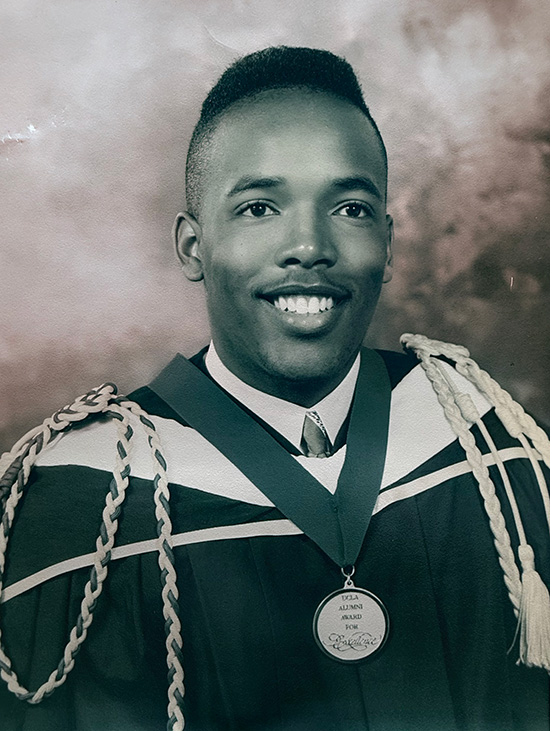
Granderson wearing the UCLA Alumni Award he received at his graduation.
He had a close friend in the trenches named Jonathan Gruber ’92, who was also determined to be one of UCLA’s top English majors and who is now global head of classical at Apple Music. “It was a really dramatic time for learning and growth for both of us,” Gruber says. “I always felt I could talk to Kwame about anything. There was no no-go area. We were dealing with really complicated philosophical issues in English lit, and that opened up our minds and allowed us to debate and think and laugh. We didn’t party in the traditional sense.”
Gruber says that his friend never blamed anyone (i.e., his parents) for the pressure he put on himself, and that he didn’t compete with anyone other than himself. That tracks with an anecdote Granderson remembers hearing when he was studying Paradise Lost as a junior. (In the event you need a refresher, John Milton’s 10,565-line Early Modern English poem deposits readers in the inescapable furnace of Hell — in more ways than one, some might say.)
Outside of class, Distinguished Research Professor of English Debora Shuger asked another student if they had any idea why the class average in her legendarily tough course was suddenly so much higher than usual. The answer was not complicated: “This kid Kwame has been tutoring all of us with this book he wrote.”
Granderson unlocked the art of essay writing by doing a granular study of papers his own UCLA professors had written. By the time he was named Outstanding Senior in 1992, his transcript was an unbroken marching band of A’s. He had won so many scholarships that he had not just covered his tuition but had also earned a profit. He’d also pulled a muscle in his eyes from studying, which would plague him at Harvard Law.
In his third year at law school, just before he graduated with honors, Granderson got a terrible backhanded compliment about how sharp his writing had become: His supervising professor read a paper of his and accused him of plagiarism.
“She said, ‘This is too well-written. Someone like you could not have written it,’” he tells me. “I think if you asked her today if her statement was racially based, she would lie to herself that she had some other motive, right? But she said, ‘I have asked two other lawyers at my law firm to help me find what you plagiarized … I’m going to make sure you get expelled.’”
Granderson was deeply offended. He knew what he had achieved.
The professor and her team found no evidence at all that he had done anything wrong, of course. She wrote to him, letting him know that she was giving the paper an A+ and asking if she could help him get it published. His reaction? “I don’t want to work with you. I don’t want to get published. I want to make money. So, if you wouldn’t mind getting out of my way, I’d like to graduate now.’”
Coming “full circle”
After lunch, we meet up at Granderson’s home, on a narrow leafy road in Beverly Hills off Mulholland Drive. He seems shy about the place — like I might not be impressed — but it’s a beautiful spot, not to mention the fact that he has also bought homes for his parents, who divorced about a decade ago, though they’re still close. His father lives in a suburb outside Miami. His mother is in the Hollywood Hills in what Granderson cheekily describes as a “mansion situation.”
After Harvard Law, Granderson spent four years as an attorney at the elite, nearly 136-year-old firm Gibson Dunn while simultaneously building up his own real estate firm. From there, he worked for the Los Angeles Unified School District, where he was part of the team that structured a $2 billion bond deal to purchase land and build schools.
By the time of the 2008 crash, Granderson, who was married at the time, had a mortgage company, a construction company and a real estate investment firm. “I owned about 50 houses and lost all of them,” he says. “That’s rough on a marriage, you know? We got a call on a Tuesday that said, ‘All 37 of your loans have just been canceled.’ We went from being very profitable to negatively cash-flowing $70,000 a month.’”
In 2011, Granderson’s father, who’d gotten a real-estate license and begun operating the Century 21 office with Granderson’s mother, got a call from someone looking to sell a mobile-home park. Granderson had never heard of one. He sent his dad to check it out. Later, he determined that the parks were undervalued by Wall Street and began buying them up. He now believes his properties will be worth a billion dollars within the next five years.
Granderson’s home office is cramped, but only because his interests are so numerous and far-flung. His bookshelves are home to Toni Morrison novels and Walt Whitman poems, as well as Taoist texts, Stoic philosophy and history. Bolstering his Renaissance man bona fides, Granderson takes artful photos when he travels, writes poetry and has completed a trilogy of historical screenplays centered on race.
At the moment, he’s at work on a new book called Thinking in the Millions, which is about expanding one’s vision and was largely inspired by his journey in rewiring his thinking to overcome poverty. His office has no shortage of computer screens: He not only oversees Granderson Holdings, Granderson Destinations and MHC Capital, but he also builds innovative writing and scholarship sites for students.
Iman Handy, a recent Harvard graduate now heading to Bain & Company, tells me she used the strategies presented in Write to the Top throughout her undergraduate years, starting with her first expository paper, which earned her an A.
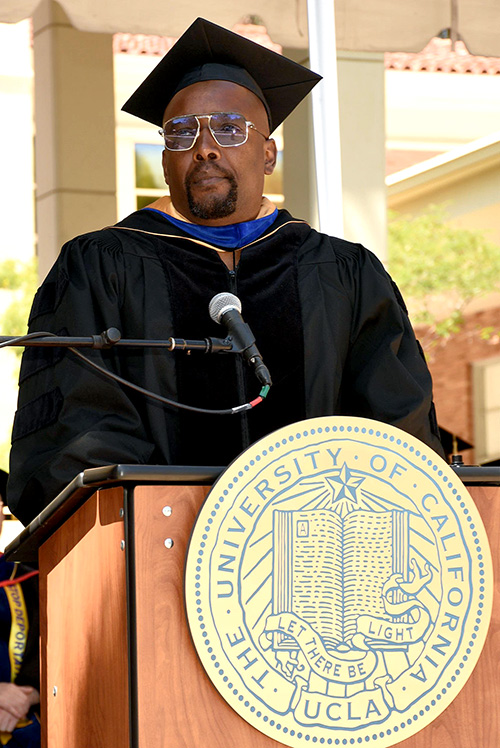
Granderson was the keynote speaker for the 2025 English department commencement ceremony.
“The triangular pattern of thesis, antithesis, synthesis blew everyone away in my class,” she says. When I ask her if she had enough confidence to think she would have gotten an A anyway, she laughs and says, “By no means.”
One wall of Granderson’s office is covered with diplomas and certificates, along with a California license plate reading DSCPLIN. Much of this had been relegated to closets for years. Until his mid-40s, Granderson, who has a 24-year-old daughter named Pharoah, couldn’t shake the suspicion that his accomplishments didn’t mean much if they wouldn’t keep his family financially safe. Eventually, he could say to himself, “I think I’ve done it. I kind of did the damn thing. I’ve got more stuff to do, but I have given a hundred percent.”
I ask Granderson if his parents — who were so demanding and protective for years, then an active part of his real estate business — are proud of him.
“It’s almost uncomfortable how effusive they are,” he tells me. “For my father, it takes the form of, ‘Wow, can you believe we did it?’ For my mother, it takes the form of, ‘Look how amazing my son is! I always knew he was a genius. I used to protect his head in the bath because I knew he was gonna be smart.’”
Among the distinguished documents on the office wall is a framed photo of Granderson in cap and gown, delivering a keynote address at the English Department’s commencement ceremony in spring 2025. He stands next to me, looking at the picture. I ask him: How did he feel up there at the podium?
“I’ve done a lot of public speaking,” he says, “and when I went to do that commencement speech, I was petrified. While they were putting the cap and gown on everybody, I couldn’t breathe. I was like, ‘Oh my god, I’m in trouble.’
“But Professor [Saree] Makdisi gave me this incredible introduction, and I was sitting onstage looking out at the audience, and I was like, ‘This is incredible that I’ve come full circle from being this 17-year-old that was completely lost and terrified to coming back and giving this presentation.’ And then my heart rate started slowing down.”
This story was originally published in UCLA Magazine. Read the complete fall 2026 issue here.