
High schoolers, community elders come together to explore artifacts from Vietnamese refugees
Event highlights Refugee Material Culture Initiative, led by classics professor Kelly Nguyen
Vietnamese Heritage Museum
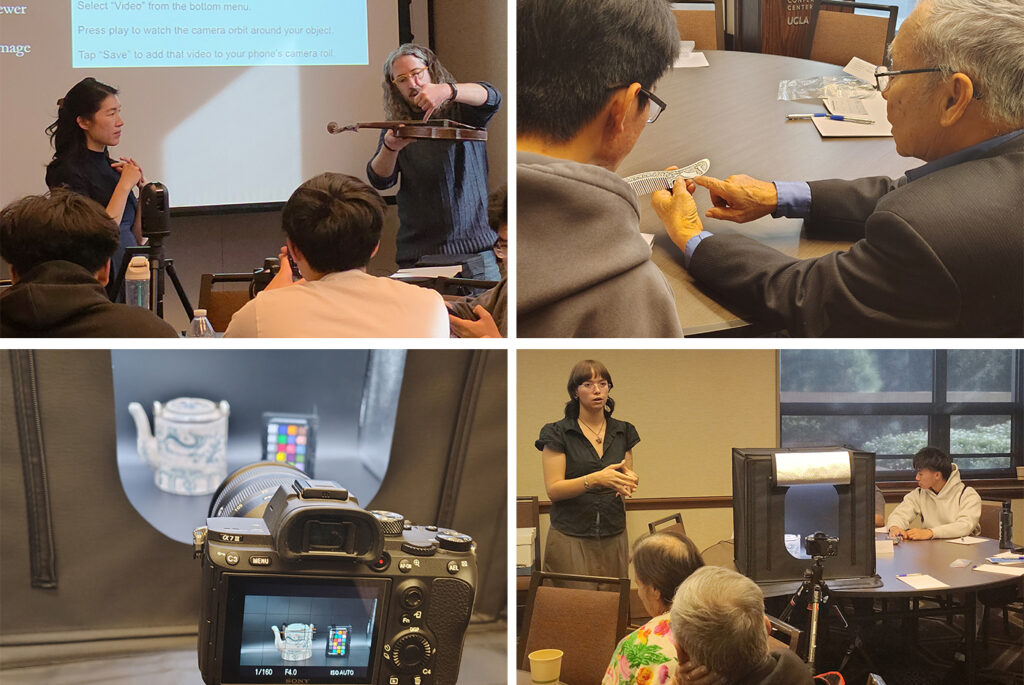
Scenes from Intergenerational Archaeology Day, including presentations by Kelly Nguyen and Doug Daniels of the Refugee Material Culture Initiative (top left), and third-year undergraduate Charley Walsh (bottom right).
| April 28, 2026
At a recent campus gathering, a 90-year-old man named Lê Trị stood before a rapt audience and described how he had secretly crafted a violin while living in a Vietnamese prison re-education camp in 1976 — carrying on even after guards had previously confiscated a guitar he had made and beaten him with it.
His surreptitious project was inspired, he said, by his belief that music was the only thing keeping hope alive among those imprisoned around him.
The moving testimony took place during Intergenerational Digital Archaeology Day, an event organized by UCLA classics professor Kelly Nguyen, in late January.
And that violin the man described? It is now on display — virtually — as a 3-D scan in a digital archive managed by the Refugee Material Culture Initiative, which is led by Nguyen. The initiative is a collaboration with the Vietnamese Heritage Museum in Garden Grove, California.
The digital archaeology event brought more than 50 high school students from Westminster High School and more than 30 elders and community members from Orange County’s Little Saigon neighborhood. With seating arranged to ensure the generations were mixed, elders shared stories about their personal experiences as refugees from Vietnam, mostly during the 1970s. They worked together to determine the provenance of other artifacts from Vietnamese refugees, discussing where and when they might have been used.
Charley Walsh, a third-year UCLA undergraduate majoring in classics and anthropology who helped run the workshop, said that led to one lighthearted moment: Examining one object from the 1970s, a student guessed that it had come from the 1920s, which elicited some laughter from one of the elders. But Walsh also said it was especially rewarding to observe the high-schoolers and elders interacting with each other throughout the day. One moment that stuck with them was the sight of an older man hunched over a provenance sheet, writing things down together with a student.
“The elders were so excited that they had young people sitting at the same table as them who, in other contexts, might not be talking about this with them,” they said.
The guests also heard from Walsh and other UCLA scholars about the Refugee Material Culture Initiative’s efforts to document and preserve such artifacts in an online database. The collection incorporates about 100 objects donated by members of the Vietnamese diaspora, including handcrafted combs made in re-education camps, military uniforms and a Vietnamese–English typewriter.
Nguyen, who also is a core faculty member of the Cotsen Institute of Archaeology, said that by the end of the day, students and elders were asking if the event would be held again. Indeed, she said, her goal is for the event to be one element of an ongoing relationship between her team and members of the Vietnamese diaspora community.
“We didn’t want this to be just an outreach project or a one-off event,” she said. “We always wanted it to be a sustainable, truly community-engaged project, where the community serves as co-thinkers and collaborators with us.”
The day concluded with a lecture by Nguyen, who shared the stage with three of the elders — including Trị, the violin maker — who had donated artifacts to the initiative, all speaking in Vietnamese about their objects and their experiences.
“It was really great to see them realize the power of their stories for the younger generation, and to see that their experiences matter,” Nguyen said, “not just for the younger generation, but for scholars as well.”
The RMCI is housed in the Cotsen Institute of Archaeology, with support from the UCLA College Division of Humanities. Nguyen also teaches “Decolonizing Refugee Data from Rome to Vietnam,” a course in which students create digital exhibitions comparing artifacts from antiquity and the modern Vietnamese refugee experience.
Read more: Professors bring new voices, viewpoints to study of classics