
Think distraction is a uniquely 21st-century problem? Medieval readers would like a word
Faculty First Person
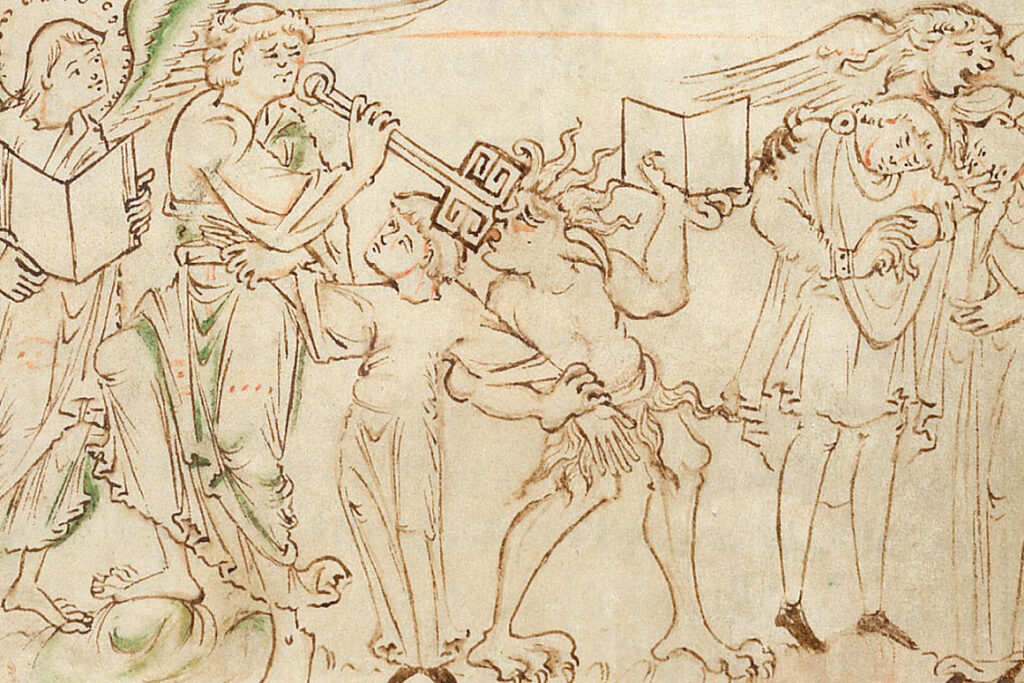
Courtesy of the British Library, Stowe MS 944, fol. 7r
A depiction of the Last Judgement produced around 1031 in Winchester, taking place as a battle of books, with an angel and a demon both wielding their own.
| May 13, 2026
Erica Weaver is an associate professor of English whose research and teaching focus on the earliest English literature. She is the author of “The Hermeneutics of Distraction in Early Medieval England” (Oxford University Press, 2025), and co-editor of “Dating Beowulf: Studies in Intimacy” (Manchester University Press, 2020) and “The Legacy of Boethius in Medieval England: The Consolation and its Afterlives” (ACMRS Press, 2018).
It is now a common assertion that we live in an age of distraction. Increasingly, this is seen as a problem for reading — especially when it comes to serious matter. But long before the advent of smartphones and social media, these were also pressing concerns in the Middle Ages.
Sometime between 397 and 401, the Church Father Augustine of Hippo lamented in his “Confessions,” “Behold, my life is distraction.” As he was well aware, distraction opened the door to all other temptations. What later poets and preachers would deem the “seven deadly sins” were actually first understood as eight kinds of distracting thoughts that thinkers had the power either to linger over or to rebuff.
Far from an innocuous sensation, then, distraction posed one of the most significant spiritual dangers of the period. It even invalidated central devotional acts like reading, praying and reciting the Psalms. After all, as the eighth-century monk the Venerable Bede quipped, how could distracted supplicants expect God to heed their prayers when they did not pay attention to them themselves?
What later poets and preachers would deem the “seven deadly sins” were actually first understood as eight kinds of distracting thoughts.
Then, as now, focused reading and prayer proved difficult to maintain. On one hand, John Cassian, known as the father of Western Monasticism, prescribed “frequent reading,” “continual meditation on the Scriptures” and “frequent singing of the Psalms” — all decidedly textual activities — as bulwarks against distraction, each primed to cultivate a state of heightened attention. On the other, these were precisely the undertakings that proved most prone to distraction. As the great fourth-century theologian of the Egyptian desert, Evagrius of Pontus explained of a distracted reader:
“When he reads, the one afflicted with acedia” — a condition of listlessness resembling our modern distraction — “yawns a lot and readily drifts off into sleep; he rubs his eyes and stretches his arms; turning his eyes away from the book, he stares at the wall and again goes back to reading for awhile; leafing through the pages, he looks curiously for the end of texts, he counts the folios and calculates the number of gatherings. Later, he closes the book and puts it under his head and falls asleep.”
Even in isolation in the desert, it could be hard to stay focused on his book. Reading may offer an antidote to wandering minds, but it could also prove hard to maintain. So, reading itself was prioritized as an activity that required particular attention and that posed particular risks.

Erica Weaver
While medieval authors and teachers may not have had to contend with students using generative AI to summarize dense material, they would absolutely have recognized the temptations and dangers that we observe today, including the fact that skimming or disengaging with texts does real harm to those who were meant to read them.
As a certain Oswald of Ramsey wrote in a late–10th- or early–11th-century poem on the virtues of difficulty, challenging texts are doctificando, capable of expanding our very capacity to know or to attend. The difficulty is a crucial part of what makes these texts worthwhile. So elaborate word games, highly stylized poems, riddles and obscure vocabulary offered useful tools for sharpening readers’ minds. Indeed, England’s first “man of letters,” the prolific monk and bishop Aldhelm of Malmesbury likewise recognized that readers are, or should be, like Olympic athletes, because textual interpretation entails a similar kind of mental training and ongoing exercise.
My latest book, “The Hermeneutics of Distraction,” writes this cultural and intellectual history. In doing so, it demonstrates that it was the management of distraction that helped to create and sustain textual and religious communities, from the idealization of desert asceticism around the year 420 right through the development of Western monasticism. I argue that the pervasive threat of distraction, paradoxically, inculcated attentive reading and interpretation, as monastic reformers’ efforts coalesced around the need to condition and control the potentially wayward minds of their readers. The history of distraction is therefore inextricably entangled with the history of reading and producing texts.
My study centers on the influential circle of Æthelwold, Bishop of Winchester from 963 to 984, and like-minded monastic thinkers in the 10-century “correction” movement traditionally known as the Benedictine Reform, which effectively created Benedictine monasticism and in the process reshaped monastic life across Europe.
Guarding against distraction thus became an occasion for literary and devotional innovation, so that distraction itself became a constellating force in the literature and culture of early medieval England.
In this formative century-long moment, the threat of distraction precipitated the development of several different tactics for reorienting attention. Confronted with distraction as an unending problem, early medieval English monks and nuns developed a demanding literary style known as the “hermeneutic style,” which could defamiliarize even the most well-known texts, like the Pater noster (the Lord’s Prayer) and the Psalms.
Poets like the aforementioned Oswald and schoolmasters like the cantankerous Byrhtferth of Ramsey also experimented with new techniques for producing poetry, classroom texts and even dramatic performances of liturgical material like the Visitatio sepulchri or the visitation to Christ’s tomb. Guarding against distraction thus became an occasion for literary and devotional innovation, so that distraction itself became a constellating force in the literature and culture of early medieval England.
So, while at first this may seem like a strikingly contemporary problem — or at least one relegated to much later masterpieces of distraction such as Laurence Stern’s “Tristram Shandy” (1759–1767), William Cowper’s “The Task” (1785) or T.S. Eliot’s “Four Quartets” (1943) — accounts of readers plagued by distraction and new aesthetic modes meant to foster attention permeate the surviving corpus of early medieval literature. Much Old English and Anglo-Latin literature is therefore preoccupied, thematically and formally, with preoccupation.