
By combining diverse fields, this English seminar prompts students to explore new research paths
‘The class got me feeling lost in the best way’
Sean Brenner/UCLA Humanities
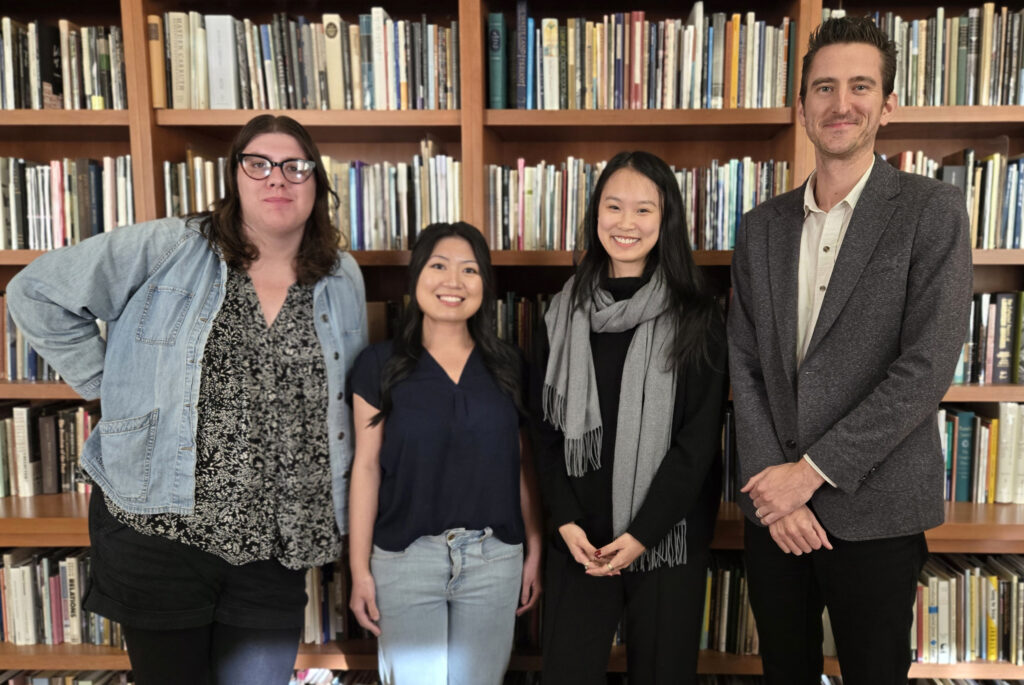
Rosalind Shoopmann, Kim Hu and Sunny Xiaoyang Hua with Professor Alex Mazzaferro in the Grace M. Hunt Memorial English Reading Room in Kaplan Hall.
| May 22, 2026
A recent UCLA graduate seminar on the science of politics in Early America was about much more than the name suggests.
The subject matter — the emergence of a branch of political philosophy based on early modern natural science in pre-1900 American literature — was compelling in its own right. But one unusual aspect of the course is how English Professor Alex Mazzaferro used the material: to inspire students to generate original scholarly projects by combining seemingly disparate academic disciplines — like, say, science and politics.
“The larger goal of the course was to use one example of interdisciplinary inquiry to aid students working on a variety of literary periods and topics in developing original research projects by bringing together fields that do not often speak to one another,” Mazzaferro said. “The hope was that uncovering the shared concerns and methods of seemingly unrelated disciplines would enable these rising scholars to ask new questions, build new audiences and reach new conclusions — in other words, the result would be greater than the sum of its parts.”
Among the students in the seminar this academic year were Kim Hu, Rosalind Shoopmann and Sunny Xiaoyang Hua, all doctoral students in English. Each of them said the seminar gave them new ways to approach their own research.
“The class got me feeling lost in the best way,” Hua said. “There’s a lot that I didn’t know, but now I want to know. That’s the beauty of what we call interdisciplinarity, but it’s actually just human curiosity.”
We asked the students for their reflections on how the seminar’s interdisciplinary focus shaped their thinking.
☙ ❧
For her seminar paper, Kim Hu examined how natural disasters and the wilderness, as colonial settlers saw it, figured as sites of crisis that challenged 17th-century English settlers’ identity. The work melded ecocriticism, American Gothic literature and history.
“There’s a tendency for people outside of literary studies, and humanities in general, to look at our fields as existing in isolation,” Hu said. “When we dig more deeply, we can see how literature, and other textual works, capture the multifaceted and complex nature of the human experience and engage with problems presented to us by science, history, politics and so forth. I wanted to home in on that with my project.”
Hu said exploring scientific methodologies to approach her research enabled her to uncover new findings and widen the scope of what she could write about.
“We studied how empiricism and the ways that people collect data and translated it to how we can interpret things about English culture or political power at that time,” she said. “Being able to do that showed me how to go about combining subjects like ecocriticism, the Gothic and philosophy to reveal something I hadn’t thought about before.”
Hu said she is excited for courses like Mazzaferro’s seminar to open new paths of inquiry for other students interested in humanities research.
“People should know that this type of interdisciplinary work is possible, especially if research hasn’t crossed their minds yet,” she said.
☙ ❧
Rosalind Shoopmann was drawn to the seminar because of her longstanding interest in the philosophy of science.
“It was an opportunity to think through questions about epistemology and how empirical data was verified between continents in the 17th century,” she said.
Her seminar paper combined early American literature, the history of ideas, political theory and “book history,” or the history of handling and distributing printed matter, to investigate the origins of nationalism in North America.
“I was interested in the early initial moment of divergence when settlers in Virginia, for example, started thinking of themselves as no longer straightforwardly English, but rather in some way different by virtue of the experience of landing in North America,” Shoopmann said.
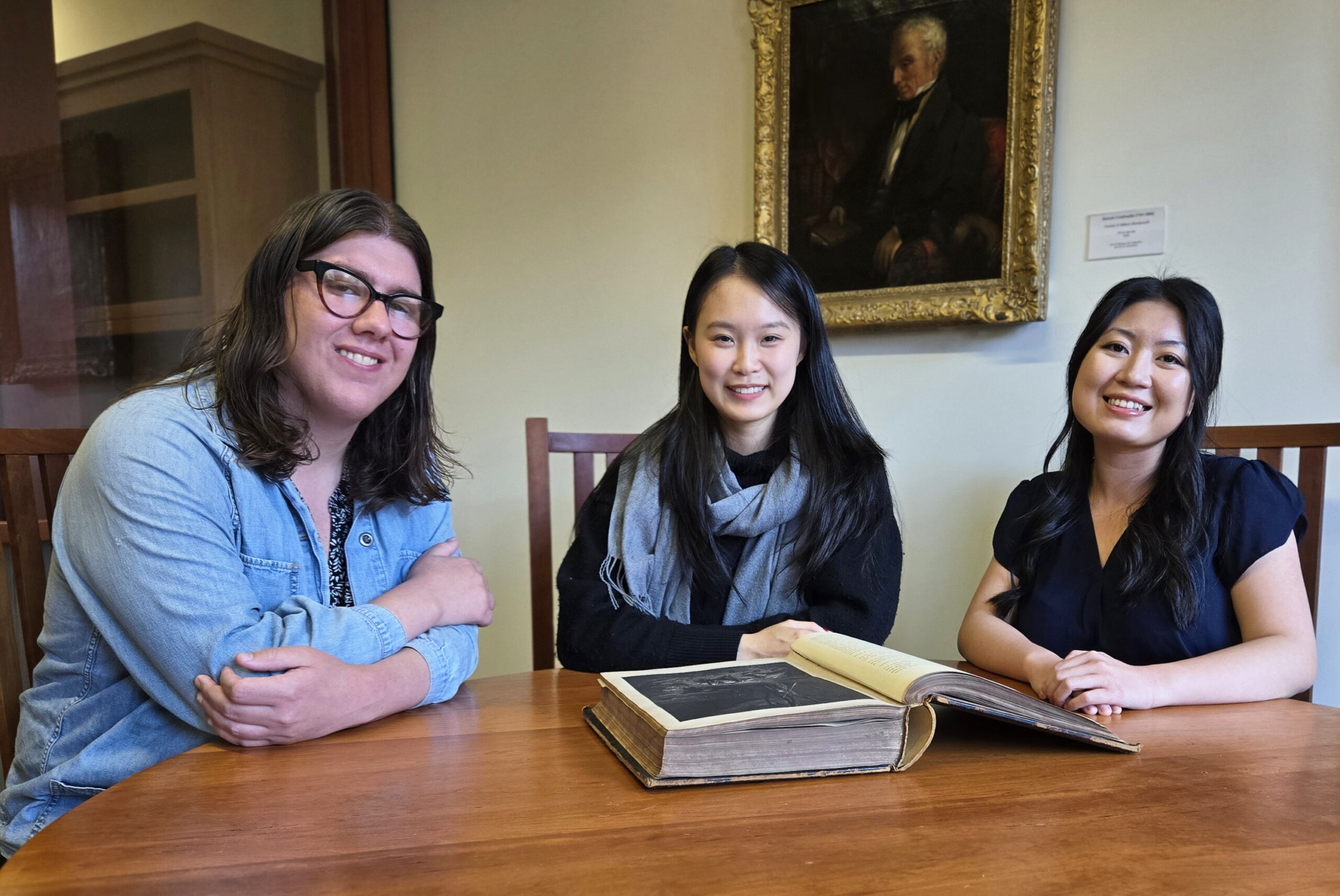
From left, Shoopmann, Hua and Hu. The way Alex Mazzaferro presented course readings revealed patterns that might not have been evident otherwise, Shoopmann said.
The political relevance of nationalist ideology was something Shoopmann had been thinking about independently, and Mazzaferro’s class served as the setting to approach that broader political concern through multiple other lenses.
Shoopmann said she appreciated the way Mazzaferro juxtaposed materials for the course.
“Reading the material in the way he arranged it, I noticed broader currents and patterns that I probably would not have noticed if I read them separately,” she said. “It was a good space for thinking through thorny aspects of intellectual history.
“I don’t think I would have been able to think these things through if it weren’t for everyone else also engaged in that process of thought and experimentation.”
☙ ❧
For Sunny Xiaoyang Hua, the discussions of science in the class helped reframe her perception of English literature research.
“We often separate the humanities from science because the two are vastly different,” she said. “But there’s actually a lot of shared logic between them.”
Hua said one especially useful strategy students learned came from Mazzaferro encouraging them to identify common motifs across broad ranges of texts.
“He demonstrated how to build a vast network of information to examine and identify patterns, and to form connections we could use to understand things differently,” she said.
Hua said her project for the course — which drew from British colonialism, American settler colonialism and gender studies — inspired her to mine her own ways of thinking and open herself up to the different directions her research could go in the future.
“My project had a generative impact on my own future thinking,” she said. “As an early-stage graduate student, I still have a lot to read and learn, and although primitive and tentative, this experiment has incentivized a personal inclination to think wider across disciplines.”