
A humble Excel spreadsheet gives rise to a massive online database of Hittite
Anthony Yates and his team are cataloging 1.2 million words in the ancient language
Sean Brenner/UCLA Humanities
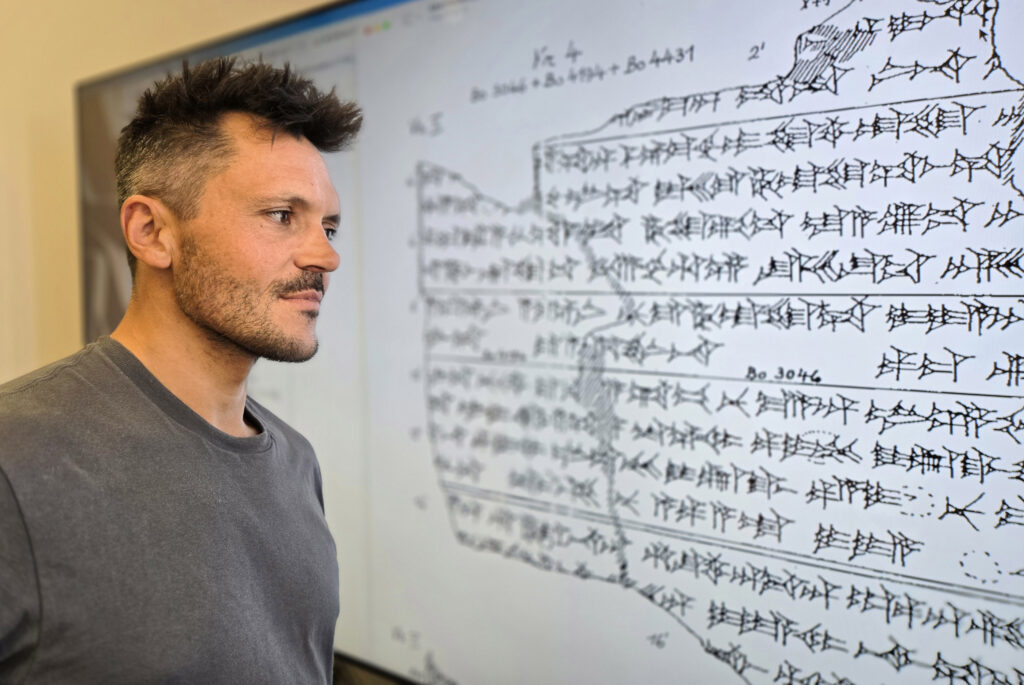
Anthony Yates and a digital representation of one of thousands of the Hittite tablets his team examined for the project.
| November 2, 2026
While conducting research on Hittite in 2023, Anthony Yates began cataloging the language’s linguistic features on an Excel spreadsheet.
Hittite, a now-extinct language, was spoken between the 17th and 13th centuries B.C. in Anatolia, the peninsula that forms most of what is now Turkey, and has been the focus of Yates’ research for more than 10 years. The language survived largely because it was preserved in inscriptions on thousands of clay tablets and tablet fragments.
Yates, an assistant professor of Near Eastern languages and cultures and Indo-European studies, said the spreadsheet was a necessity for keeping track track of the similarities and differences between different words. “Even Hittite dictionaries weren’t consistent,” he said.
But as Yates’ simple spreadsheet grew, he realized he could turn it into a resource that would be useful for other scholars. So, supported by grants from UCLA DataX and the UCLA Jeffrey P. Cunard Center for Global Antiquity, Yates and a small team of students are transforming his Excel document into an interactive database called the Morphologically and Phonologically Annotated Database of Hittite.
Yates hopes to publish the entire resource as an open-access website by the end of 2027. The database will enable other researchers to access English translations, search for different word segments and access phonetic notations, all of which should help them decipher what the 3,000-year-old language sounded like, and how other Anatolian languages evolved from it.
An understudied language with wide-ranging influence
“When we study the prehistory of all Indo-European languages — English, Spanish, Greek, Hindi and Russian among them — the Hittite data has a special place in figuring that out,” Yates said. “It’s the first Indo-European language to show up on the historical record.”
Considering its major influence on other Indo-European languages, Hittite is understudied, Yates said. The language is not offered as a major at any U.S. university, and Yates estimated that only a few hundred scholars currently conduct scholarship on the ancient language.
The new database will further UCLA’s leadership in Indo-European studies: The campus is the only institution to offer a master’s and doctorate in the subject — Yates himself earned a Ph.D. from the Program in Indo-European Studies in 2017 — and Yates’ elementary Hittite class enrolls a dozen students per year.
The website’s infrastructure is being built by John Clayton, a UCLA lecturer in Indo-European studies, and two UCLA computer science majors, Sparsh Johri and Austin Gao.
Meanwhile, Yates leads a team of five who are developing the database’s content. That group is made up of UCLA graduate students Sabrina Hart, Aidan Holmgren, Natalie Rudin and Caitlin Smith, and undergraduate student Christina Ginger. Collectively, they have cataloged 1.2 million Hittite words by combing through preexisting dictionaries and digital copies of more than 30,000 cuneiform script tablets.
After translating Hittite script into Roman characters, Yates and his team determine each word’s components — its roots and affixes. By presenting words in that context, the database will enable linguists to compare the features of Hittite to those of other languages.
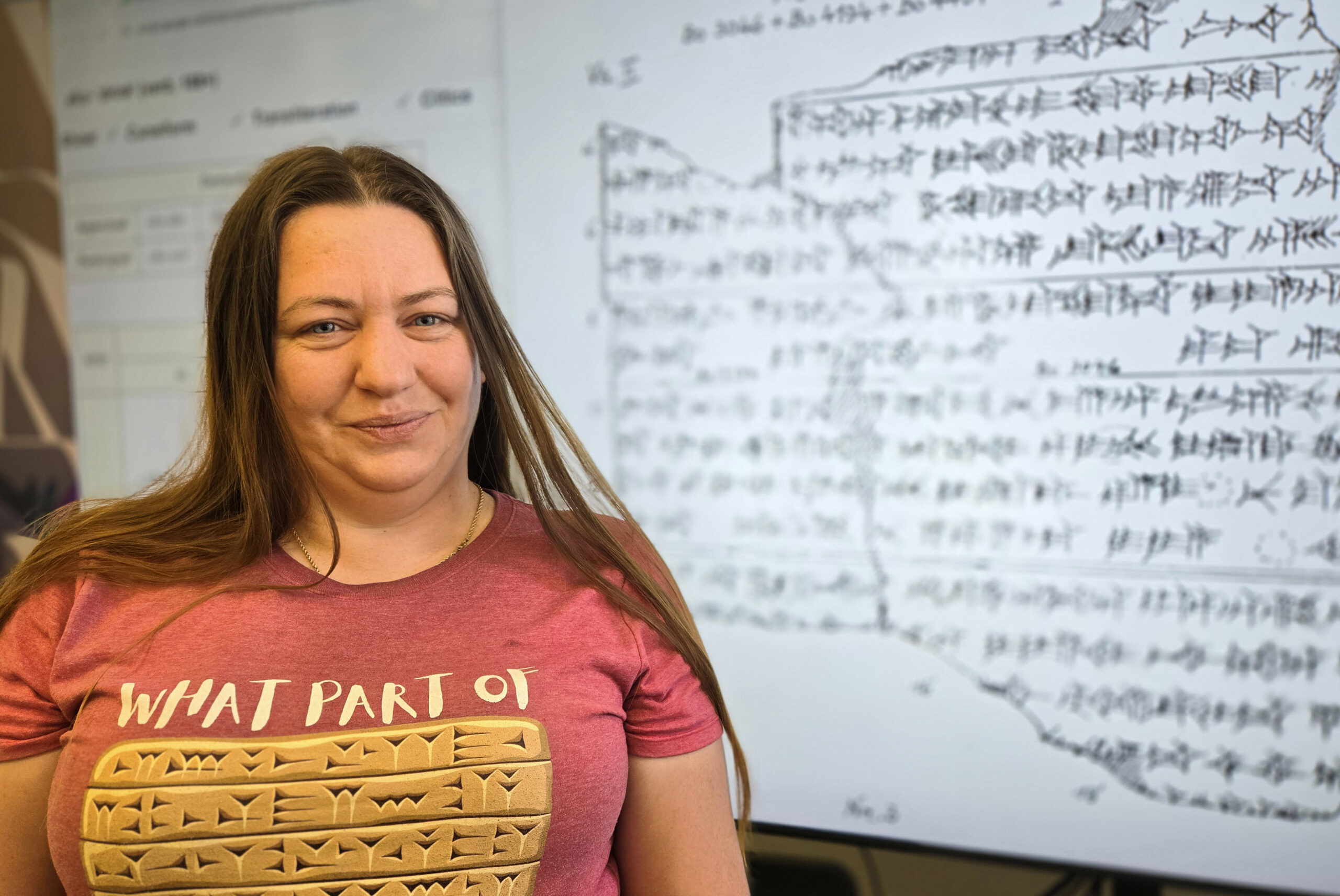
Undergraduate researcher Christina Ginger said her work on the project has made it feel like she is “actually encountering Hittite in the wild.”
For instance, scholars have hypothesized that the Hittite suffix -atar transforms verbs and adjectives into nouns, just like the English suffixes -ness (as in happiness) and -ity (in words like activity). Yates said it had been difficult for Hittite scholars to determine whether -atar more closely resembled -ness or -ity. Because the database allows users to search for word segments, rather than just entire words, Yates can now answer that question: His team has concluded that -atar was more like -ness in its spontaneous use.
“When we find a word with -atar in a corpus, we get the sense that we were ‘present’ at a moment of linguistic creation, which is kind of neat in itself,” Yates said. “Before, we could read a lot of Hittite and formulate hypotheses about what occurs in the language. Now, we can actually assign concrete numbers to features of the language.”
Meaningful research experience
Ginger, the project’s undergraduate researcher, said one of the most challenging and rewarding aspects of the work has been gathering insights about the language from texts that are in neither English nor Hittite.
“I got to catalog words from a German–Hittite dictionary, and I made out the meanings of German words through their commonalities with English,” said Ginger, who is on track to graduate this fall with degrees in European languages and transcultural studies; Latin; and the ancient Near East and Egyptology. “Getting to see two iterations of each Hittite word gave me a better sense of the language.”
After graduating, Ginger plans to pursue a doctorate in ancient languages, and she said the project has been a valuable opportunity to experience graduate-level research. She added that being able to tease out minor differences in words she came across independently boosted her confidence in her research skills.
“In a classroom, your hand is held to an extent,” Ginger said. “It felt exciting to do something on my own — like I was actually encountering Hittite in the wild.”
For his part, Yates said he hopes the new database will inspire similar tools for other Indo-European languages, like Sanskrit.
“There are exciting advances in digital humanities that are making fine-grain research possible,” Yates said. “It’s going to help us paint a clearer picture of Indo-European history.”