

- This event has passed.
Screening Dispossession in Abya Yala: Collaborative Filmmaking and Environmental Justice in Mining Contexts
May 18 @ 4:00 pm
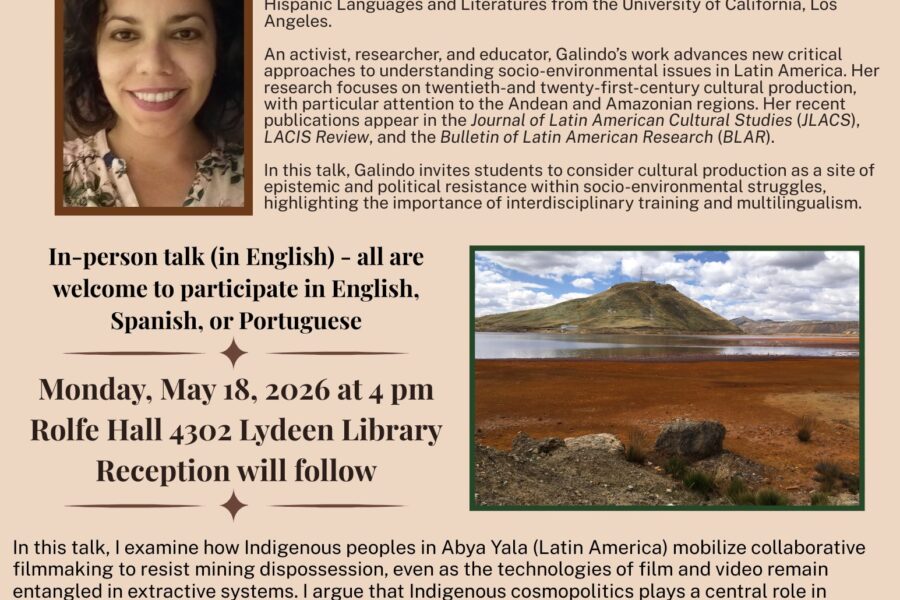
In this talk, I examine how Indigenous peoples in Abya Yala (Latin America) mobilize collaborative filmmaking to resist mining dispossession, even as the technologies of film and video remain entangled in extractive systems. I argue that Indigenous cosmopolitics plays a central role in contemporary audiovisual narratives that contest hegemonic representations of mining, contributing to the decolonization of extractivist perspectives and to the defense of Indigenous territorial, visual, and cultural sovereignty in Abya Yala.
Drawing on selected films from Peru and Brazil and the work of Indigenous thinkers such as Ailton Krenak and Davi Kopenawa, I introduce the concept of “orphanization” to reframe dispossession beyond purely material or human-centered frameworks. This concept highlights how extractivism fractures relational worlds, disrupting connections between people, land, and more-than-human life. By bringing Indigenous thought into conversation with critical theory, this talk highlights how cultural production can reshape the way we understand environmental justice, dispossession, and resistance.
BARBARA GALINDO is a Chancellor’s Postdoctoral Fellow in the Department of Media and Cultural Studies at the University of California, Riverside.
She was previously an ACLS Emerging Voices Postdoctoral Fellow in Race, Ethnicity, and Indigeneity (2022–2024) at the Institute for Research in the Humanities at the University of Wisconsin–Madison. She holds a Ph.D. in Hispanic Languages and Literatures from the University of California, Los Angeles.
An activist, researcher, and educator, Galindo’s work advances new critical approaches to understanding socio-environmental issues in Latin America. Her research focuses on twentieth-and twenty-first-century cultural production, with particular attention to the Andean and Amazonian regions. Her recent publications appear in the Journal of Latin American Cultural Studies (JLACS), LACIS Review, and the Bulletin of Latin American Research (BLAR).
In this talk, Galindo invites students to consider cultural production as a site of epistemic and political resistance within socio-environmental struggles, highlighting the importance of interdisciplinary training and multilingualism.