

- This event has passed.
14th Annual ucLADINO conference: The Ladino Diaspora and Community Resilience: Memory and Adaptation
May 19 @ 9:00 am - 4:30 pm
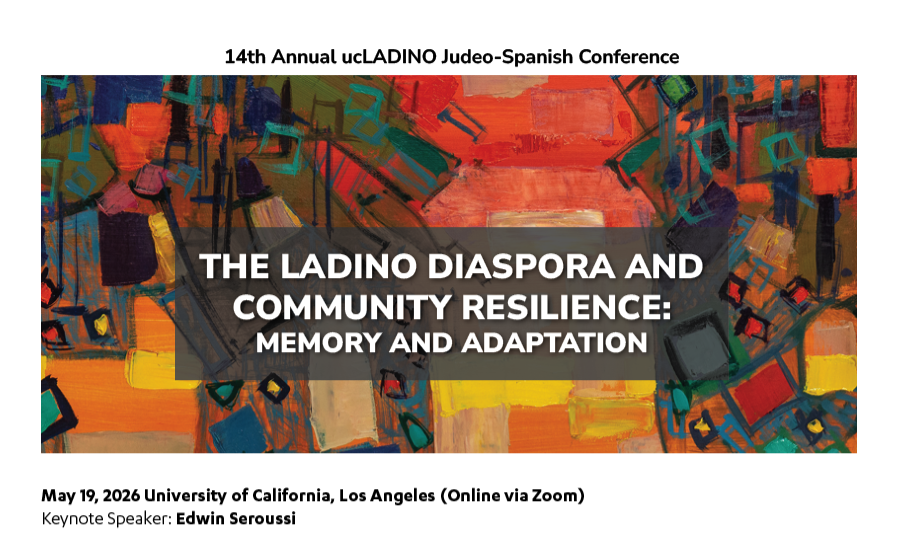
In its fourteenth consecutive year, the ucLADINO conference supports and celebrates the growing preservation of Ladino language and culture in the Judeo-Spanish diaspora. The theme for this year’s ucLADINO conference centers around Ladino and community resilience, exploring the ways that Ladino language preserves cultural memory yet continually adapts and reacts to change. What is the role of language transmission amidst migration and cultural ruptures? How has Ladino practice adapted to a range of spaces, from the domestic sphere and local community centers to towns, cities, nations, archives, and digital networks?
CLICK HERE TO REGISTER FOR UCLADINO CONFERENCE
14th Annual ucLADINO Conference
The Ladino Diaspora and Community Resilience:
Memory and Adaptation
May 19, 2026, The University of California, Los Angeles
Schedule
Introductions 9:00 – 9:10 AM PST
Panel 1 | Ladino and Jewish Texts 9:10 – 10:10 AM PST
Panel 2 | Ladino Theater, Literature, and the Press 10:20 – 11:20 AM PST
Keynote | Edwin Seroussi 11:30 – 12:20 PM PST
Ladino Song Scandals: The 2026 Edition
Break 12:20 – 1:20 PM PST
Panel 3 | Creation: Heritage and Cultural Dialogue 1:20 – 1:50 PM PST
Featured Roundtable | Notebooks of Sonic Memory 2:00 – 3:00 PM PST
Panel 4 | Intergenerational Language Transmission 3:10 – 4:10 PM PST
Closing Remarks 4:15 – 4:30 PM PST
Panel 1 | Ladino and Jewish Texts
Moderated by Dr. Bryan Kirschen, Binghamton University
Date/Time: Tuesday, May 19th, 2026, 9:10 – 10:10 AM PST
Javier Leibiusky | CERMOM (INALCO)
Customs and Traditions in the Commentary on Pirkei Avot from the Meam Loez (Isaac Magriso, Constantinople, 1753)
Javier Leibiusky (b. 1975, Buenos Aires) grew up in Israel and has lived in Paris since 2007. He is a researcher at INALCO, holding a PhD in Languages, Literatures, and Societies of the World. His work focuses on Judeo-Spanish language and culture, and he teaches Modern and Biblical Hebrew. Alongside academia, he writes fiction, publishing short story collections in Argentina and France, including Llueven Uñas, La Conspiration des Riobambas, and Acoustic Stories. He recently released his first novel, Howmme.
Marcel Israel | Independent Scholar
Sephardic Jews of the Balkans during the Ottoman Empire, in some documents in Ladino, found in the Cairo Genizah
Dr. Marcel Israel, Ph.D., trained in Industrial Controls and Telecommunications. A Sephardic Jew, born in Plovdiv, Bulgaria, living alternately in Madrid/ Spain, and Sofia/ Bulgaria. Speaks Ladino as a native language. Former President of the Central Religious Council of the Jewish Communities in Bulgaria and currently a Board member of Religions for Peace Europe based in Berlin. For about 40 years, an independent scholar in Jewish History and (Ladino) Linguistics, presenting multiple scientific contributions at conferences, seminars, or webinars in different countries in Europe, the USA, and South America.
Esther Rute | Ben-Gurion University of the Negev
Ladino in Responsa: An Inheritance Dispute between Amsterdam and the Ottoman Sephardic Diaspora
Esther Rute is a PhD candidate at Ben-Gurion University of the Negev. She holds two M.A. degrees from the Hebrew University of Jerusalem, in Jewish History and Spanish Studies, and a B.A. in Arabic and Hebrew Philology from the Complutense University of Madrid. Her research focuses on Sephardic rabbinic literature in Judeo-Spanish in the Ottoman world, with particular attention to legal culture, converso identity, and transcultural dynamics between Western European and Ottoman Jewish communities in the early modern period. She works with rabbinic sources in Ladino and Hebrew.
David M. Bunis | The Hebrew University of Jerusalem
Pierre Baudin d’Allauch (b. c1838): A Little-known French Friend of the Ottoman Jews and his Writings in Judezmo
David M. Bunis is professor emeritus at the Center for Jewish Languages and the Department of Hebrew Language, The Hebrew University of Jerusalem. He is the author of A Lexicon of Judezmo Language (in Hebrew, Jerusalem, 1999), Voices from Jewish Salonika (Jerusalem-Salonika, 1999), and numerous articles on the Judezmo (Ladino, Judeo-Spanish) language and its literature and on Jewish languages as a field of scholarly inquiry; editor of Languages and Literatures of Sephardic and Oriental Jews (2009); co-editor of Rabbinical Literature in Yiddish and Ladino (2025); Massorot, devoted to Jewish language traditions, and Caminos de leche y miel: Jubilee Volume in Honor of Michael Studemund-Halévy (2018). In 2006 he received the Yitzhak Ben-Zvi Prize, and in 2013, the EMET Prize.
Panel 2 | Ladino Theater, Literature, and the Press
Negotiating Identity
Moderated by Madeline Hudalla, PhD Candidate, UCLA
Date/Time: Tuesday, May 19th, 2026, 10:20 – 11:20 AM PST
Lilian L. Cano | University of Texas at San Antonio
Ladino, Cultural Memory, and Diasporic Resilience in Vida propia
Lilian L. Cano is Professor of Practice in the Department of Modern Languages and Literatures at the University of Texas at San Antonio and a Ph.D. candidate in English. Her research centers on Ladino (Judeo-Spanish), Sephardic Jewish studies, and the relationship between language and identity in literature. Her work examines how code-switching, narrative voice, and cultural memory shape identity in Sephardic and Spanish-language novels. She has presented at national and international conferences and is committed to the study and preservation of Ladino as a language of diaspora and cultural expression.
Sarit Cofman-Simhon | Emunah College of Fine Arts and Design
Late Ottoman Judezmo Theatre: A National Biography
Dr. Sarit Cofman-Simhon is a theatre researcher interested in performative practices in diverse Jewish languages and historical periods, on which she has published extensively. Sarit is based at Emunah Academic College of Fine Arts and Design, Jerusalem, where she is Head of Theatre Department. Her book From Language to Performance: Jewish Tongues on the Israeli Stage was published in 2023 in Hebrew. Her next book explores diverse performative phenomena in Jewish culture.
Sanja Trifunović | University of Vienna
Judeo-Spanish Aspects of Karagöz Shadow Theatre: Memory and Adaptation in the Post-Ottoman Era
Sanja Trifunović is a linguist and orientalist, currently a PhD candidate at the University of Vienna. She also attends online classes on endangered Jewish languages at the Oxford School of Rare Jewish Languages. She holds an MA in Philological Sciences from the Faculty of Philology, University of Belgrade, where she also obtained an MA/BA in Modern and Ottoman Turkish Language and Literature, Arabic and English. Her research interests include anthropological linguistics, language typology, endangered Jewish languages, Sephardic studies, folklore, music, theatre and film. She has participated in several international conferences on Jewish Sephardic studies, including the last two ucLADINO conferences.
Lydia Vlasidou | York University
Negotiating Belonging in the Judeo-Spanish Press of Early 20th Century New York
Lydia Vlasidou is a PhD student in History at York University, Toronto and she holds an MA in Arab and Hebrew Cultures from the University of Granada. Her research focuses on Sephardic identity formation in the late Ottoman and early modern Greek periods, as well as the Sephardic diasporic experience, questions of integration and relationships between diaspora communities and the homeland at a personal as well as institutional level. She has worked as a historical researcher with institutions including the Spanish National Research Council, the Aristotle University of Thessaloniki and the Holocaust Museum of Greece.
Keynote
Date/Time: Tuesday, May 19th, 2026, 11:30 AM – 12:20 PM PST
Edwin Seroussi | The Hebrew University of Jerusalem
Ladino Song Scandals: The 2026 Edition
Edwin Seroussi is the Emanuel Alexandre Professor Emeritus of Musicology at Hebrew University of Jerusalem, Chair of the Academic Committee of the Jewish Music Research Centre, Visiting Scholar at Dartmouth College, and Jewish Sound Scholar at the University of Pennsylvania. His research focuses on Jewish musical cultures of the Mediterranean and Middle East and their interactions with Islamic cultures, Judeo-Spanish song and music in Israel. Besides his academic activities he is active in the music scene of Israel and abroad in diverse capacities as producer, advisor, member of the board of musical institutions and representative to the International Music Council (UNESCO). He has been awarded several prestigious prizes, among them the Israel Prize in the field of musicology for 2018.
Panel 3 | Creation: Heritage and Cultural Dialogue
Virtual Gallery and Artist Talk
Moderated by Courtney Blue, PhD Candidate, UCLA
Date/Time: Tuesday, May 19, 2026, 1:20 – 1:50 PM PST
Becky Behar | Brandeis University
Tu Ke Bivas: An Illustrated Talk
Becky Behar is a Colombian-born, Boston-area photo-based artist. Her staged photographs explore motherhood, domesticity, and generational ties, with recent work focused on Sephardic identity and rituals. Blending autobiography and fiction, she draws on Dutch painting, using light, shadow, and symbolic still lifes to examine memory, faith, and inherited gesture. Behar has exhibited nationally and internationally, including at the Museum of Fine Arts, Boston, and the Griffin Museum of Photography. Her work has appeared in The Boston Globe, Lilith, and Jewish Boston. She received the 2025 Isaac Anolic Jewish Book Arts Award and is a Visiting Scholar at Brandeis University’s Women’s Studies Research Center.
Ofer Ronen | Musician
Morenika Nos Llaman: A musician’s perspective on Ladino and Jewish musical culture in Spain today
Ofer Ronen is a guitarist, composer, and music researcher based in Barcelona. Trained in classical and flamenco guitar, he studied musicology at the Hebrew University of Jerusalem and worked for six years at the Jewish Music Research Centre under Prof. Edwin Seroussi. He later specialised in flamenco in Seville, completing a musical performance master’s degree in Barcelona. His work explores the intersection of flamenco, Middle Eastern, Jewish, and Mediterranean musical traditions, including Ladino repertoire, integrating performance and research. Ronen has performed internationally across Europe, Israel, and North America, focusing on cultural dialogue and hybrid musical identities.
Featured Roundtable | Notebooks of Sonic Memory
Moderated by Dr. Vanessa Paloma Elbaz, University of Cambridge
Date/Time: Tuesday, May 19, 2026, 2:00 – 3:00 PM PST
Vanessa Paloma Elbaz | University of Cambridge
The Judeo-Spanish Cancionero as Embodied Transmission of Becoming-Memory
Vanessa Paloma Elbaz is a Senior Research Associate at Peterhouse and the University of Cambridge’s music faculty. A previous Senior Fulbright scholar, Marie Sklodowska Curie fellow and Posen fellow among others, she is the chair of the International Council for Music and Dance’s Mediterranean Music Study Group. She was the general editor for a special issue on Judeo-Spanish Songbooks forthcoming by Presses de l’INALCO, an edited volume by the British Academy on Sound and Memory in the Western Mediterranean and her monograph on Judeo-Spanish women’s songs from Northern Morocco is forthcoming from Brill. Her work is often featured in the international media such as BBC, New York Times, Al Jazeera, France 24 and others. She founded KHOYA: Jewish Morocco Sound Archive in 2012 and launched a multilingual online exhibit with one interview from its collection http://yalalla.org.uk.
Judith Cohen | York University
My ethnomusicologist self examines the Ladino songs in my performer self’s song notebook
Judith Cohen is a Canadian ethnomusicologist, medievalist and singer, working with Sephardic music, music among Portuguese and Brazilian Crypto-Jews, and related diaspora traditions in the Balkans, French Canada, Spain, Portugal l, BraIl and others. She also works as a storyteller, embedding her research and travels into her stories to reach and interact with non-academic audiences.
Pam Sezgin | University of North Georgia
The Besso Songbook: A Late Ottoman Sephardic Musical Legacy
Dr. Pam Sezgin is Professor of Anthropology at the University of North Georgia (USA). Her research is in political anthropology and ethnomusicology regarding Sephardic Jews in the Ottoman Empire (19th and 20th centuries).
Renato Kamhi | Violinist, PhD Sorbonne Université
The Flory Jagoda Songbook: Memories of Sarajevo, elements of a collective memory
Originally from Sarajevo, Bosnia and Herzegovina, Renato Kamhi has been immersed in Judeo-Spanish music since childhood. He holds a doctorate from Sorbonne University on the role of the diaspora in the revitalization of the Judeo-Spanish musical repertoire in the former Yugoslavia. Violinist, Renato Kamhi holds two master’s degrees (violin and teaching) and teaches at a music conservatory in the Paris region. A founding member of the piano trio ARK, he performs with the ensemble in France and across Europe.
Panel 4 | Intergenerational Language Transmission and Sustainability
Moderated by Dr. Rachel Baron-Bloch, UC Irvine
Date/Time: Tuesday, May 19th, 2026, 3:10 – 4:10 PM PST
Derya Agis | Ankara University
Judeo‑Spanish Culinary Diplomacy Through an Ecolinguistic Lens
Derya Agis is an academic researcher and anthropologist specializing in the intersections of language, culture, and the environment. Her work frequently explores Cognitive Metaphor Theory, Ecolinguistics, and Critical Discourse Analysis, with a particular focus on how these frameworks apply to both historical and contemporary political narratives. She has a deep research interest in Italian-American and Sephardic studies, specifically examining linguistic heritage and the role of culinary diplomacy in literature. Her scholarly contributions include investigating botanical and sensory history, notably the 19th-century scientific and literary perspectives on environmental health. Agis is also an active member of the academic community, contributing to international networks such as H-Envirohealth, where she explores the intersecting histories of health and medicine. Her recent publications include work on environmental justice and eco-cognizance. Beyond her core research, she is dedicated to curriculum development and is currently expanding her expertise in Renaissance culture and the Italian language. She holds a B.A. and Ph.D. from Ankara University on Italian Language and Culture, an M.A. in Linguistics from Hacettepe University, and an M.S. in Anthropology from METU.
Fabiola Varela-García | University of Wisconsin Eau Claire
The Diaspora of the Spanish Language in Eurasia: Memory and Maintenance of Sephardic Spanish in Istanbul
Fabiola Varela-García is a Full Professor at UW-Eau Claire with a PhD from the University of Pennsylvania. Specializing in Sociolinguistics and Spanish Phonetics, she has conducted research on Andalusian, Guatemalan indigenous languages, and 18th-century Isleño Spanish of Louisiana. Today, she is presenting on behalf of herself and her mentees: Bricyn Barziza, who graduates this May with a degree in Education and Spanish, and Léa Guilmineau, now a Master’s student in Germany. Their UWEC ORSP-funded study analyzes Judeo-Spanish dating back to the 16th century, which is still spoken today in Istanbul, utilizing digital archives to establish a foundation for fresh research and the preservation of this historical linguistic heritage.
Jacob Ceki Hazan | Lund University
Who Still Carries Ladino in İzmir?
Jacob Ceki Hazan was born and raised in İzmir, Turkey, within the city’s Sephardic Jewish community. Like many in his generation, he did not grow up speaking Ladino but absorbed it through earlier generations of his family. He is currently completing an MA in Jewish Studies at Lund University in Sweden, where his research explores the İzmir Jewish community and how its heritage is preserved and presented. He runs avierto.net, a Turkish-language Jewish Studies platform, and izmirjcc.org, the İzmir Jewish Community’s website. He is now based in Baltimore, Maryland.
Carlos Yebra López | California State University, Fullerton
A Star Is Born: Estreyika and the Radical Possibilities of a Ladino Chatbot
Carlos Yebra Lopez is a scholar of Hispanic linguistics whose work focuses on Ladino (Judeo-Spanish) language, culture, and its contemporary revitalization. He is an Assistant Professor of Spanish Linguistics at California State University, Fullerton, and the author of Ladino on the Internet: Sepharad 4 (Routledge, 2024), the first critical and systematic account in English of the online revitalization of Ladino. He is the Principal Investigator behind Estreyika, the first Ladino chatbot.