
New website brings LA’s lost poetry history to the fore
With ‘Extremes and Moderations,’ Brian Kim Stefans resurrects work dating back to the 1870s
Courtesy of Brian Kim Stefans
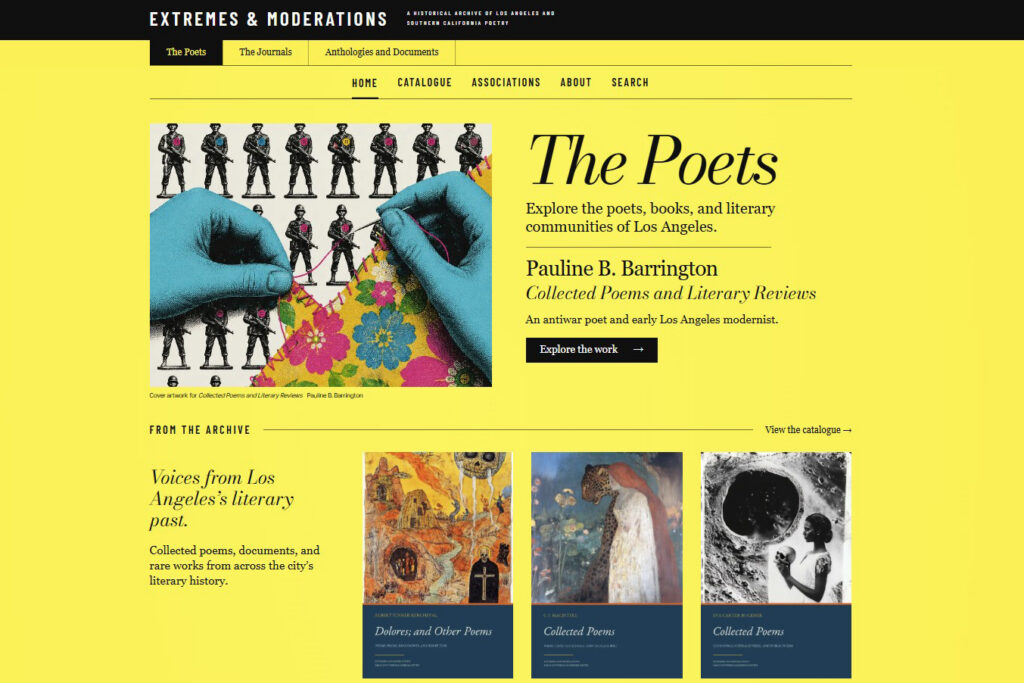
The project was originally conceived as a print anthology, but when his collection grew to encompass work by more than 75 poets, Brian Kim Stefans turned it into a searchable website.
| November 23, 2026
When he joined the faculty of the UCLA English department in 2008, Brian Kim Stefans assumed that Los Angeles held a rich poetic history. In New York City, where he had previously lived, and during a visit to Toronto, he had noticed how those cities’ poetry seemed to shape the zeitgeist.
“But when I talked to my friends about the poetry tradition of Los Angeles, few knew the fuller history of what happened here,” Stefans said. “It had just kind of disappeared.”

Brian Kim Stefans
Now, after more than 15 years of work, he has published “Extremes and Moderations,” an online archive of the forgotten poetry of Los Angeles and Southern California, mainly from the 1870s to the 1970s.
The project, originally conceived as a print anthology focusing only on Los Angeles poetry, began to take shape in 2009. As Stefans identified more and more poets – through searches in UCLA’s Charles E. Young Research Library and on the internet – the project, like the city itself, sprawled.
“I really took a deep dive, and there’s still more out there,” Stefans said. “I used a lot of online archives; I bought a lot of books. Sometimes I would come home from the research library with three big Trader Joe’s bags full of books to scan.”
In 2019, Stefans’ working draft of the anthology came in at more than 500 pages covering 77 poets, even as he continued to discover more poets by the dozen.
Stefans realized that a print publication would be insufficient, and he pivoted to a digital format in 2025. And, despite his professed ambivalence toward generative AI tools, Stefans turned to Claude and ChatGPT to organize the thousands of files he had amassed, design the website layout and write biographies of the poets for the site. The technological assistance enabled him to continue building the archive; it now boasts work by 150 poets.
Replicating the model
This summer, Stefans used the same methods to build a site that archived the University at Buffalo Poetics List, a listserv for poets that was active from 1993 to 2014. The listserv’s original contents are available online as text files, but Stefans said the files are difficult to parse and occasionally contain errors, such as incorrect dates. Stefans fixed the errors he found and created reading editions, anthology-style documents sorted both by topic and date.
Both archives have an AI-powered search feature, which Stefans said can answer more complex queries than traditional keyword searches and can synthesize results, pulling in context from the web when necessary, with citations. For instance, without knowing any names, readers can ask for poets who wrote about the Southern California desert and receive a list of suggested poets and magazine issues to kickstart their research.
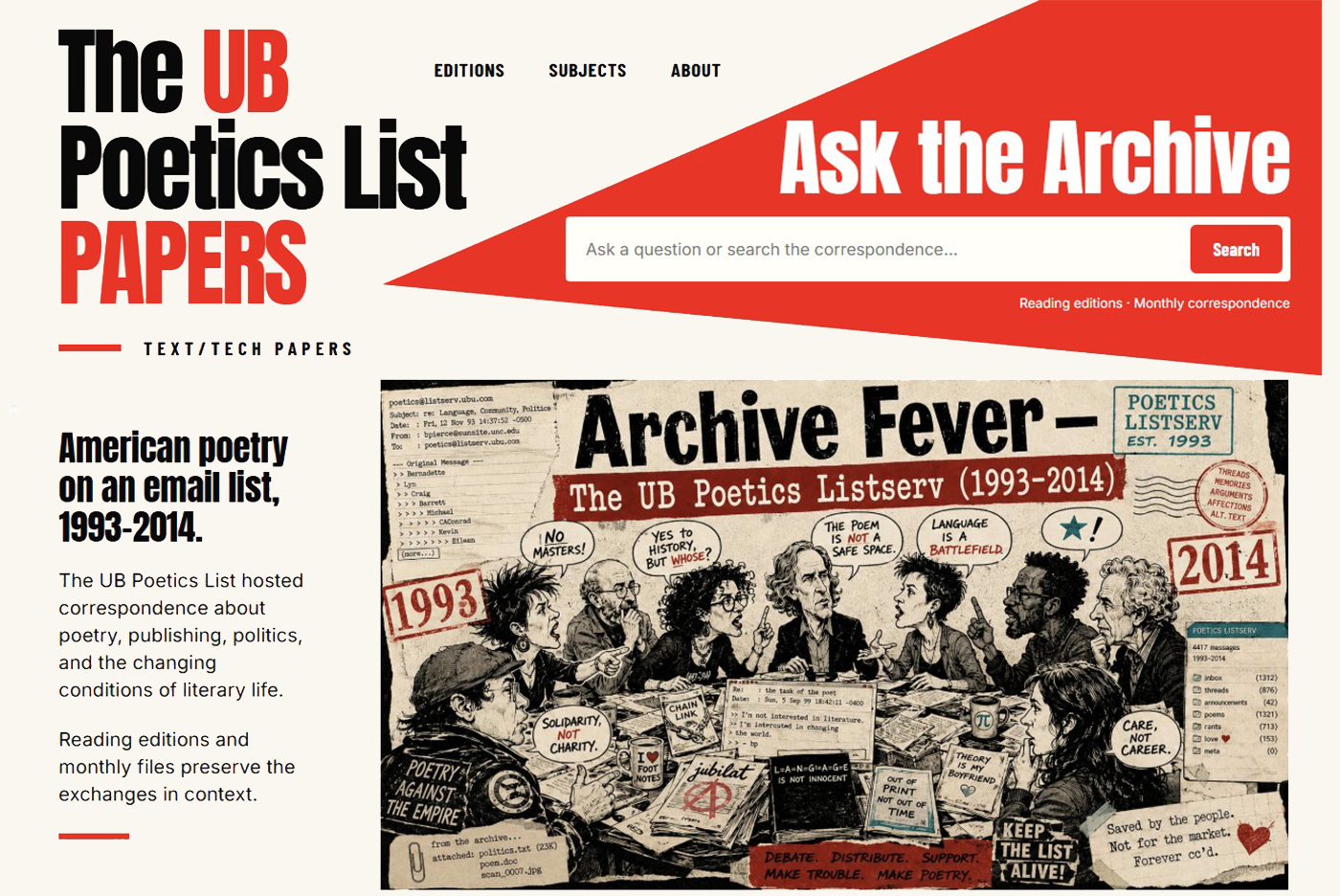
Stefans replicated his process to preserve a University at Buffalo-based poetry listserv that ran from 1993 to 2014.
“Extremes and Moderations” and “The UB Poetics Papers” are both projects of the Text/Tech Media Lab, which Stefans directs. The lab’s focus is bringing literature into conversation with technology, and Stefans said he envisions it as a center of interdisciplinary creation in the English department.
Some of the first scholars to use “Extremes and Moderations” in their research will be Stefans’ own students. In a capstone seminar during the winter quarter, “Modernism Through Los Angeles Poetry,” students will explore how modernist ideas manifested in the work of Los Angeles poets. For their research projects, they’ll use the “Extremes and Moderations” archive to look for examples.
“I want the students to go into the archive and make these linkages themselves,” Stefans said. “This will be the first research anyone will have done into a lot of these poets, who have been forgotten. It will be the first step into getting this work out there.”
Read more about Brian Kim Stefans
How Brian Kim Stefans incorporates AI into his creative process