
Investigating the rise of social companion AI
Grace Wang, a third-year undergraduate, combined her varied academic interests for a summer research project
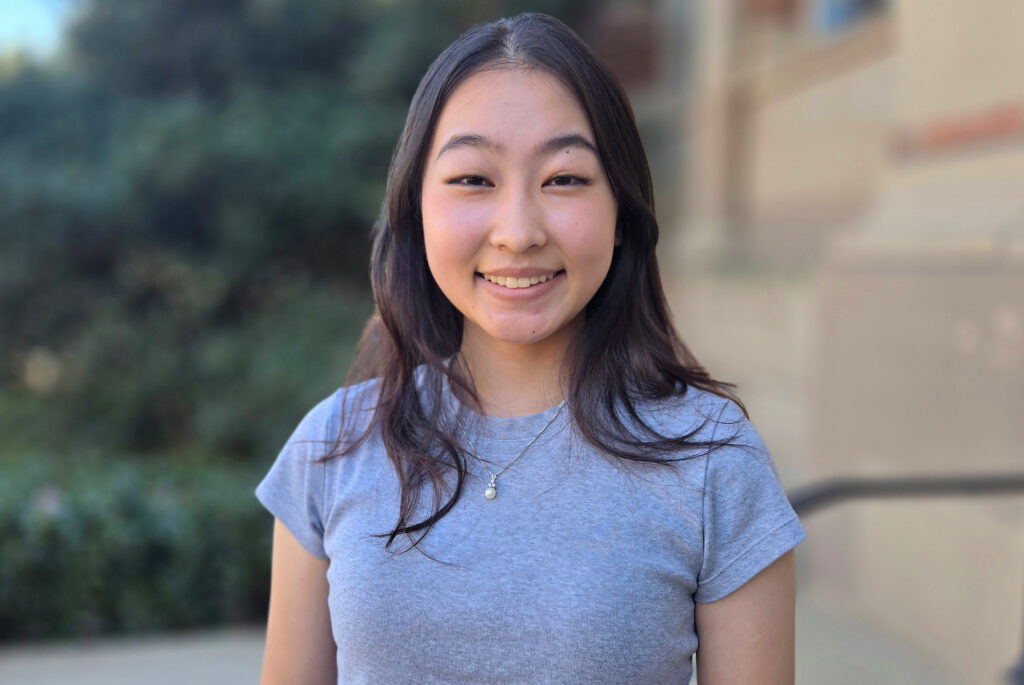
Sean Brenner/UCLA Humanities
Grace Wang says her summer research experience gave her the opportunity to approach questions around AI through an interdisciplinary lens.
| October 20, 2026
Grace Wang’s academic interests are wide-ranging: The third-year undergraduate is pursuing majors in neuroscience, comparative literature and biology, as well as a minor in health humanities.
Not surprisingly, a research project Wang is completing now draws on all those disciplines. She spent much of the past summer working on the project, “The Calculus of Social Companion AI.” The project was facilitated by the UCLA Undergraduate Research Center’s Summer Fellows Program.
Wang said that when that project is completed this fall, she’ll continue her exploration but narrow her focus a bit, to explore the dynamics of social companion AI and bereavement. Her interest in that topic was spurred by two UCLA courses — a comparative literature class called “Death in Literature” and a portion of an anthropology course taught by Daniel Fessler, who served as faculty advisor for Wang’s summer research — as well as her experience this summer volunteering at a hospice facility.
Looking ahead, Wang plans to apply for M.D./Ph.D. programs in medical anthropology and has her eye on a career as a physician–social scientist.
In an interview with with the UCLA Undergraduate Research Center for the Humanities, Arts and Social Sciences, Wang spoke about a key lesson she gleaned from “Frankenstein,” the most interesting things she learned from her project, and why even independent research can be a team effort.
How did you first get interested in your research project?
I have always been drawn to approaching issues with an interdisciplinary lens — for example, bringing what I know about the brain, as a neuroscience student, to humanistic inquiries about what people are thinking and feeling, in comparative literature. This led me to research in biological anthropology under my current research advisors, Professor Daniel Fessler and grad student Sophie Klitgaard, with whom I explore issues of human health and behavior, integrating frameworks across evolutionary psychology, cognitive science, and linguistics.
My project, investigating the rapid rise of social companion AI, or SCAI, emerged from this set of interdisciplinary interests. I was recently re-reading Mary Shelley’s “Frankenstein,” which carries a broader reminder that, if we’re creating something new through research, we need to be prepared to reckon with the implications of that pursuit of knowledge. This is one of the key ideas that drove me to research AI: I do not think we are fully ready for the implications it is having across fields in and outside of academia — but we need to be, considering our growing dependence on it.
I feel strongly that this site of inquiry demands more interrogation of how people think about human-AI relationality, how we interact with other agents (human and non-human), and the opaqueness of AI use as we know it. Concomitantly, it was an opportunity to apply my multidisciplinary interests and to explore mixed-methods, and so these interests all ultimately converged into this research project on social companion AI.
What has been the most exciting aspect of your research so far?
Because this research project employed, in part, ethnographic methods, it has been endlessly fascinating to hear, one-on-one, what users think about questions such as: where they think information goes once they type it out to a chatbot, where the responsibility for protecting user privacy lies, and how in-person privacy risks differ from on-line privacy risks.
It is one thing to theorize based on existing literature, but another thing entirely to hear users describe their own experiences. For example, one participant talked about thinking the use of AI for emotionally intimate contexts was ridiculous, but that while living abroad, they found themselves sucked into the validating sycophancy of the technology. It was very meaningful to hear users of social companion AI share their own thoughts and experiences.
I am now in the process of qualitatively analyzing and thematically coding the interview data, which I have found equally intellectually stimulating.
What has surprised you about your research or the research process?
Although this was designed as an independent research project, I have learned that the research process is not one that can be done alone, or in a vacuum. Even beyond having mentors or advisors to guide me through the process, having other senior scholars and peers to think and talk with was requisite to producing good research.
Despite setting out with the idea of trying to do research on my own, my current research feels, in many senses, more like a group project. Doing an extensive amount of thinking and writing, as the research process requires, can feel very isolating, so it’s been quite valuable to pick the brains of other people researching similar things.
I met, for example, with a computer scientist at USC doing similar research, and spent all summer marinating in ideas across hours-long Zoom meetings with my grad student mentor, Sophie Klitgaard; her lovely cat, Misha, a regular presence in our meetings; and other research assistants in our affiliated research group that helped transcribe the many hours of interview data we had on our hands.
Especially in humanities and social sciences projects, the work can feel lonely, but I found myself surprised by how much easier it was to have good, more articulate ideas when I was spending time talking to other people in adjacent and similar spaces.
What advice do you have for other UCLA students thinking about doing research?
Having an interesting question or idea is half the battle! If you are interested in getting into research, I would encourage you to start by probing what feels the most fun to think about — for example, that one thing from a lecture that your mind goes back to, or some curious observation you keep making in some everyday setting. From there, things will fall more or less into place.
What effect do you hope your research has in your field, at UCLA, in your community, or in the world?
I hope that my research on the perceived benefits and ethical risks of SCAI will help extend digital privacy research into a market of rapidly growing social companion AI technologies, where a user-informed perspective as such can help navigate a novel mode of social interaction and companionship.
The conversation about AI is one that grows more pressing and relevant by the day, and I hope to be a part of making it as comprehensive and user-informed as possible.
Learn more about research opportunities for humanities, arts and social sciences students at the Undergraduate Research Center and find additional scholarship offerings on the Humanities Division website.