
Susan Kresin honored for excellence in teaching
The senior lecturer was recognized by the American Association of Teachers of Slavic and East European Languages
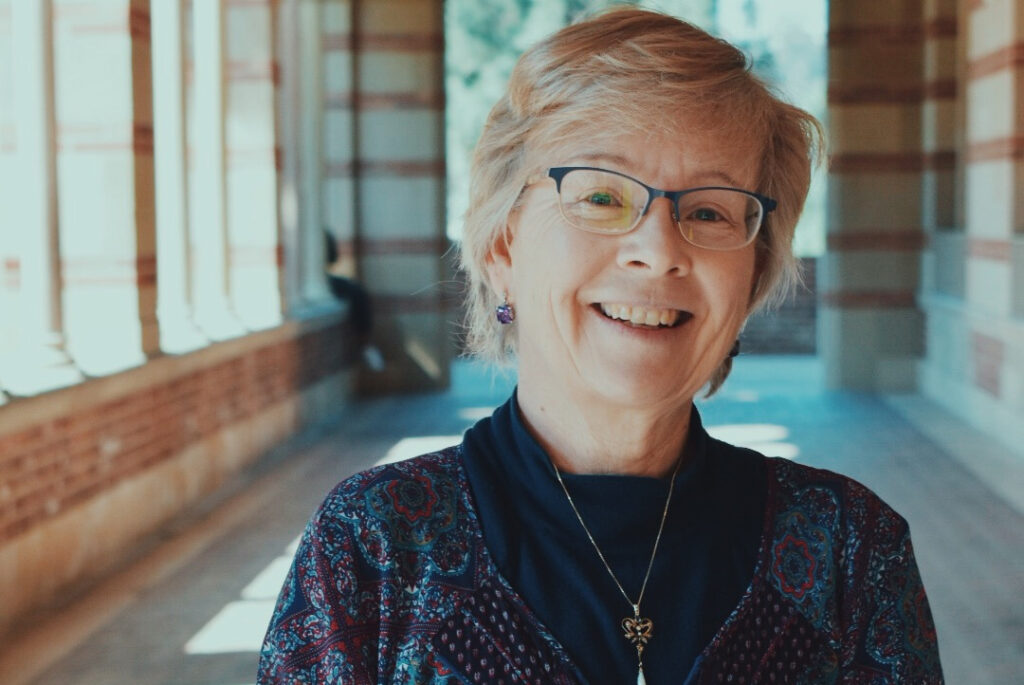
Courtesy of Susan Kresin
Susan Kresin, who has taught at UCLA since 1996, was praised by peers for her “boundless energy and love for her students.”
| March 19, 2026
Although she has taught Russian and Czech at UCLA for 30 years, Susan Kresin has not run out of new things to discover.
“There is always something to learn about and explore, because the humanities can potentially encompass anything having to do with communication, cross-cultural understanding and the arts,” said Kresin, a senior lecturer in the Department of Slavic, East European and Eurasian Languages and Cultures.
That sustained curiosity — along with her unique ability to connect with her students — has earned Kresin the Excellence in Teaching Award for educators at the post-secondary level from the American Association of Teachers of Slavic and East European Languages.
The honor is presented annually to an educator whose work has had a transformative impact on students and the broader field. The association’s award citation cites a colleague who said Kresin “instinctively takes others under her wing and continually advocates for students and early-career colleagues alike,” providing “concrete, practical advice on both teaching and research, while also inspiring with her boundless energy and love for her students.”
Underpinning Kresin’s approach is her commitment to learning each student’s interests and background, which helps her tailor lessons and class projects.
“I’m very lucky to teach small enough classes that I can get to know my students as individuals, each with their own constellation of interests, goals, motivations, and strengths and weaknesses,” she said. “No two human minds are ever the same, which makes the process of trying to adapt and optimize what I can offer them a fascinating challenge.”
Beyond UCLA, Kresin has helped shape pedagogy at the national level through her work with AATSEEL and the American Council of Teachers of Russian, where she has addressed subjects such as personalized learning, project-based learning and teaching approaches to support neurodiverse students. She also is on the ACTR board of directors and executive committee, a co-author of a Czech-language textbook, “Čeština hrou” (McGraw-Hill, 1997), and a member of the Czech Language News editorial board.
At a time when geopolitical concerns have limited some study-abroad opportunities, particularly in Eastern Europe, Kresin said she has made it her mission to bring the Russian-speaking world to her students — often by tapping the rich cultural opportunities Los Angeles offers. For example, in 2025, she arranged for her students to translate a contemporary Russian play for the Echo Lubimovka theater festival. Their work was incorporated in the play’s staging, and Kresin and a handful of students attended the performance.
Kresin also has been a longtime advocate of instruction in less commonly taught languages —languages, she said, that tend to attract especially dedicated students.
“Students who choose to take somewhat unusual languages tend to be very motivated, as well as open-minded and eager to explore new things,” she said. “That is a very supportive environment for experimentation.”