
Humanities Division boasts 5 Distinguished Teaching Award winners
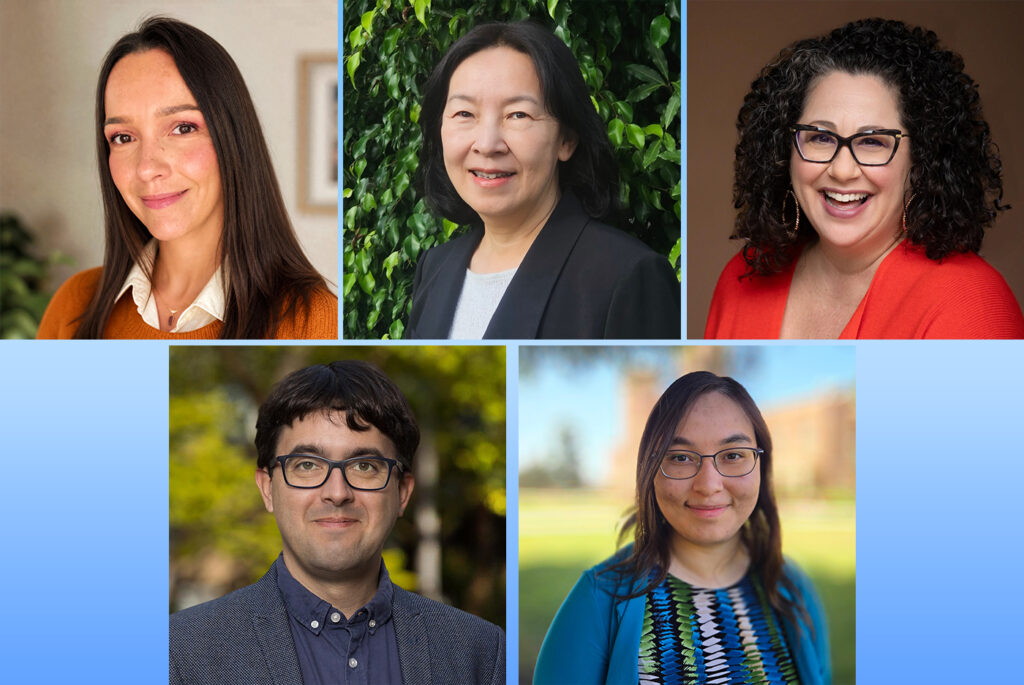
Courtesy of the subjects
Daria Bahtina, Seonkyung Jeon and Lauri Mattenson (top row, left to right), and Javier Patiño Loira and Katarina Yuan (bottom, left to right).
| June 9, 2026
Superb teaching is one of the hallmarks of the UCLA College Division of Humanities. The latest evidence? Of the 18 faculty and teaching assistants from across the entire campus who earned UCLA Distinguished Teaching Awards for 2026, five are based in the Humanities Division.
Daria Bahtina (Linguistics), Seonkyung Jeon (Asian Languages and Cultures), Lauri Mattenson (Writing Programs) and Javier Patiño Loira (Spanish and Portuguese) were honored in the faculty categories, and doctoral student Katarina Yuan (English) was recognized among the campus’s outstanding teaching assistants.
Presented annually, the awards “recognize deserving instructors for their creativity in the classroom, dedication to helping students thrive, and commitment to continually enhancing the educational experience,” according to the UCLA Teaching and Learning Center, which administers the program. Recipients receive awards of $6,000 and are honored in the fall at the Andrea L. Rich Night to Honor Teaching.
Meet this year’s winners from the Humanities Division:
Daria Bahtina
Continuing Lecturer, Linguistics
Award: Undergraduate Mentorship
As a sociolinguist, Bahtina aims to extend her students’ cultural understandings of their day-to-day conversations.
Across courses ranging from the lower-division “Scientific Study of Language and Society” to the upper-division “Bilingualism and Second Language Acquisition,” Bahtina encourages students to critically examine the intersections of language with social identities, cultural practices and interactional contexts, including topics such as gender, generation and media discourses.
“I try to model openness and vulnerability in the classroom,” she said.“ It’s incredibly rewarding when students respond by engaging honestly and enthusiastically sharing examples from their own lives.”
Bahtina also mentors students working on research projects for course credit, a natural extension of her teaching philosophy, which prioritizes hands-on learning and promoting students’ self-confidence.
“When students are given trust, encouragement and the right tools, they often exceed their own expectations,” she said. “They’re able to show how much they can contribute to academic conversations about language and bias, and even broader social change.”
Seonkyung Jeon
Lecturer, Asian Languages and Cultures
Award: Practice of Teaching
Jeon primarily teaches Korean language courses and “Variable Topics in Advanced Korean: Language, Society, and Culture,”subjects she said are especially rewarding for her to teach in a cultural epicenter like Los Angeles.
“Interest in Korean language and culture in the United States has grown tremendously, and L.A. is the hub of this cultural exchange,” she said. “It’s special to see my students become meaningful bridges between Korea and the United States.”
As a language instructor, Jeon understands that risk-taking and making mistakes is at the core of the learning process. She said she focuses on making her classrooms low-anxiety environments where students feel free to collaborate with one another.
“I know that my students have connected when they continue conversations beyond assigned tasks,” she said. “I feel especially proud when I see students use their Korean language skills in real-world settings—whether through professional work, community engagement, or cultural exchange.”
Lauri Mattenson
Senior Continuing Lecturer, Writing Programs
Award: Practice of Teaching
Writing might appear to be primarily a cerebral exercise, but in her teaching, Mattenson emphasizes the mind–body connection. A fundamental principle of her work is embodied cognition.
“We need to understand that learning is not just filling the mind and ignoring the body,” said Mattenson. “Students are often told before they get to college that you just have to memorize a lot of things and repeat them back for exams. But I really want them to understand that learning helps you embody the kind of person you want to be — and that ideas are not just inert abstractions, but living forces that shape how we exist in the world.”
While all of Mattenson’s teaching revolves around writing, her courses cover a wide array of applications and contexts, from stand-up comedy as public pedagogy and free speech on campus (recurring themes of the English composition class she regularly teaches) to career readiness and public speaking.
“I am always asking students, ‘Why does this matter,’ and ‘What’s at stake?’” she said. “I encourage students to consider how ideas, concepts and theories apply to our behaviors and real choices.”
Javier Patiño Loira
Associate Professor, Spanish and Portuguese
Award: Practice of Teaching
In Patiño Loira’s classroom, students immerse themselves in the literary and scientific perspectives of early modern Spain through classes like “Embodied Minds: Love & Emotions in Early Modern Hispanic Literature and Science,” and “Performing One’s Life in the 17th-Century Transatlantic Hispanic World.”
“When I first introduce a text, we find ourselves laughing at the exact same stories that were written 400 years ago,” he said. “That shared laughter proves that the students are ready to make the most of the intellectual and creative voyage I try to offer.”
As higher education adapts to the digital age, Patiño Loira has evolved his teaching to reward imagination and originality in students’ work. For example, he said he strives to integrate creative writing into his assignments, rather than sticking to traditional academic essays.
“Our students are incredibly gifted at responding creatively to literary texts through a diverse range of genres,” he said. “I see no sign that their boundless curiosity and desire for learning have waned in the slightest.”
Katarina Yuan
Doctoral student, English
Award: Teaching Assistant
Yuan said she draws from her own journey to inspire UCLA undergrads embarking on theirs. One class she teaches is Critical Reading and Writing, which introduces first- and second-year students to literary analysis, helping students improve their writing and comprehension skills.
She has taught the course since 2022, but over the past few years, she has begun to incorporate more nontraditional texts into her syllabus — “Dungeons & Dragons” manuals and fan fiction, for example — aiming to include material that speaks to students’ different backgrounds and interests. She found the change helped students better connect and engage with the work.
“I think the selection of texts is inherently very personal,” Yuan said. “I’m choosing texts that I wish I had read when I was an undergrad. Other times, I’ll bring in a text that I don’t have much of a personal connection to, but that I know other people love, and that’s my personal connection.”
Yuan said she is grateful for her students and she takes pride in seeing them connect with reading and writing on a more personal level. Above all, the one-time aspiring biologist is inspired by the opportunity to help her students plant the seeds of inquisitiveness they need to grow academically at UCLA and in their lives beyond graduation.