
Sarah T. Roberts on midterms, AI and the battle for digital control
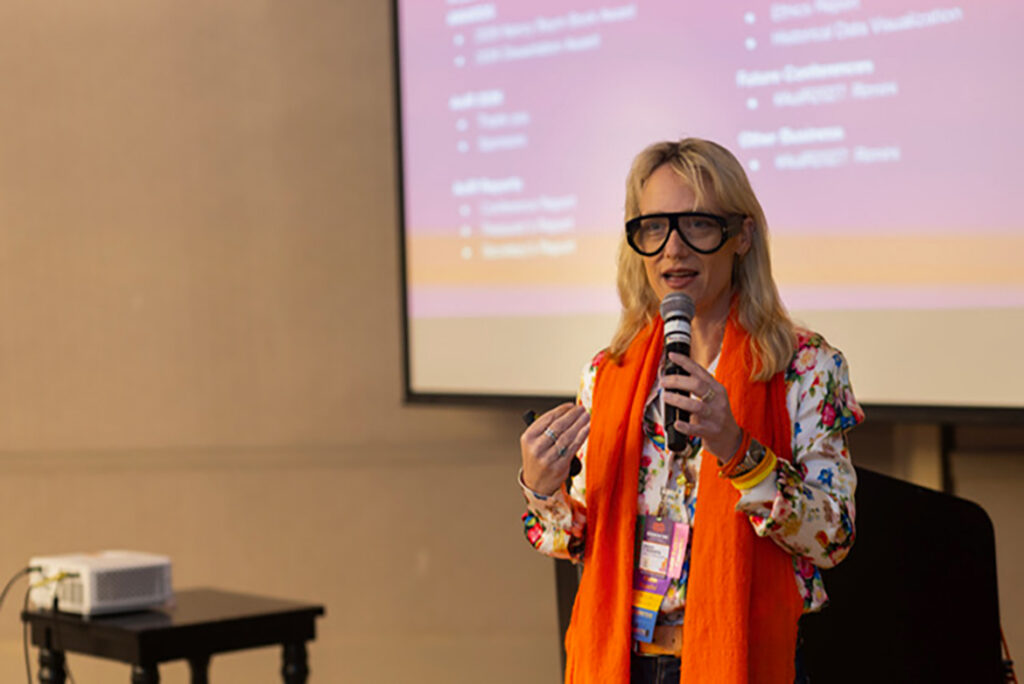
Courtesy of Sarah Roberts
Speaking about the upcoming midterm elections, Sarah T. Roberts observes that many voters don’t trust data centers and the technologies they fuel. “It’s a pretty clear demonstration that their unpopularity actually can unite voters. A savvy candidate might pick up on that.”
| October 29, 2026
The internet, artificial intelligence and other digital technologies continue to impact many aspects of our lives and make headlines as Election Day approaches.
Sarah T. Roberts, professor in the departments of digital humanities, gender studies and information studies, and faculty director and co-founder of the UCLA Center for Critical Internet Inquiry, researches how power, geopolitics and economics play out on the internet and through digital technologies, often deepening global inequities and social injustice. She is frequently consulted on issues related to policy, worker welfare, governance and content moderation, as well as the broader internet ecosystem.
Roberts, who is also president of the Association of Internet Researchers, addressed these issues in a Q&A with UCLA Newsroom. Answers have been edited for clarity and length.
How does AI’s growing presence affect voters in the upcoming midterm elections?
I have been interested to see how, in a time of such deep political polarization and animus, AI — particularly its environmental and social impacts — seems to be an issue that can bridge these otherwise acrimonious divides, fill seats at city council meetings, and foment grassroots community activism across all sorts of demographics.
Simply put, people do not want these noise-polluting, resource-extracting, electricity-sucking data center behemoths in their backyards. They also don’t trust the promises made by corporate interests and politicians that claim data centers will bring jobs or other kinds of prosperity to communities; on the contrary, these installations hire very few people at all and their 24/7 operation is a resource drain on the rest of the people who live and work near them.
People also don’t trust the technologies that they are told these data centers fuel. It’s a pretty clear demonstration that their unpopularity actually can unite voters. A savvy candidate might pick up on that.
How do you recommend voters sift through misinformation, including political ads generated or altered by AI? How are tech monopolies impacting the average voter?
I think everyone needs to start by becoming more educated and practicing discernment as they consume political material, particularly online.
We are at a low in my lifetime of unfounded claims and untraceable campaigns being foisted on voters from all directions. These kinds of ecosystems used to be easier to control by a smaller media landscape, but also because we had greater will in enforcing erroneous, unfounded claims from unreliable sources, fact-checking, and tracing money and campaign spending on things like ads from third-party groups.
We are also seeing the big social media companies themselves being accused of election manipulation in real-time lead-ups to races around the globe, such as in the hotly contested Brazilian presidential race, where the incumbent candidate has sought to crack down on such manipulation and undue influence during his time in office. These companies are far from neutral; they have much to lose and gain in these races around the world and within the United States, and their ability to restrict or amplify what people see knows no equal.
What role should the government play when it comes to social media and potential harms to children and youth?
Governments must pay attention to the protection of its citizens. Unfortunately, in the United States, much of that work has come after harms have already been done, through civil court proceedings yielding record-breaking judgments against companies like Meta — Facebook and Instagram — and Alphabet — Google and YouTube. Many argue in favor of greater technological barriers to entry for young people on these platforms, including using technologies, but others suggest that keeping young people from information sources by introducing new layers of intrusive technologies is not the easy solution it seems.
The simple fact is that these firms continue to enjoy unprecedented indemnity via things like Section 230 of the Communications Decency Act of 1996, which has allowed them to eschew liability for content on their platforms by claiming that they are simply conduits passing content among consumers, rather than producers and manipulators of the same who bear responsibility for what they allow and what they remove.
My best advice … Read actual papers of record. Read history and learn from documentaries. Put yourself in a position to question things that sound too easy to believe or too quick to anger you.
Those legal protections and the ecosystem they have engendered are largely responsible for the unregulated miasma in which we all find ourselves today, including kids who may have never known any other media landscape than this one, but also has captured people of all ages who turn to their phones and unvetted material produced by unknown actors with dubious motives and take what they hear, see and read at face value.
We know, for example, that there are entire state apparatuses devoted to manipulating and influencing people on the other side of the globe. These are sophisticated, highly resourced efforts that are absolutely not being disclosed and count on amplification from regular people to spread their misinformation and sow discord.
How are you involved in the Association of Internet Researchers, and why is that work important?
The Association of Internet Researchers, of which I am president, is a two-and-a-half-decade-old scholarly society that is international in scope and interdisciplinary in field and method. The shared commonality among us is that we research the internet and digital technologies and their impacts on society.
At this year’s annual gathering, our 26th, we heard from member researchers from Brazil, Australia, South Africa, China, Mexico, Estonia, Chile, the United States, Canada, Sweden, Italy and more; in all, 48 countries were represented. Forty-nine percent of our participants were attending their first conference, and we had a huge retention rate from our 2025 conference in Brazil.
That conference was our first ever in Latin America, and this year’s was the first in a Spanish-speaking country and the first in Mexico. This is a fact of which I am very proud; I delivered my opening remarks in Spanish, and that was followed by a keynote address from native Mixe linguist and activist Yásnaya Elena Aguilar Gil; we provided on-site simultaneous interpretation from Spanish to English, done by real humans — not AI — as interpretation in real time is an art and a craft all its own.
The internet and related digital technologies are international and have politics; it’s arguably the most important site of state control, perhaps with the exception of literal military occupation, on the planet. Unlike the people who migrate around the world to seek better presents and brighter futures, the internet and data flows, as well as the flows of capital they portend, do not meet border-based restrictions. Our researchers do deep, long-term research and surface new trends and phenomena years before the general public catches on. We research the ties these powerful companies have; the resources they have at their avail and those they extract from the environment; the impact and influence they have on the public; the policies and regulations that seek to govern them; and the resistance and alternatives created in their wake.
What advice do you have for people who want to be informed to vote responsibly in the upcoming midterm elections — and beyond?
As we think about how the internet and digital technologies impact our everyday lives, we tend to think about our experiences as passive viewers, scrolling through a TikTok or Instagram feed, making an online purchase, or watching a show or movie. But the internet is much more than that and the rest of it is often imperceptible by design.
Consider its infrastructure and who controls it, such as the undersea cables that transmit data from one continent to the next; or the Starlink network controlled by Elon Musk, a partisan who [reportedly] used his control to slow down internet links being used by Ukrainian military; or intangible phenomena like commercial content moderation, which users may experience when their own content is removed [without notification]; or the use of recommender systems that use algorithmic manipulation combined with massive stores of individual user behavior and content preferences to serve up exactly what they think a user wants to see and not necessarily what they should see.
This is an opaque, largely unregulated industry that makes massive profit on our passivity, preferences and willingness to not question it.
My best advice for everyone out there is to seek out many sources of information, including those outside your own personal political preference. Read actual papers of record. Read history and learn from documentaries. Put yourself in a position to question things that sound too easy to believe or too quick to anger you. Try to think for yourself because these companies count on the fact that you won’t and that you’ll just click to the next piece of “content” after this brief message from a sponsor.
At least on TV, we knew when the ad breaks were and what they were selling. Nowadays, if we can’t figure out what’s being sold and by whom, chances are it’s us.