
Ahmanson Scholarship Seminar students become curators for Clark Library exhibition
‘No Place Like Home: 18th-Century London in an Age of Change’ showcased Georgian-era artifacts
Bailey Hart
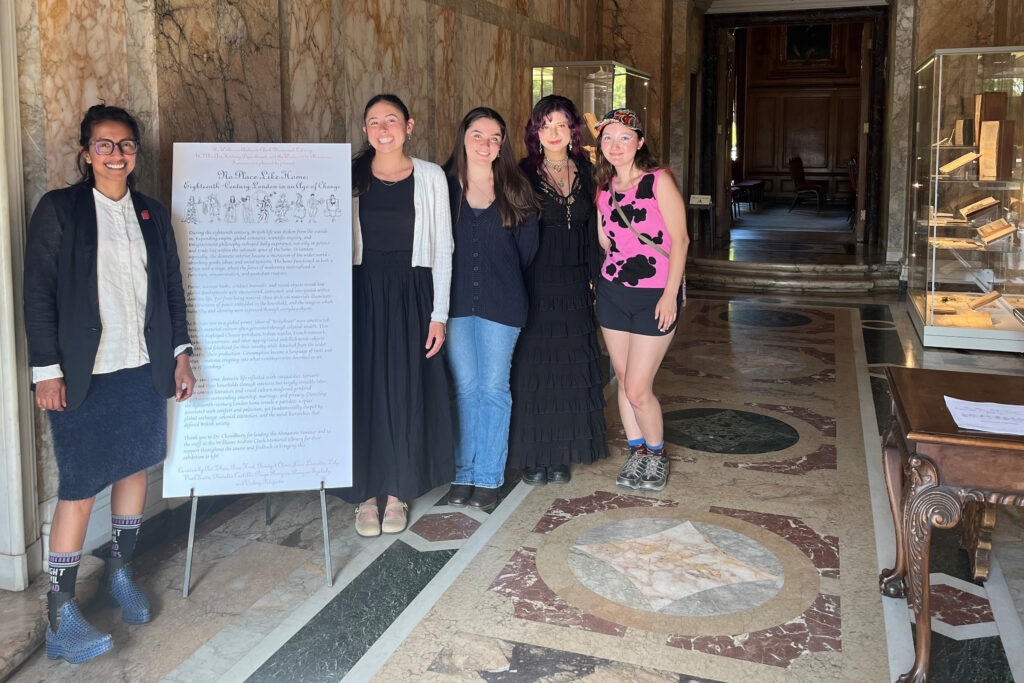
Professor Zirwat Chowdhury (left) with some of the students who organized the exhibition: Paige Runyan, Bridget Cline, Natalia Castillo and Juno Lumetta.
| June 23, 2026
Nine UCLA undergraduate students gathered each week at the William Andrews Clark Memorial Library during the winter term to learn about the material and visual culture of 18th-century London.
But their immersion into the Georgian era didn’t end when the quarter did: The students parlayed the experience into an opportunity to curate an exhibition at the Clark. The exhibition, titled “No Place Like Home: 18th-Century London in an Age of Change,” was on display during the spring quarter, showcasing letters, household objects like fans and playing cards, and account books, all drawn from the Clark’s collection.
It all began with a UCLA Ahmanson Undergraduate Scholarship Seminar taught by art history professor Zirwat Chowdhury, “At Home in 18th-Century London.” Students from an array of majors — English, communication, architecture, psychology and art history among them — had to be selected for the seminar through a competitive application. The Ahmanson scholarship provides each student with a $1,000 scholarship upon completion of the class, as well as covering the cost of transportation to and from the Clark.
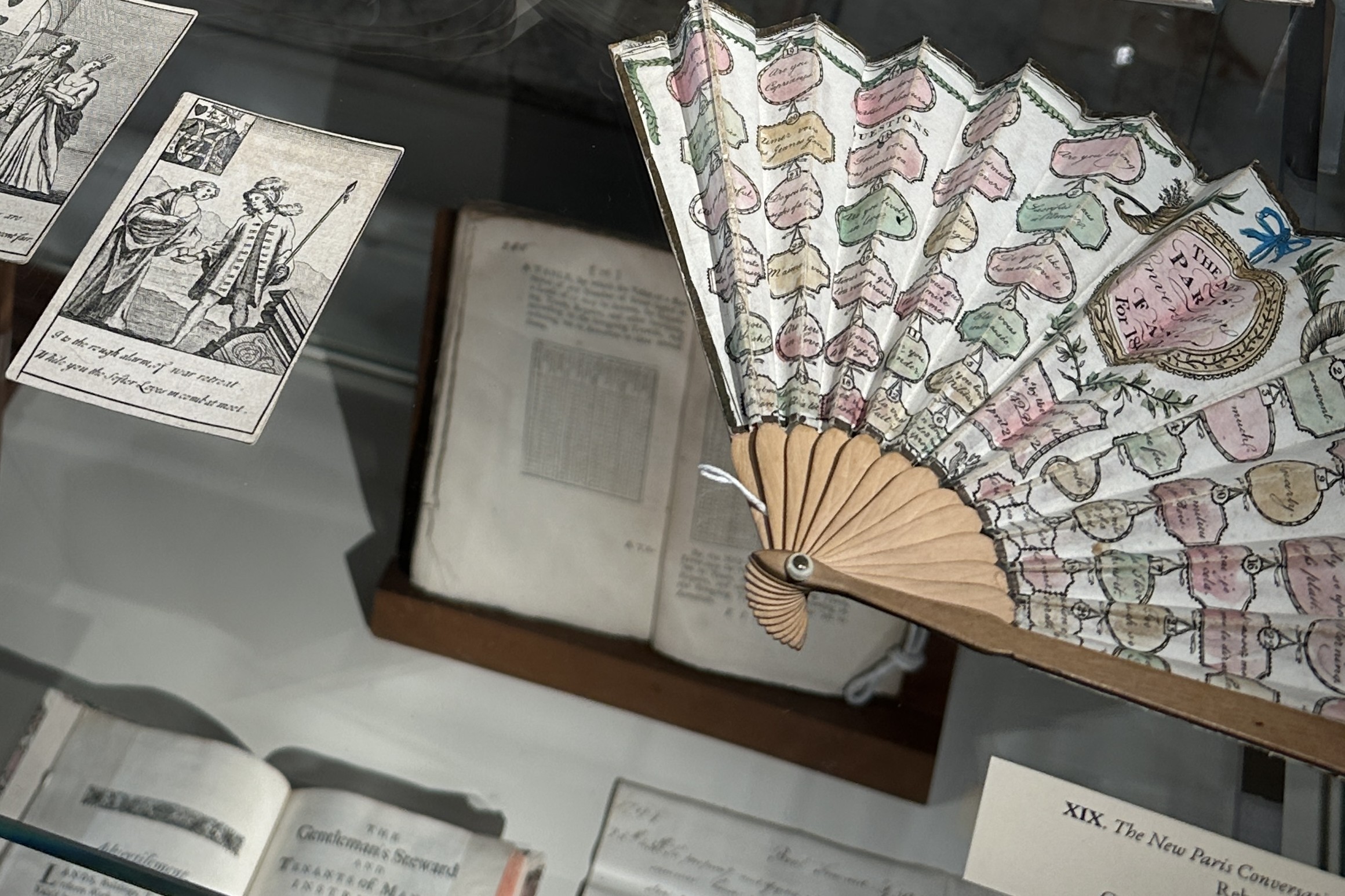
Among the unusual objects on display were illustrated playing cards (left) and a conversation fan.
The Ahmanson seminar is typically offered once each academic year, but because of strong interest from faculty members, it was offered twice during 2025–26 and two seminars are planned for the upcoming academic year.
Chowdhury structured the quarter so that students spent the first half of the course deep in readings, before venturing into the Clark archives to find materials that related to their developing research interests.
Paige Runyan, an English and communication major who just completed her third year, said she relished the opportunity to work directly with rare primary sources.
“The most exciting part for me was the switch from the first five weeks, which were similarly structured to some of my English classes, to the second five weeks, where it was much more hands-on — we could take what we had learned and apply it,” Runyan said. “The ability to pull whatever works I wanted, or take one concept I really love and just explore it — that was groundbreaking for me.”
The exhibition encompassed two large display cases, with the students organizing objects thematically around the themes of geography, commodities, trade, gender and domestic life.
Runyan said one of the most interesting objects the students selected was a “conversation fan,” a decorated handheld fan that women of the era might have used to convey messages, based on where and how it was positioned. The exhibition also included pictorial playing cards with romantic maxims, old account books recording household expenditures and a globe whose interior revealed charts of the constellations.
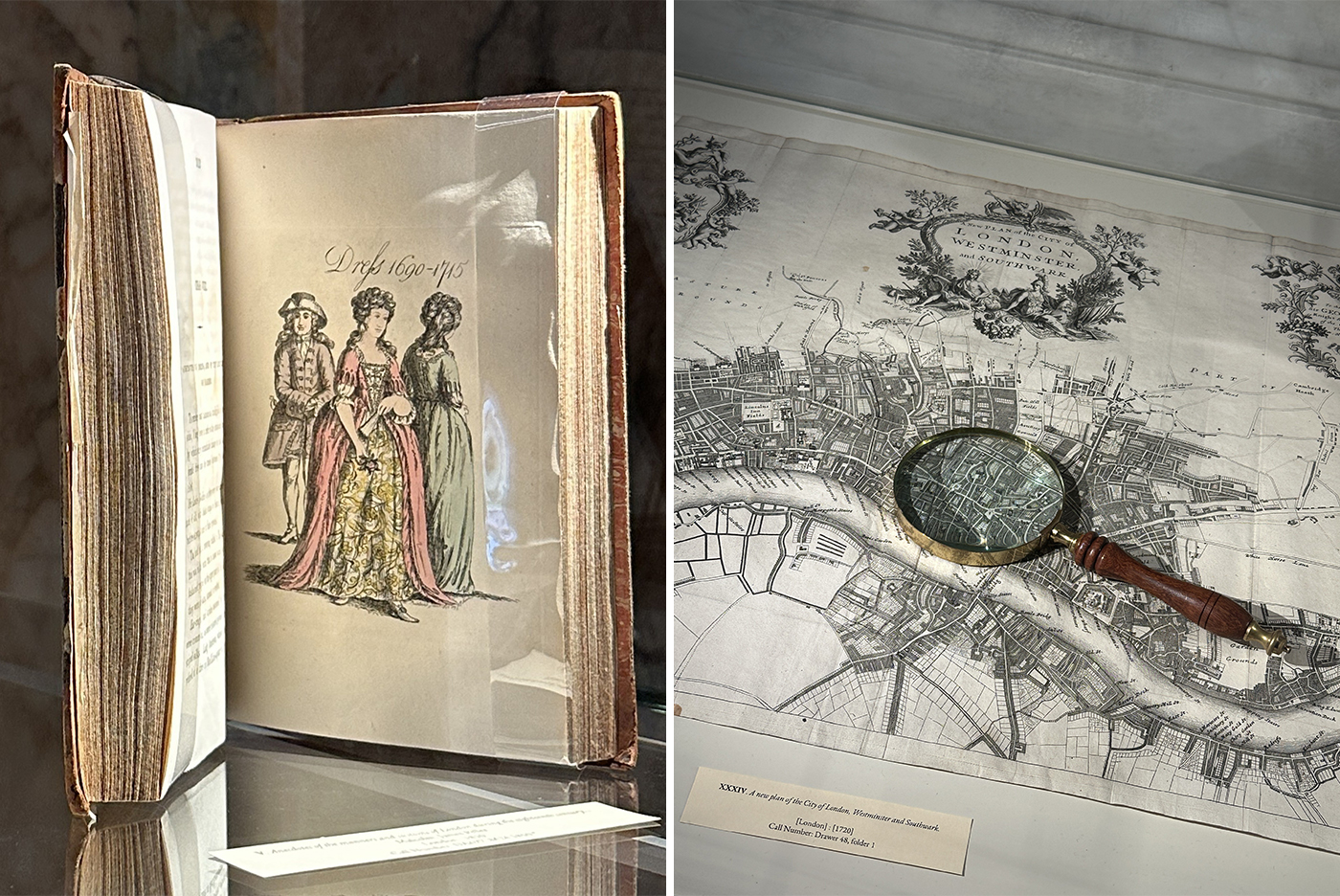
Materials from the Clark Library collection offered insights into fashions of the time, along with a view of 18th-century London.
Chowdhury said the students’ enthusiasm for the hands-on work was palpable.
“What made it great for me was that the students never really made me doubt what they were doing, because they were just so energized,” Chowdhury said. “I really tried to reinforce that all of these resources exist for all of them — the Clark is a research library, but it is also a university library, and it only makes sense for our students to use it.”
For the students, working as a team to curate a coherent exhibition required both familiarity with the materials and a commitment to collaboration — deciding which objects to include, how to arrange them and how the different sections would relate to one another.
“They had to learn not just how to curate an exhibition, but to curate an exhibition together, which is challenging,” Chowdhury said. “Nine people working on one exhibition meant they had to figure out the themes, coordinate how the themes speak to each other and make sure they weren’t all picking the same objects.”
For Runyan, the result of that coordination ultimately provided the most rewarding part of the experience.
“The most magical part was when we all put our topics together and realized: I could see how women and porcelain, fashion and fabrics, and courtship and marriage pair together, and I see how ports and trade and commodities form a kind of foil to that,” Runyan said. “Seeing all of our work integrated together, and then knowing that people would come see our exhibition — that was really something.”