
Ziyan Xie looks at machine vision through a humanist’s lens
The graduating senior taught an undergraduate seminar and conducted research in Germany

Sean Brenner/UCLA Humanities
Ziyan Xie’s passion for studying the intersection of technology and society led him to study in Europe, teach an undergraduate class and create a playable documentary.
| June 3, 2026
Throughout his time at UCLA, Ziyan Xie has delved deeply into questions about human–computer interaction.
Xie, a German and cognitive science major who will graduate next week, has explored the subject in an undergraduate seminar he taught, at a German university and through his latest research project, which will culminate in an interactive documentary about the history of computer vision.
That project, funded by a scholarship from the Undergraduate Research Scholars Program, explores “machine vision,” technology in which cameras and sensors capture visual information to help people — or, increasingly, AI-powered machines — detect motion or identify humans and objects.
Under the mentorship of Steve Anderson, a professor of design media arts at the UCLA School of Theater, Film and Television, Xie created a three-part playable documentary called “See/Saw,” which allows players to simulate machine vision and learn about its role in surveillance technologies.
Players are first prompted to play a desktop game in which clusters of color disperse against a black background, with each cluster representing a person detected in a camera’s visual field. Different hues represent the direction of the person’s motion, and the cluster’s saturation represents their speed. At random intervals, the clusters erratically scatter, and the player must try to return the clusters to an orderly flow by moving and clicking their computer mouse.
When a player finishes the game, the screen splits into two sections, with half displaying a narrated documentary on the political history of machine vision, and the other showing a replay of the player’s experience with the game. The goal is to encourage the player to reflect on what it means to look through the eyes of a machine.
“The way by which drones or surveillance cameras create images is a black box for us humans,” Xie said. “By playing and watching this documentary, one can hopefully visually understand how suppressing the chaotic clusters is the same process by which machines, for example, help police suppress crowds.”
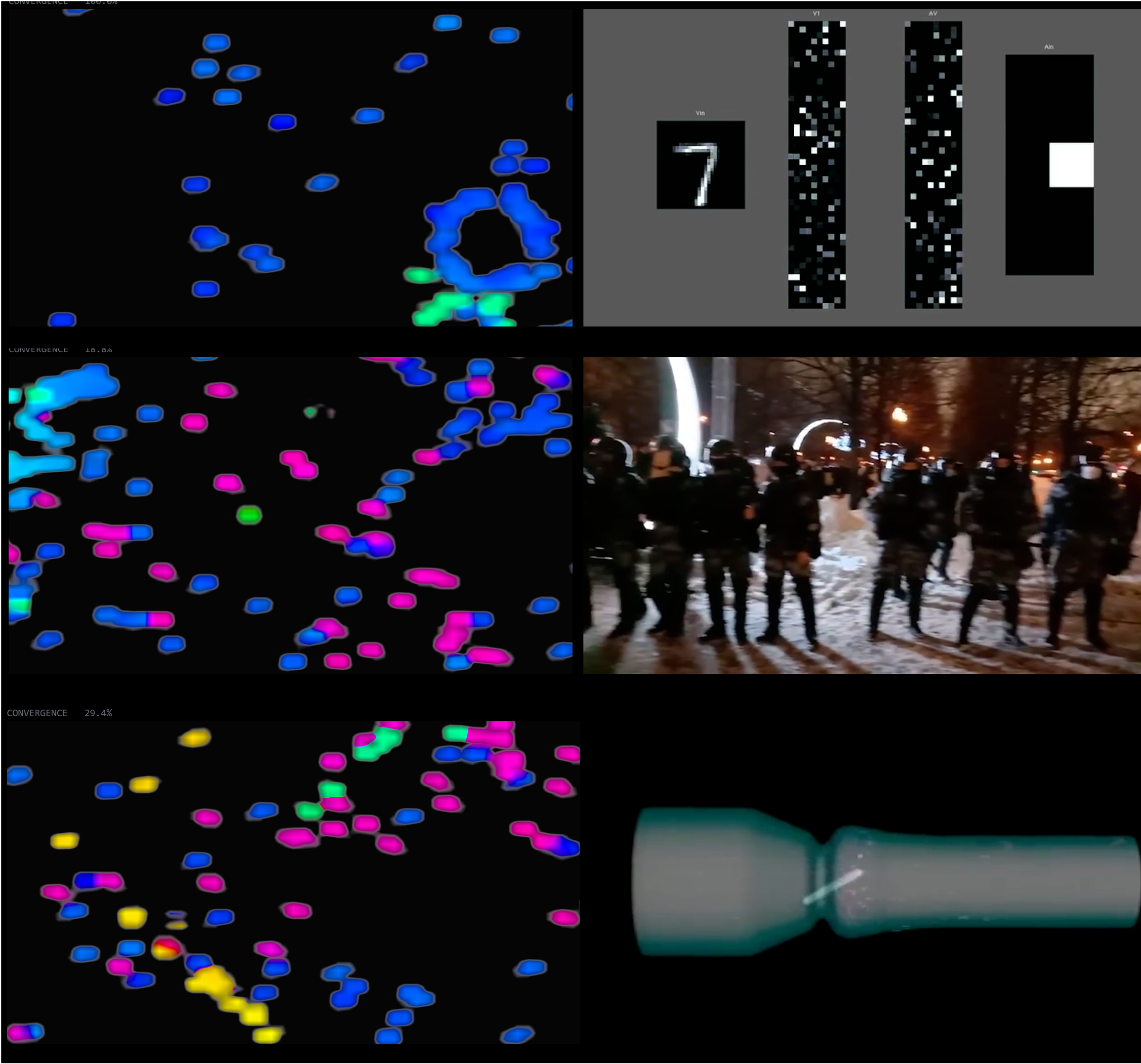
A screen capture from Xie’s “See/Saw” project. Images on the left are replays of a player’s game; on the right are corresponding images of applications of machine vision.
Although Xie’s work is mainly focused on technology and cognitive science, he said the humanities play a large role in how he shapes his research questions.
“The technical layer of a system tells you how it works, but history and literature tell you what it’s doing to people,” Xie said.
Reframing the AI discussion
At a time when so many people are justifiably concerned about the prospect of artificial intelligence making their jobs obsolete, Xie said he’s motivated to reframe the discussion: “How can we interact with the machine, rather than worrying about whether the machine will replace us?”
Considering that dynamic through a humanistic lens was the animating principle of a UCLA undergraduate seminar that Xie designed and taught in spring 2025. Supported by the Undergraduate Student Initiated Education Program, he created a class called “The Questions Concerning Video Game” — the phrasing of the course name was a nod to philosopher Martin Heidegger’s essay “The Question Concerning Technology.” In it, Xie guided students through the philosophy of video games, posing questions such as, What does it mean to play text-only games? What are the political implications of simulating military action? And, are players necessary for a game?
“The course attracted a lot of engineering and other south campus students, for whom the language of theoretical texts can be brand-new,” Xie said. “But if you think alongside your gaming experience, philosophy becomes something you embody and feel.”
During one class, Xie prompted students to think about their visceral reactions to playing Cookie Clicker, a game in which players try to generate as many small cookies as possible by repeatedly clicking on a larger cookie. The same week, Xie assigned philosopher Gilles Deleuze’s 1990 essay “Postscript on Societies of Control,”which warned that technological advances will work to subtly influence our beliefs and decisions.
Xie found that students readily connected the principles of the game to Deleuze; his class discussed how the gameplay in Cookie Clicker felt automatic, stripping players of their creativity and agency.
David Kim, a professor of European Languages and Transcultural Studies, was Xie’s faculty mentor for the teaching experience.
“I knew that Ziyan was a self-motivated, brilliant student,” Kim said. “But the class really gave him a unique opportunity to bring his entire being — his academic interests, his hobby and his postgraduate aspirations — to one space and share his hard work with peers. He really bloomed as a person and as a student-teacher.”
Xie’s passion for studying the intersection of technology and society also led him to study in Europe. In 2025, he was one of 250 students from North America, the U.K. and Ireland to receive a prestigious DAAD scholarship from the German Academic Exchange Service. The program provides students with the chance to conduct research at German universities.
Xie spent his summer at the Media Informatics Group at the Ludwig Maximilian University of Munich, where he researched how people interpret data visualizations — like pie charts or bar graphs — in virtual reality, under different conditions such as time constraints or with reward incentives.
After graduating, Xie is considering pursuing a doctorate in cognitive psychology or continuing work on a web application called Thyself, which he co-developed with a group of friends. The app curates personalized recommendations on what to read and watch based on a transparent algorithm. As long as the environment is intellectually stimulating, Xie is interested.
“What really matters is, how do I connect all the ideas going on in my mind and deliver them to people?” Xie said. “And being human is utterly the most important thing to think about.”