

- This event has passed.
All Consuming: Germans, Jews, and the Meaning of Meat
April 28 @ 4:00 pm - 5:30 pm
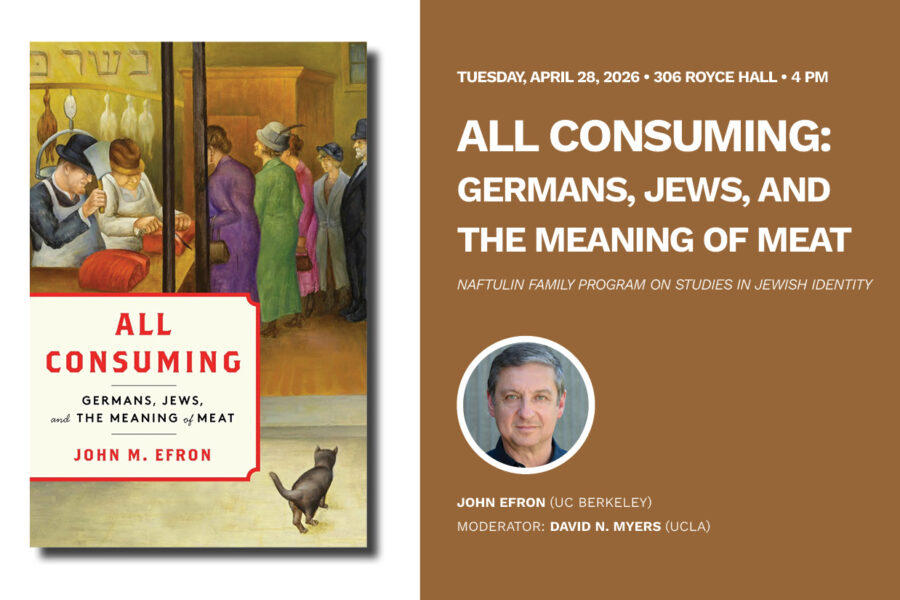
Meat is one of the most visible markers of Jewish distinctness and social separation. In his most recent book, John Efron argues that meat has played an especially important role in the formation of Jewish and Christian identities in Germany from the Middle Ages until today. To an extent not seen elsewhere in Europe, the importance of meat is reflected in many realms including the visual arts, literature, religion, politics, commerce, and home life. Studying the history of meat and its multiple meanings in Germany tells us much about the changing nature of German and German-Jewish identity, the links between religion, nationality, politics, and food. Above all, focusing on meat provides us with a singular window into the rich, fraught, and ultimately tragic history of German Jewry.
John Efron is the Koret Professor of Jewish History at the University of California at Berkeley, where specializes in the cultural and social history of German Jewry. A native of Melbourne, Australia, he has a B.A. from Monash University, an M.A. from New York University, and a Ph.D. at Columbia University. In his work, Efron has focused on the way German Jewry attempted to reinterpret and reinvent Jewish culture in the wake of its complex encounter with modernity. Among his publications are Defenders of the Race: Jewish Doctors and Race Science in Fin-de-Siècle Europe (Yale UP, 1994); Medicine and the German Jews: A History (Yale UP, 2001); German Jewry and the Allure of the Sephardic (Princeton UP, 2016); The Jews: A Modern History (Routledge, forthcoming 2025); and All Consuming: Germans, Jews, and the Meaning of Meat (Stanford UP, 2025).
Tuesday, April 28, 2026 • 306 Royce Hall • 4 PM
All Consuming: Germans, Jews, and the Meaning of Meat
John Efron (UC Berkeley)
Moderator: David N. Myers (UCLA)
Naftulin Family Program on Studies in Jewish Identity