
Team led by Todd Presner receives $308,000 grant to study how AI is shaping Holocaust history
Sean Brenner/UCLA Humanities
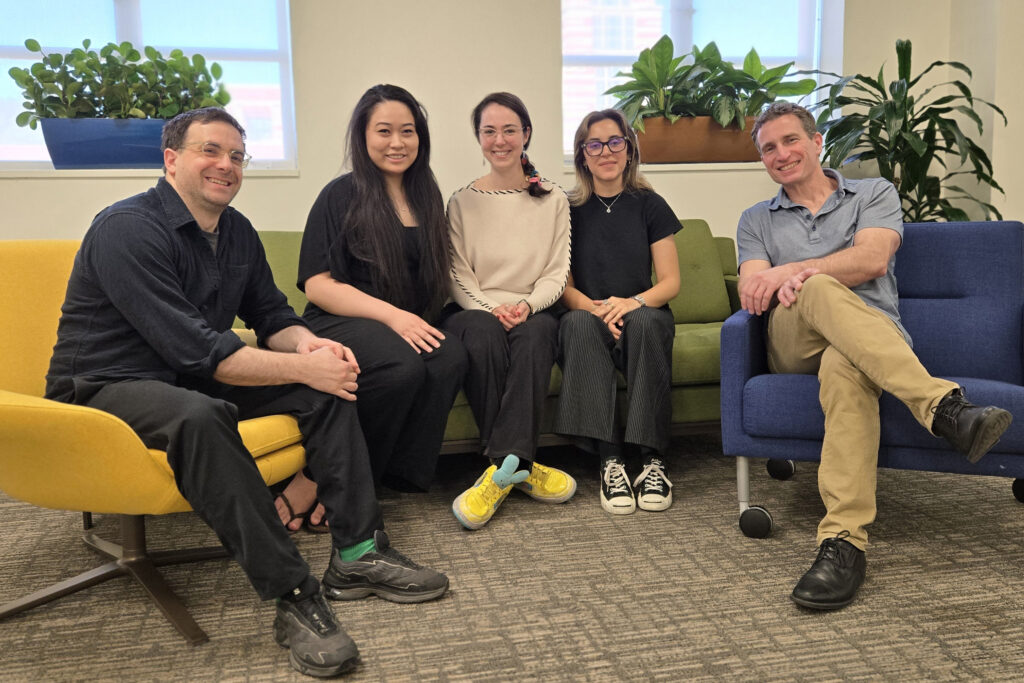
Todd Presner (right) with members of his AI and Cultural Heritage Lab, postdoctoral researcher Ulysses Pascal, technical lead Aileen Tang, and graduate student researchers Anna Bonazzi and Sophia Toubian.
| March 4, 2026
As a tool for teaching and learning history, artificial intelligence has become a double-edged sword.
“AI has the potential to make historical knowledge more broadly accessible,” said Todd Presner, UCLA professor of European languages and transcultural studies. “But it also has the potential to undermine historical truths and imperil historical knowledge.”
That dichotomy underpins a three-year project led by Presner through UCLA’s AI and Cultural Heritage Lab, exploring the promise and pitfalls of generative AI in sharing — and shaping — historical information about the Holocaust.
Now, Presner’s lab has received a $308,000 grant from the Conference on Jewish Material Claims Against Germany (Claims Conference), to support the project, “Prompting the Past: Generative AI and Holocaust History.” The project grew out of a collaboration with the U.S. Holocaust Memorial Museum.
The funds will enable research in four primary areas: understanding how AI is shaping public knowledge of the Holocaust, exploring how AI models engage with existing large-scale Holocaust archives, documenting how AI fosters Holocaust disinformation on social media, and developing a set of best practices for the use of generative AI by museums, libraries and educators.
Some educational technology companies have already employed AI in potentially problematic ways, Presner said, pointing to the development of AI avatars that enable students to “speak” with Anne Frank or the Nazi leader Heinrich Himmler. But the technology has also been applied in ways that Presner said are more useful and promising — for example, using facial recognition tools to identify faces in historical photographs, which helps historians build more complete and accurate records.
Sophia Toubian, a doctoral candidate at the UCLA School of Education and Information Studies and a member of Presner’s lab, said the project is especially timely because of how Holocaust misinformation is spreading online in 2026.
“We’re incredibly lucky to be given the opportunity to look at something that is happening online, right now,” she said. “These are things that we are all experiencing currently — you log on and you see people saying all kinds of things about the Holocaust — so it’s meaningful to be able to track these things as they’re happening, and to look at how they’re changing the way people are learning and sharing knowledge of the Holocaust.”
Toubian also said as an area of inquiry, the Holocaust lends itself especially well to this sort of examination because of the history of denialism and misinformation around it.
The researchers will examine how Holocaust misinformation is spreading on social media channels such as X, Instagram, Reddit and 4Chan. And they’ll look at how four major AI models — Claude, Grok, Gemini and ChatGPT — are creating narratives and data about the Holocaust.
Aileen Tang, a UCLA alumna who is the project’s technical lead, said one arm of the research involves a longitudinal study of how each of the AI models respond to questions about the Holocaust. Other researchers have posed that question at specific points in time, Tang said, but this may be the first study to observe trends over a longer period and across multiple models.
The researchers intend to produce white papers to guide institutions that engage with Holocaust archives and research. “That part of the project is really exciting because our relationship with history is being restructured in real time right now, as are the ways we understand and consume information,” Tang said.
Another aim, Presner said, is to test the extent to which an approach called “retrieval augmented generation” — pointing AI models to credible, authoritative sources — can encourage the models to reliably produce more accurate information.
“Ultimately,” he said, “our hope is that our research will inform how companies develop more robust tools and ethical responsibilities for addressing hate speech and Holocaust denial on their platforms.”
The Conference on Jewish Material Claims Against Germany (Claims Conference) represents world Jewry in negotiating for compensation and restitution for victims of Nazi persecution and their heirs. Among its activities, the Claims Conference administers compensation funds, funds social welfare services and allocates funds to preserve the memory and lessons of the Shoah. It is supported by the German Federal Ministry of Finance.