
The birth of (Re)Defining Health
How a formative course in health humanities inspired Sophia Zhao and her peers to form a new organization
Stephanie Yantz for UCLA Humanities
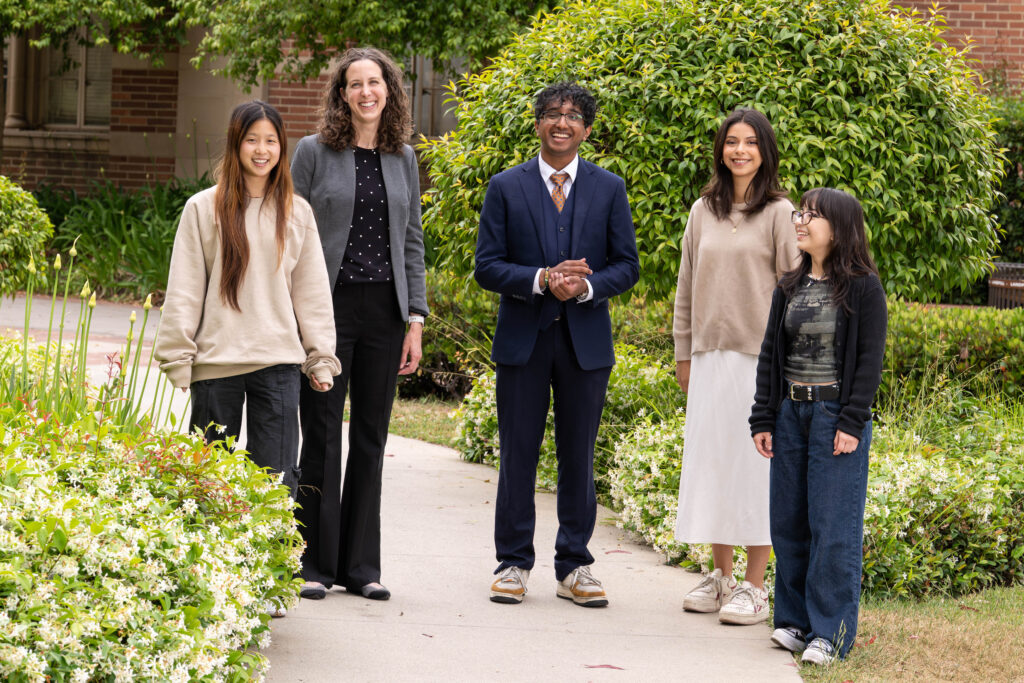
Sophia Zhao (left) with Professor Whitney Arnold and (Re)Defining Health members Raymond Kallely, Yalit Gonzalez Hernandez and Emily Sagastume.
| September 2, 2025
Sophia Zhao graduated from UCLA in June with a degree in neuroscience and a minor in comparative literature.
I stumbled upon the class “Medical Humanities in Comparative Contexts: Health and Illness,” taught by Professor Whitney Arnold, in my sophomore year at UCLA.
As a student aspiring to enter the medical field, my understanding of medicine up to that point was rooted primarily in biology and clinical practice; I hadn’t considered how stories, identity and social context shape patient care.
The medical narrative is invaluable in the way that it empowers the teller, educates the reader and fosters thoughtful conversation. There’s a subtle yet transformative power in reading such stories: they help us empathize and learn without even realizing it. Professor Arnold’s course — including its curated reading list, excerpted below — allowed me to develop a foundation for the type of care I hope to provide.
When class was over, my peers and I were hungry for a community invested in this work. With Professor Arnold’s support, students Tabitha Hiyane, Kai Nikchevich, Emily Sagatsume and I created the UCLA student organization (Re)Defining Health — so named because we aimed to gather students with similar passions and “redefine” our own perspectives upon drawing on outside views.
Since everyone is first a student before they are a professional, developing a strong foundation in health humanities during undergraduate studies can shape more empathetic practitioners, who in turn can contribute to a more human-centered health care system. The study of health humanities merits greater emphasis, and by providing a space for reading and conversation every week, (Re)Defining Health hopes to bolster efforts to expand this field at UCLA.
Narrative foundation: Sophia Zhao’s impressions of selected readings from the Health and Illness course
“Frankenstein,” Mary Shelley
Reading this classic work through a health humanities lens expanded my understanding by illustrating that health and illness are often defined by context and perception.
“The Spirit Catches You and You Fall Down,” Anne Fadiman
In this work, I saw reflections of my own experiences, particularly in how cultural differences can become significant barriers to receiving appropriate care.
“The Wounded Storyteller,” by Arthur Frank
This core reading helped me appreciate how narrative can be a powerful tool for self-reconciliation and healing.
This article appeared in the 2025 UCLA College Magazine, “State of Mind.” Read the full issue here.