
2 Humanities Ph.D. candidates chosen to develop, teach undergrad seminars
Ryan Schaller, Suong Thai selected for UCLA Collegium of University Teaching Fellows program
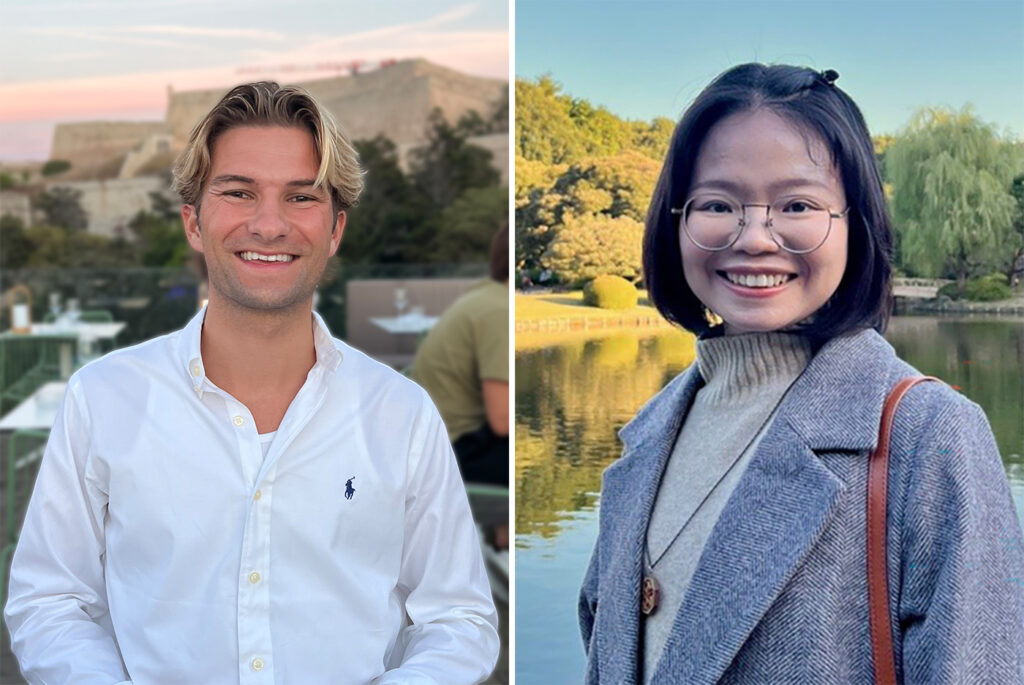
Courtesy of Ryan Schaller; Courtesy of Suong Thai
Ryan Schaller (left) will teach about the cultural and political impact of colonial-era imagery on the francophone world; Suong Thai’s seminar will consider film and literature as a lens for understanding the aftermath of the Vietnam War.
| February 13, 2026
Adapted from an article published by the UCLA Teaching & Learning Center. Read the full story here.
As an undergraduate at the University of Michigan, Ryan Schaller wrote an honors thesis on literary narratives by second-generation Maghrebi immigrants in France and Spain. Now that he’s a UCLA doctoral candidate in the Department of European Languages and Transcultural Studies, that experience continues to inform his scholarship.
“Though my project has changed considerably since then, I do see thematic connections between my undergraduate research and my dissertation on the impact of colonialism on contemporary culture and society, the movement of people and cultural objects across borders, and more,” said Schaller, whose focus is French and Francophone studies.
Schaller is one of six advanced doctoral students selected to design and teach a research-based undergraduate course this spring through the Collegium of University Teaching Fellows. The program, administered by the UCLA Teaching and Learning Center, gives undergraduates hands-on experience in their academic disciplines while also preparing graduate students for future teaching careers.
Schaller’s course, “Old Photos, New Stories: Empire and the Afterlives of Images” will invite students to examine works of fiction, film and photography to consider the cultural and political impact of colonial-era imagery on the francophone world. They will choose between completing an analytical research paper or a photography-inspired creative project.
“Regardless of whether or not students wish to pursue research beyond their undergraduate program, course-based research opportunities allow students to take ownership of the material they learn about in class,” Schaller said. “This may give them a chance to personalize their studies in ways not typically offered in other GE courses.”
Schaller was one of two teaching fellows selected from the Humanities Division. Also a part of the 2026 cohort is Suong Thai, a doctoral candidate in the Department of Asian Languages and Cultures.
Thai’s seminar, “Vietnam War and Popular Culture in Transpacific Relations,” will focus on film and literature as a vehicle for viewing the multilayered nature of that devastating war. The course aims to encourage students to approach and evaluate a subject from multiple perspectives, and advance their ability to analyze cultural works with historical sensitivity and ethical responsibility.
Thai said the course topic draws from that of her own dissertation, which looks at war, empire and memory in Japanese postwar and Vietnamese refugee literatures.
“I was also inspired by a course taught by my advisor, Professor Thu-Huong Nguyen-Vo, on the representation of the Vietnam War in popular culture,” she said. “I was a TA for this course twice and always wished to have a chance to adopt and expand parts of its content and methodology for my own course.”
For Thai, the opportunity to burnish her teaching skills by leading a course of her own is a significant one. But she said she also appreciates the chance to exchange insights and ideas with her peers.
“Participating in the collegium gives me the chance to communicate with and learn from other junior professionals whose diverse backgrounds and concerns enrich my otherwise limited exposure to pedagogy discussions.”