
A Russian language class project takes center stage during L.A. theater festival
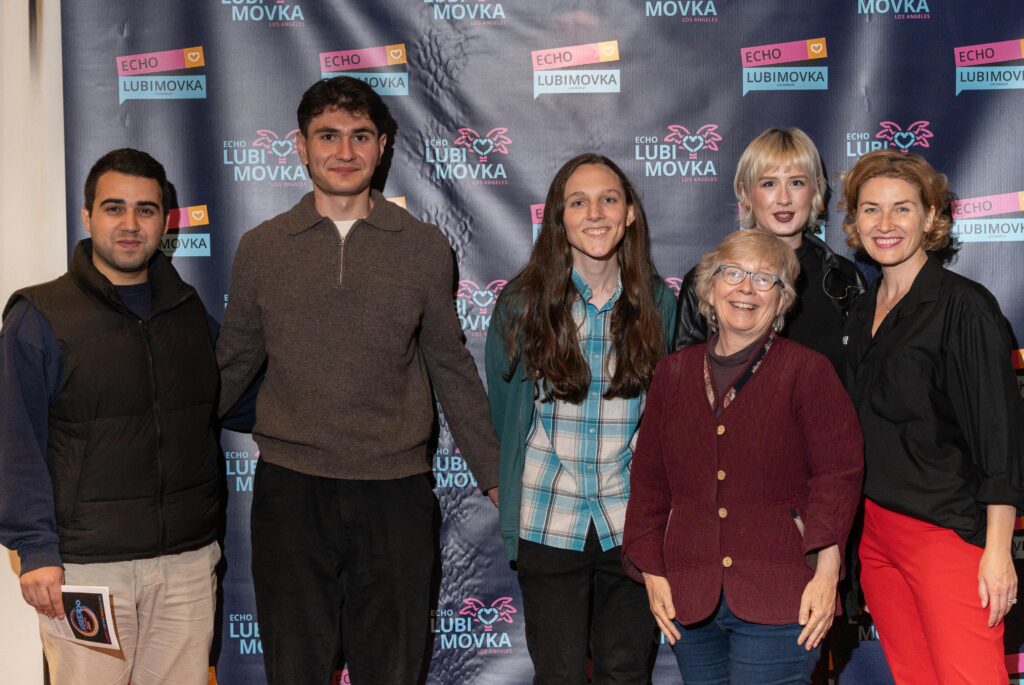
Courtesy of Elena Mercuri
UCLA students (back row, from left) Benyamin Fallahi Motlagh, Mathias Kuchimpos, Chris Carver Miller and Viola Perkins with theater producer Elena Mercuri (right), and UCLA senior lecturer Susan Kresin (front).
| November 13, 2025
The closing performance at a Russian language theater festival last weekend had a special UCLA Humanities connection.
During the reading of “Stars in a Black Hole” by the Russian-born playwright Nika Velt, actors performed their parts in Russian while English supertitles were projected on a screen behind them. That English translation had been prepared by UCLA undergraduates and graduate students taking a Russian language class led by senior lecturer Susan Kresin.
The performance was part of the Echo Lubimovka independent festival of Russian-speaking drama, Nov. 7 and 8 at the Odyssey theater in West Los Angeles.
The opportunity came about because just before the start of the fall quarter, the play’s producer, Elena Mercuri, reached out to the UCLA Department of Slavic and Eastern European Languages and Cultures seeking a scholar — or scholars — who could produce a translation on a tight schedule. Kresin saw it as a perfect teaching and learning opportunity for her students and they got to work on the translation.
For students, the project provided new insights into nuances of Russian language and differences between formal and colloquial speech.
“In my past translations, I defaulted to a more literal Russian-to-English translation to prove my knowledge of the language,” said Viola Perkins, a fourth-year undergraduate majoring in Russian studies and European studies. “But through this experience, I learned that a better translation conveys the intent of the statement as well. I was forced to think more creatively about how certain idioms or colloquial phrases should be conveyed.”
Beyond that, students said the work provided valuable perspectives on Russian culture and history.
“Translating the play surprisingly relied on a lot of historical and social context,” said Lilly Wellons, a third-year political science major who is minoring in Russian language. “For many of us — non-heritage speakers — understanding the subtleties of certain phrases and terms was quite challenging. The process gave our class a unique opportunity to dive deep into post-Soviet Russia and really understand the nuances needed to translate the play into natural, casual English speech.”
As part of the process, Mercuri visted the class twice — once to answer questions about the work and another time to watch the students perform a staged reading. (Because the latter class took place on Halloween, Mecruri even brought Russian treats for the students.)
Students also met with Welt, who now lives in France, over Zoom to ask her about the play.
A handful of the students also took advantage of the opportunity to see their work come to life at the performance on Nov. 8.
“It was amazing being able to see to see the result of our efforts in person,” said Mathias Kuchimpos, a third-year cognitive science major. “Talking to all the other attendees was great, and it really motivated me to get more involved in the Russian-speaking community.”