
‘We don’t have to leave our communities behind when we enter academic spaces’
Through a Mellon Mays Undergraduate Fellowship, Nat Escobedo dove into the Inland Empire art community
Sean Brenner/UCLA Humanities
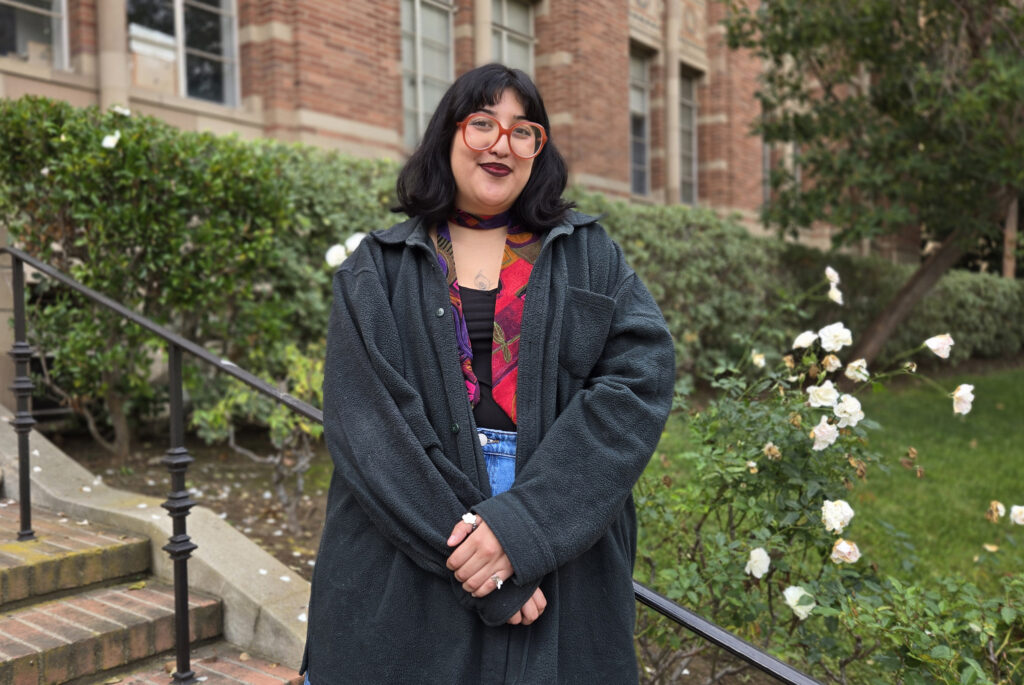
Nat Escobedo’s research tells an important but overlooked story about the Inland Empire art community.
| November 20, 2025
During their first year at Riverside City College, Nat Escobedo worked at the nearby Cheech Marin Center for Chicano Art and Culture, welcoming visitors and guiding them through the collections.
Three years later, Escobedo is a UCLA undergraduate pursuing a sophisticated research project that honors her experience in the Inland Empire’s art community.
When they arrived at UCLA in 2024, Escobedo did not intend to pursue independent research. But during their first days on campus, they overheard a fellow student talking about research as a hallmark of the Bruin experience.
“They said, ‘If you’re going to be at UCLA and you’re not going to do research, it’s like going to a steakhouse and eating a salad,’” said Escobedo, who is on track to graduate in spring 2026 with degrees in art history and Chicana and Chicano studies.
Although she heard that comment only in passing, Escobedo had an epiphany. She remembered that during her time at “The Cheech,” she had read exhibition catalog articles written by Charlene Villaseñor Black, who through early 2025 was a UCLA professor of art history and Chicana and Chicano studies. Now that she was at UCLA, Escobedo emailed Villaseñor Black to ask if she could meet and discuss research opportunities.
“We sat down and had a conversation about both myself and the research, and she was incredibly helpful,” Escobedo said. “It’s so important to have a faculty mentor willing to build community with you.”
Their conversation led Escobedo, who uses she/they pronouns, to apply for the Mellon Mays Undergraduate Fellowship, which funds two-year research projects in the humanities and social sciences for students interested in pursuing careers in academia.
How art strengthens community
Escobedo’s project investigates how some Inland Empire artists reject incentives to leverage their creative output primarily for individual and financial gain. Instead, Escobedo has found, the artists she is studying are motivated by the opportunity to document and share the stories of the Inland Empire’s working class.
In her paper, Escobedo will argue that these artists’ work strengthens their community in the face of challenges like pollution, dangerous working conditions and low wages.
Villaseñor Black, who is now the Loevner Fellow and Tutor in History of Art at Worcester College of Oxford University, has continued to advise Escobedo on the project. She said the research tells an important but overlooked story.
“There are incredible artists and organizations in the Inland Empire who are making a difference in people’s lives, but they have not been well-studied,” Villaseñor Black said. “Nat’s research promises to change all of that.”
For instance, Escobedo is writing about an artist named Toni Sanchez, whose art expresses the anger that some Inland Empire residents feel toward corporations that contribute to pollution in the region, or that have driven out small businesses. One of Sanchez’s works is a triptych that depicts an Amazon warehouse in flames with the words “Burn them all down” sketched above it.
“All of this oppression is very visible, yet how people have responded and reacted to it is not,” Escobedo said. “Through this art piece, she is giving this resistance the chance to be seen.”
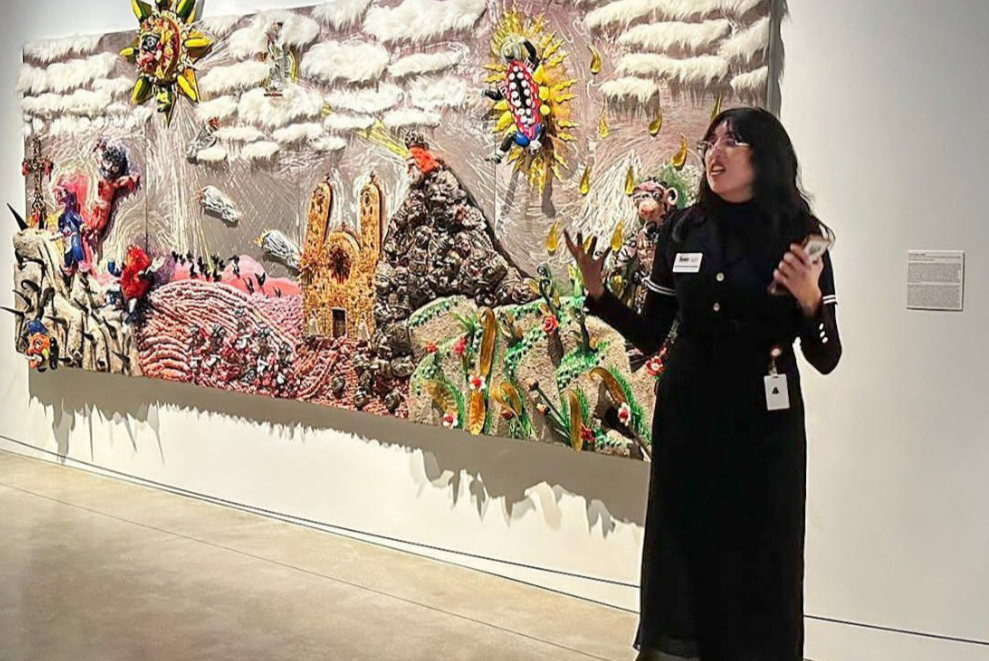
Escobedo leading a tour at the Cheech Marin Center for Chicano Art and Culture in 2022.
But Escobedo also contends that the artists she is studying do more than just amplify the community’s grievances. She has found that their work helps build community; the museums and galleries that display their work become backdrops for poetry readings, artist pop-ups,and other neighborhood activities.
“A lot of these spaces take on a bunch of different roles with art at the center of it,” Escobedo said. “They’re art galleries, but they also do all of these other things.”
An immersive experience
Throughout her project, Escobedo has maintained her connections to the community she writes about. She has joined protests, political reading groups and fundraisers; she even shared her research stipend with the three artists she is writing about.
“What is most unique about Nat’s approach to research is her absolute commitment to her community in the Inland Empire,” Villaseñor Black said. “She is a brilliant young scholar, without a doubt, but her commitment to giving back to her community is unusual in academe.”
Escobedo’s work is already inspiring other young scholars and creators. After Escobedo spoke about her project at a UC Riverside conference in May 2025, a Riverside student approached them to compliment the presentation. The student said Escobedo’s presentation had renewed her own motivation to create and share her art.
“I heard from a lot of people at the conference, ‘This type of research is exactly what we need in art history,’” Escobedo said. “It’s all a reminder that we don’t have to leave our communities behind when we enter academic spaces.”
Escobedo, who plans to present their work at Undergraduate Research Week in the spring, said the project has been a fitting encapsulation of their past few years. “It feels like a love letter to all the experiences I’ve had,” they said.
Although it was only a passing comment that sparked Escobedo’s research journey, she is now in the thick of graduate school applications, with an eye on programs in ethnic studies, art history or American studies. Whatever field they choose, Escobedo’s goal is to ultimately teach at a community college and carry forward the spirit of discovery that defined her time as a Bruin and as a Mellon Mays fellow.