
Artistry of ancient Greece on display at Getty Villa – and in 3 campus events this fall
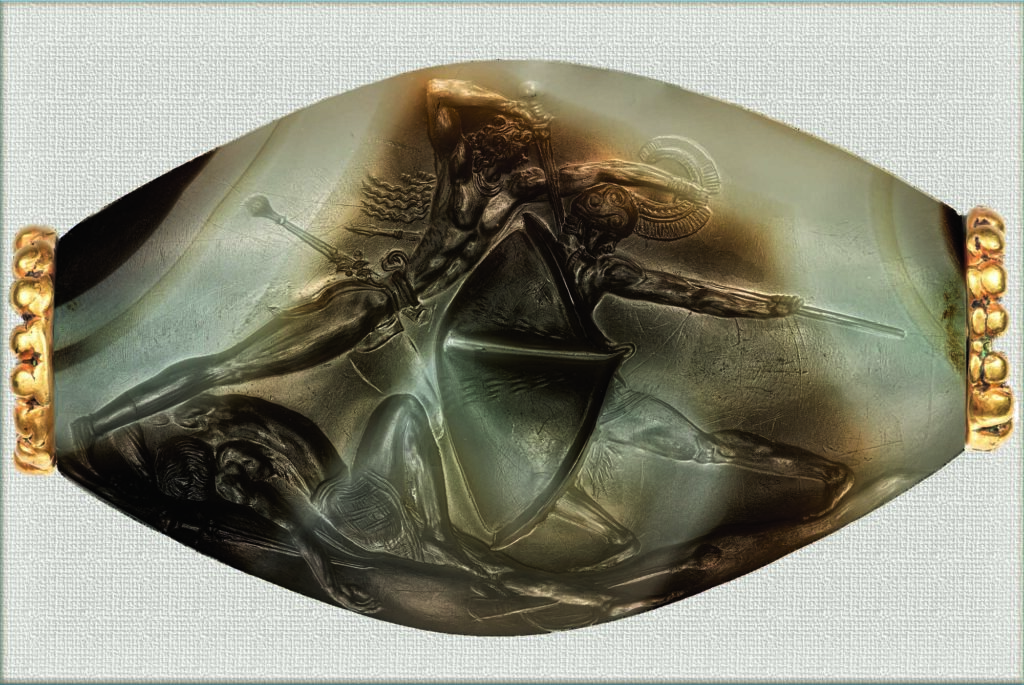
Jeff Vanderpool/University of Cincinnati Department of Classics/Hellenic Ministry of Culture
“Sealstone with a Battle Scene (The Pylos Combat Agate),” which dates to the middle of the second millennium B.C., is one of the many pieces on display showing off artists’ ability to work in miniature.
| October 13, 2025
An exhibition currently on display at the Getty Villa reflects the keen artistic skills of the Mycenaean and Minoan civilizations of ancient Greece.
“The Kingdom of Pylos: Warrior-Princes of Mycenaean Greece” presents dozens of artifacts ranging from small, engraved gemstones to finely crafted gold and silver crowns, dating back to the Late Bronze Age, in the latter half of the second millennium B.C. Many of the items on display were excavated by archaeologists in 2015 from the previously untouched tomb of a man nicknamed the “Griffin Warrior.”
The tomb is located in Pylos, a town in the Messenia region of southern Greece. Although not much else is known about the Griffin Warrior, the accoutrements from his tomb, which dates to around 1450 B.C., suggest he may have had a lavish lifestyle. Those and other artifacts in the exhibition provide a small glimpse of traditional Mycenaean and Minoan life — portraits of women in skirts striding with flowers in hand, and ivory combs displayed in conjunction with cosmetic boxes and ear picks.
With few clues about the social standing of the artists who created these objects, or the societal values they reflect, scholars have turned to studying the artistry itself. David Schneller, a UCLA art history professor whose specialties include ancient Greece, said the detail in the work of the Mycenaeans and Minoans reveals their dedication to working across different materials, sizes and colors.
“Regardless of who they were in terms of gender identity or social class, we can say a lot about their ability to work in miniature,” he said. “Some of their techniques are still unknown to us, but it would have taken extraordinary skill to work with materials that are both local to Messenia and materials like gold and semiprecious stones from far-flung places — and at such small scale.”
Bringing ancient Greece to campus
In the coming months, Bruins will have three opportunities to learn more about the civilizations that created the artifacts on display — and to see firsthand the techniques the artists used.
On Nov. 15, the UCLA Stavros Niarchos Foundation Center for the Study of Hellenic Culture will host a lecture on the craft technologies. The 2 p.m. talk in Royce Hall 314 will be followed by a live demonstration by Akis Goumas, a jewelry maker from Greece, who will recreate the processes of Mycenaean gold-working and Minoan seal-engraving.
“It’s rare to have someone so specialized in their craft come across the world and share their expertise with us,” said Schneller, who is teaching a course this quarter on art from the second millennium B.C. “When we have practitioners come in to be a bridge between our world and the ancient world, that’s when new ideas come to the fore.”

UCLA professor David Schneller, who is teaching a course this quarter on art from the second millennium B.C., said artifacts in the Getty exhibition reflect extraordinary skill, even though scholars don’t fully understand the artists’ techniques.
Schneller said the demonstration will not only demystify the technical processes by which these artifacts were made, but it will also illuminate a link between ancient artistry and the craft of contemporary family heirlooms and jewelry.
“There are so many connections to our world that we don’t even think about,” he said, noting that some of the objects on display in the Getty exhibition may have been heirlooms themselves.
The SNF Center will host two other related events this fall, both in Royce Hall 314: a lecture on Pylos and Minoan Crete by Andreas Vlachopoulos of the University of Ioannina on Nov. 22; and a symposium on art and archaeology in the second millennium B.C. on Dec. 6 showcasing recent research by UCLA graduate students and scholars from across North America.
The on-campus events were conceived and planned by Schneller and Sharon Gerstel, who holds UCLA’s George P. Kolovos Family Centennial Term Chair in Hellenic Studies and is director of the SNF Center, along with Claire Lyons, curator of antiquities at the J. Paul Getty Museum.
‘They are magical’
Schneller said the works on display at the Getty are also noteworthy because of how they draw inspiration from the creative traditions of other civilizations. One blue glass pendant, for example, is thought to have been created in Mesopotamia, in modern-day Iraq, before it was brought to Greece. (It was discovered not in Pylos, but in a tomb in Daras.) The pendant’s luminous patterns are clearly visible in the gold pendants featured in other parts of the exhibition.
“We look at these objects and they are magical to us,” Schneller said. “How were they made? What did they mean to the people who made and wore them? What was the significance of the luminous quality of blue glass and gold?”
Among other highlights of the exhibition are a rhyton, a vessel used for pouring liquid offerings during ceremonies or rituals; and warriors’ helmets made of boar’s tusk, which honored fighters of great skill and prestige.
“The Kingdom of Pylos” exhibition at the Getty Villa runs through Jan. 12, 2026. Admission is free but reservations are required. Admission to the UCLA campus events is also free, but registration is required. RSVP here for the Nov. 15 event, here for the Nov. 22 lecture, and here for the Dec. 6 symposium. The on-campus events are sponsored by the Division of Humanities.