
Indigenous people are partners in this cultural conservation research
Study led by art history professor Thiago Puglieri incorporates meaningful input from Amazon region’s Tikuna community
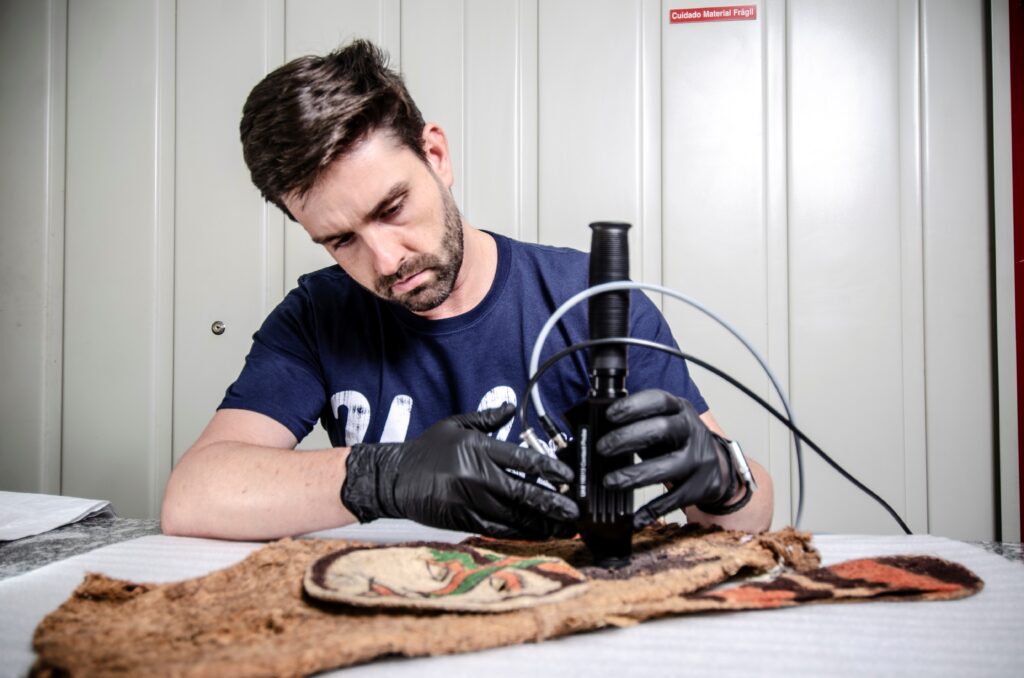
Ader Gotardo
Thiago Puglieri, a UCLA art history professor, analyzes a mask from the Museum of Archaeology and Ethnology from the University of São Paulo.
| December 5, 2025
Leia este artigo em português.
A new study by scholars from UCLA, the Los Angeles County Museum of Art and the University of São Paulo not only sheds light on a unique blue pigment from the Amazon but also took the highly unusual step of including Indigenous people in every step of a research project on their own cultural and artistic practices.
The paper, published in the journal Studies in Conservation, centers on “Tikuna blue,” a unique colorant created by the Tikuna people, who live near the borders of Brazil, Peru and Colombia. It also calls on museums and conservation scholars to rethink what materials they study and value, and to build research programs that credit Indigenous creators as collaborators, not subjects.
The study’s lead author is Thiago Puglieri, a UCLA professor of art history and a member of the UCLA/Getty Interdepartmental Program in the Conservation of Cultural Heritage.
Tikuna blue is produced by mixing the purple juice of a fruit called naīcü with iron, a recipe that has been passed down through generations but never scientifically investigated until now. Although Puglieri works in art history, his academic training was in chemistry, and the new paper includes a scientific analysis of Tikuna blue — its chemical composition, color properties and colorfastness (meaning its resistance to changing color over time when exposed to light).
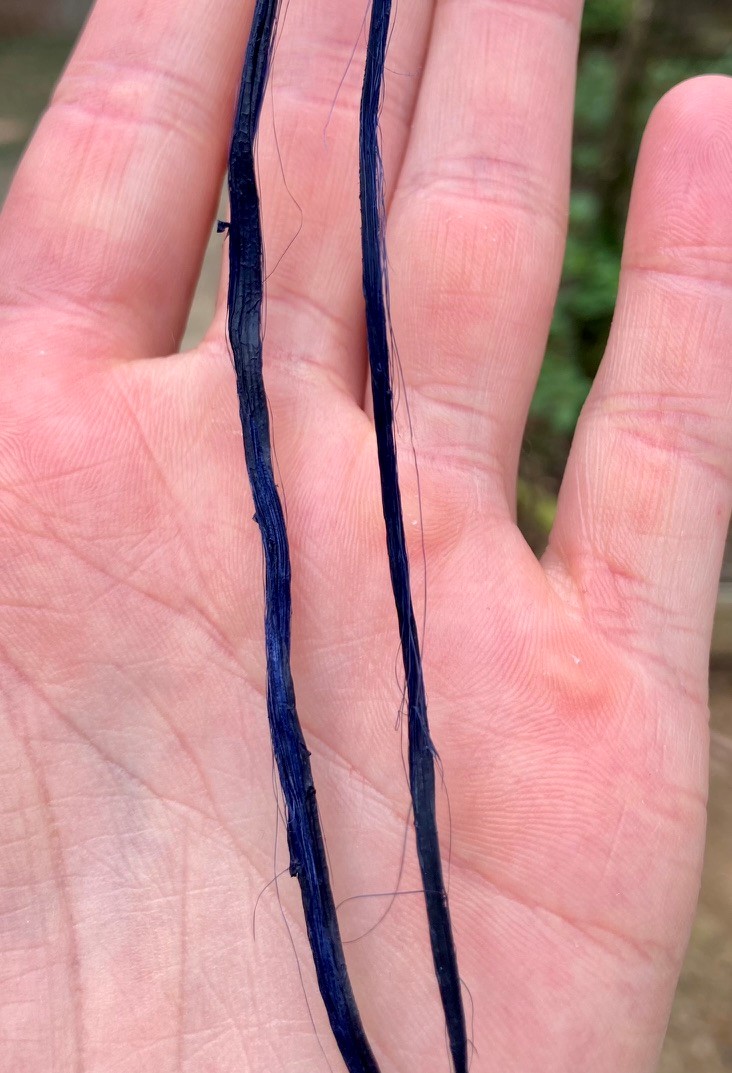
A thread dyed with Tikuna blue.
Unlike the traditional model in which academics study a culture or cultural practices at arm’s length, Puglieri and his colleagues relied heavily on input from the community they were writing about. The approach, known as community-based participatory research, is commonly used in fields like public health and social sciences but is still rare in technical art history and conservation science.
The name Tikuna blue was suggested by three Tikuna women’s artisan associations: Associação das Mulheres Indígenas Artesãs, or AMATU; Associação das Mulheres Indígenas Ticuna, or AMIT; and Associação das Mulheres Indígenas de Porto Cordeirinho, or AMIPC. In addition, community members worked with the scientists to prepare lab samples and organize a 200-person workshop on intercultural education — teaching approaches that draw from both Indigenous culture and contemporary Western practices.
And they continue to collaborate, developing materials for intercultural chemistry classes designed for Tikuna schools.
Living heritage
Puglieri said a critical principle of the work is that it treats Tikuna blue as a living part of the community’s heritage rather than just a chemical substance, and that the research team is focused on “the collaborative transmission and preservation of traditional knowledge.”
“Traditionally, as researchers, we have our own questions, our own hypotheses,” he said. “We define the methods and we collect and determine how to use the data. In community-based participatory research, we work with the communities’ needs.
“Community members have a key role in raising questions, defining hypotheses, choosing methods and deciding how to use the data. Everybody works together to define which strategies would work best.”
As a chemist, Puglieri said, he had always aspired to work more closely with communities, but the practice is extremely rare in the physical sciences. His research approach began to shift around 2016, once he began collaborating with colleagues in museum studies.
“Some of the main goals of science are to enhance humans’ well-being, dignity and capacity to live sustainably and meaningfully,” he said. “So working closely with communities is essential.”
Correcting long-standing biases
The study is part of a burgeoning movement that aims to bring a fairer balance to conservation science and art history. Those fields have long prioritized materials valued by Western museums, such as European oil paints and ancient Mediterranean pigments, while neglecting those used by Indigenous peoples. According to Puglieri, that imbalance isn’t just an oversight; it reflects longstanding colonial attitudes and practices that for centuries have defined whose art was deemed worthy of study.
By working with the Tikuna community, the authors are taking one step toward reversing that dynamic and bringing a different ethical framework to research in their fields. In a prepared statement, three of the Tikuna collaborators wrote that the participatory research approach helps acknowledge and protect core cultural knowledge.
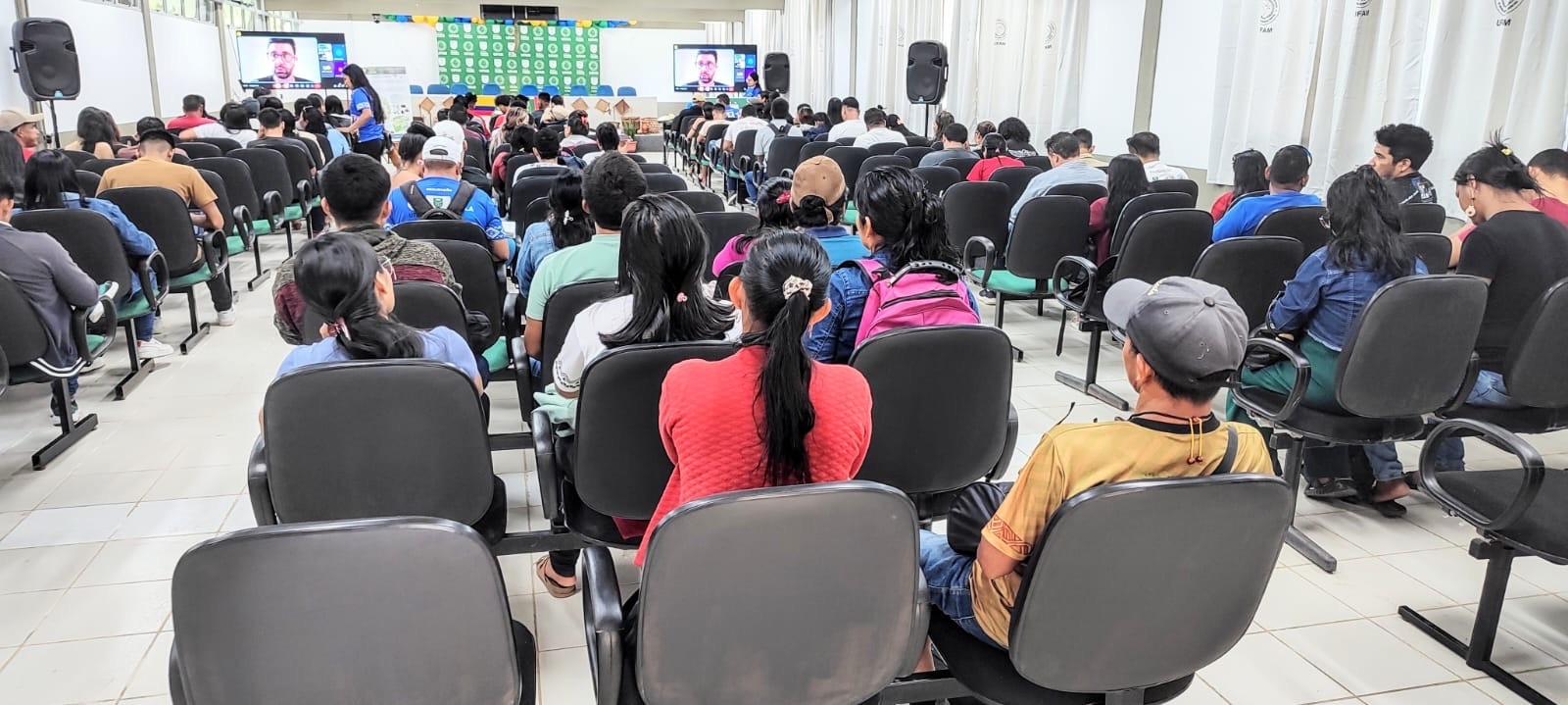
As key element of the project was an intercultural education workshop organized by Puglieri and collaborators from the Brazilian Amazon.
“Participating in a project like this gives the Tikuna culture and the Tikuna identity more visibility,” wrote Elizabeth Peres de Souza and Dayanny Peres de Souza, both of AMATU, and Salomão Inácio Clemente. “The project gave Tikuna artisans the opportunity to make decisions in strengthening the female voice in the practice of making paint in a traditional, ancestral way. This demonstrates respect for our culture on the part of Professor Puglieri.”
As for the chemistry of Tikuna blue, the researchers report that the colorant is a fragile but complex mixture of plant pigments, natural pectin and iron ions — chemically similar to the structures that make flowers blue.
The paper’s other authors are Rômulo Augusto Ando and Adalberto Vasconcelos Sanches de Araújo of the Institute of Chemistry at the University of São Paulo, and Laura Maccarelli of the Los Angeles County Museum of Art. Brazil’s Magüta Museum facilitated connections between researchers and community members (Magüta is another name for the Tikuna) and made items from its collection available to the researchers for analysis. The Institute of Nature and Culture at Federal University of Amazonas’ Benjamin Constant campus also provided support for the project.
“Reevaluating Western canonical values and practices that typically guide materials analysis in technical art history and conservation science is crucial for helping to foster a more global and inclusive vision of art history and to enhance the social impact of heritage science research,” the authors wrote in the paper. “It means decolonizing these fields and shifting Indigenous material culture and people — along with many other forms of arts, cultures, and people — from the margins to the center.”
Related: Thiago Puglieri explores nature’s most precious color