
4 Humanities faculty among winners of inaugural UCLA global grants
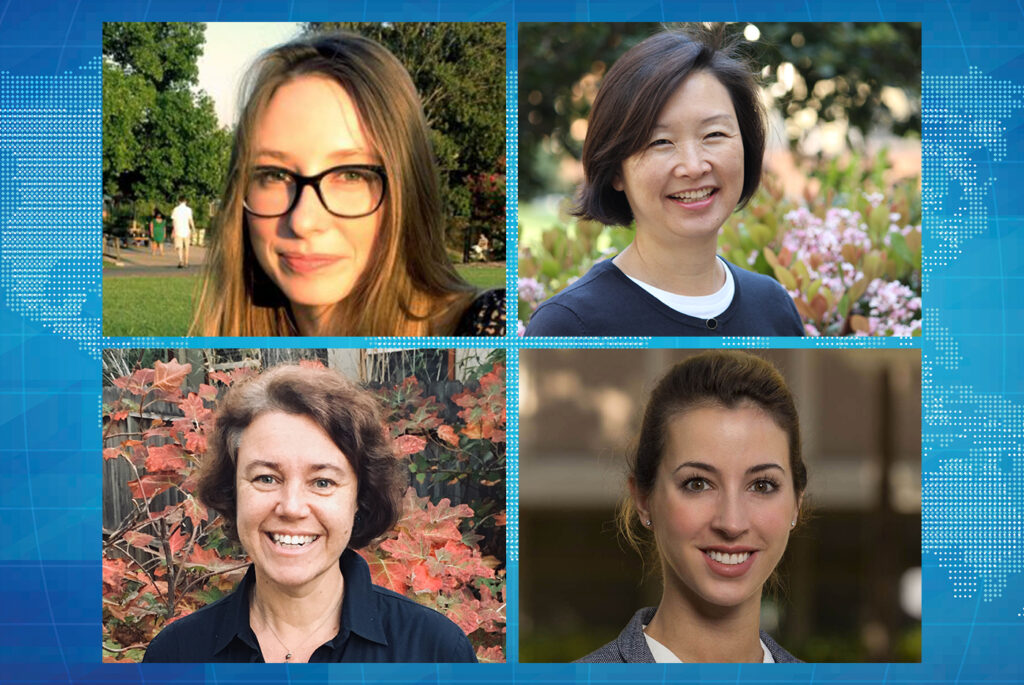
Peggy McInerny/UCLA (Jung-Kim); Reed Hutchinson/UCLA (Mateu); Courtesy of Bosch Santana and Fuchs; iStock.com/ksana-gribakina (map)
Stephanie Bosch Santana and Jennifer Jung-Kim (top row, from left) received global education grants, while Barbara Fuchs and Victoria Mateu (bottom row, from left) received research grants.
| December 3, 2025
Four Humanities Division professors are among the first recipients of new UCLA grants intended to strengthen the campus’s international standing and impact.
Stephanie Bosch Santana, professor of comparative literature, and Jennifer Jung-Kim, lecturer in Asian languages and cultures and the UCLA International Institute, both received Global Education Awards for Internationalizing Curriculum, which support faculty or departments aiming to internationalize their curricula. The education awards confer grants ranging from $5,000 to $20,000.
Barbara Fuchs, professor of Spanish and Portuguese, and of English; and Victoria Mateu, professor of Spanish and Portuguese, and of linguistics; each received a Global Research Award, which is meant to advance globally engaged research and contribute to inclusive excellence. The research awards include seed grants of up to $20,000 and global research grants of up to $50,000.
Both grant programs were introduced this year in support of the goal of expanding UCLA’s global reach, one of the pillars of the campus’s 2023–28 strategic plan. In all, 26 grant recipients were chosen by the UCLA Global Advisors Council. Read summaries of all of the inaugural winners’ projects on the UCLA Global website.
A closer look at the honorees from the Humanities Division:
Global Education Awards
Stephanie Bosch Santana
Comparative Literature
Project: Literature and Global Public Health
Bosch Santana will develop a course called “Literature and Global Public Health” that will align with the comparative literature department’s new minor in health humanities. The course will investigate the intersections between global public health initiatives and literary production.
As part of their public outreach, nongovernmental organizations produce materials to educate the public on topics such as disease prevention, family planning and the importance of regular checkups. It is not uncommon for these materials to take the form of fiction, in part as a means to make them more appealing and entertaining. In the new course, students will consider the kinds of narratives that are produced to support global public health initiatives. What forms do they take? What kinds of characters and languages do they feature? How often are they translated into local languages? And, crucially, what impact do they have both on the public health initiatives they are meant to support as well as on literary production more broadly?
Jennifer Jung-Kim
Asian Languages and Cultures
Project: Revision of Asian Digital Humanities Course
Jung-Kim’s grant will support the hiring of a graduate student researcher to help revise the “Topics in Asian Digital Humanities” course for winter 2026. The course’s new focus will be how digital technology has been used to expand Korea’s soft power and promote “K-cultures,” such as K-pop and K-dramas, around the world, including in Southeast Asia and Latin America.
The class will also explore how fans propagate Korean popular culture by forming parasocial and IRL (or “in real life”) relationships with idols and other fans through social media, fan-created content and “stan” culture.
Global Research Awards
Barbara Fuchs
Spanish and Portuguese, English
Project: Clásicos Americanos: Connecting Hispanic Theater across the Hemisphere
Under Fuchs’ direction, UCLA’s Diversifying the Classics will partner with Karina Galperín of the Universidad Torcuato di Tella in Argentina and Gabriela Villanueva of the Universidad Nacional Autónoma de México to explore how Hispanic classical theater has been received across Latin America, in different periods and under specific local conditions. Through collaborations with Argentine theatermakers, the collaborators will delve into the ways these histories shape contemporary adaptations of comedia and new dramaturgies. The project will commission new productions, convene scholars for symposia at each institution and result in a comparative edited volume.
Victoria Mateu
Spanish and Portuguese, Linguistics
Project: Spanish Language Acquisition in Children: A Transnational Research Collaboration
Children have the right to use their own language, but most of what we know about language development is based on monolingual English-learning children. Through a partnership with Universidad Nacional Autónoma de México, Mateu will investigate Spanish language acquisition.
Although Spanish is the second most-spoken language worldwide — and in the U.S. — scholars know little about how children learn the language. Likewise, although there are more bilinguals in the world than monolinguals, bilingual development remains poorly understood. Through this collaboration, the researchers will address critical gaps in how monolingual and bilingual children learn Spanish.