
Doctoral student Charles Rhodes gives Geffen Academy classes an inside look at Egyptology
Sean Brenner/UCLA Humanities
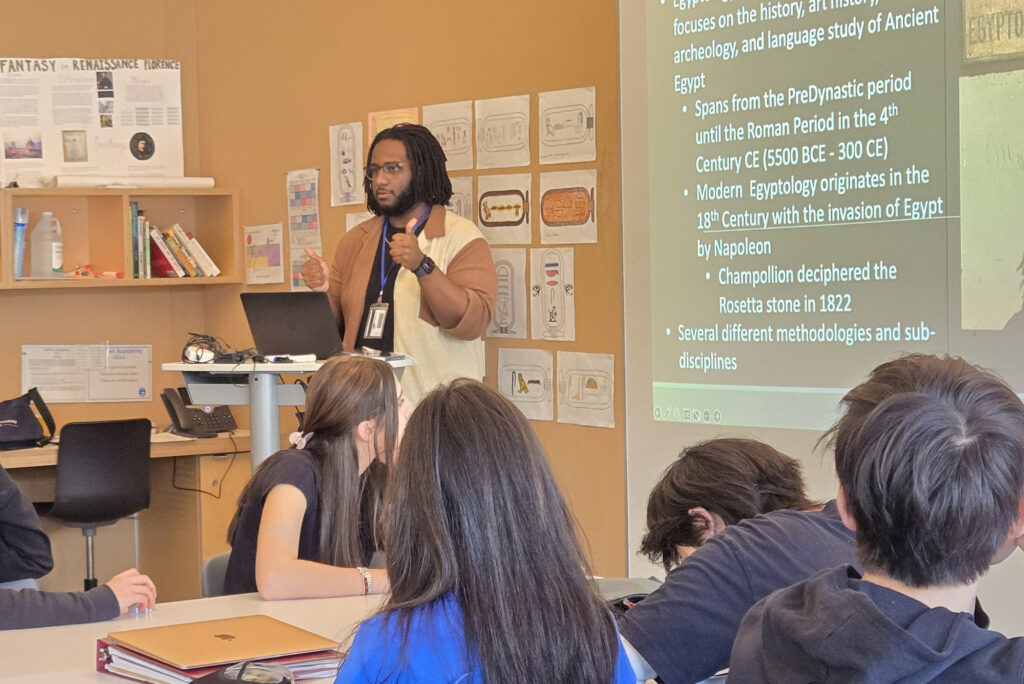
Charles Rhodes told Geffen Academy students that in addition to studying ancient texts, he has also developed 3D reconstructions of ancient landscapes and worked in museum archives. Behind him are hieroglyphics drawn by some of the students.
| February 26, 2026
Charles Rhodes didn’t discover Egyptology until his junior year of college.
But on Feb. 24, Rhodes — now a fourth-year UCLA doctoral student in Near Eastern Languages and Cultures — gave UCLA Geffen Academy ninth-graders a major head start on their exposure to the field.
Speaking to two classes taught by Johanna Day and Adam Morgenstern, Rhodes said his own path to Egyptology and Nubian studies began when he was a history major at Missouri State University. A single course on the ancient Near East fired his imagination, and with the encouragement of an MSU faculty member, Rhodes shifted his focus and went on to earn a master’s degree in Egyptology. He began his doctorate at UCLA in 2022.
Rhodes emphasized that his field is a highly multidisciplinary one, drawing on history, archaeology, art history and language study — and that it continues to evolve, with scholars incorporating expertise from ecology and geology to expand their understanding of ancient Egypt.
“There are people who you can call Egyptologists who don’t specialize in reading hieroglyphs,” he said.
In truth, Rhodes’ audiences weren’t entirely new to Egyptology before Rhodes’ visit. They have been studying the ancient Egyptian city of Thebes this semester as part of a “literary cities” class. And in January, at the invitation of Solange Ashby, a UCLA professor of Egyptology, several of them attended World Languages Day, where they learned how to write their names in hieroglyphics.
While Rhodes’ own scholarly focus tends toward textual study rather than archaeology, he told students that he also has worked in museum archives, analyzed excavation notes and used digital humanities tools to reconstruct ancient landscapes in 3D, including a temple complex at Kawa in present-day Sudan.
Rhodes’ morning talk prompted an array of thoughtful questions from the class. One of his presentation slides listed the chronology of rulers during the Napatan and Meroitic dynasties in the Kingdom of Kush, from about 785 B.C. to the third century A.D. One student asked why the list didn’t include dates for the reigns of several Meroitic rulers.
Rhodes explained that while the Egyptian language was favored during the Napatan period — meaning records from the time are easier to understand — during the later Meroitic dynasty, rulers used Meroitic, which remains difficult to decipher. As a result, less is known about when Meroitic kings’ and queens’ reigns began and ended.
But Rhodes might be a part of solving that issue. He’s part of a UCLA graduate seminar focused on better understanding Meroitic grammar.
UCLA at Geffen Academy Day is Feb. 27. Idan Blank (Linguistics and Psychology) and Tara Prescott-Johnson (Writing Programs) are among the UCLA faculty and staff leading workshops and seminars for Geffen Academy students in the annual event.