
Refocusing the narrative around a larger-than-life literary figure
Senior Brinn Wallin says her research on Sylvia Plath is ‘the most prized part of my years as an undergraduate’
Randall Tobias
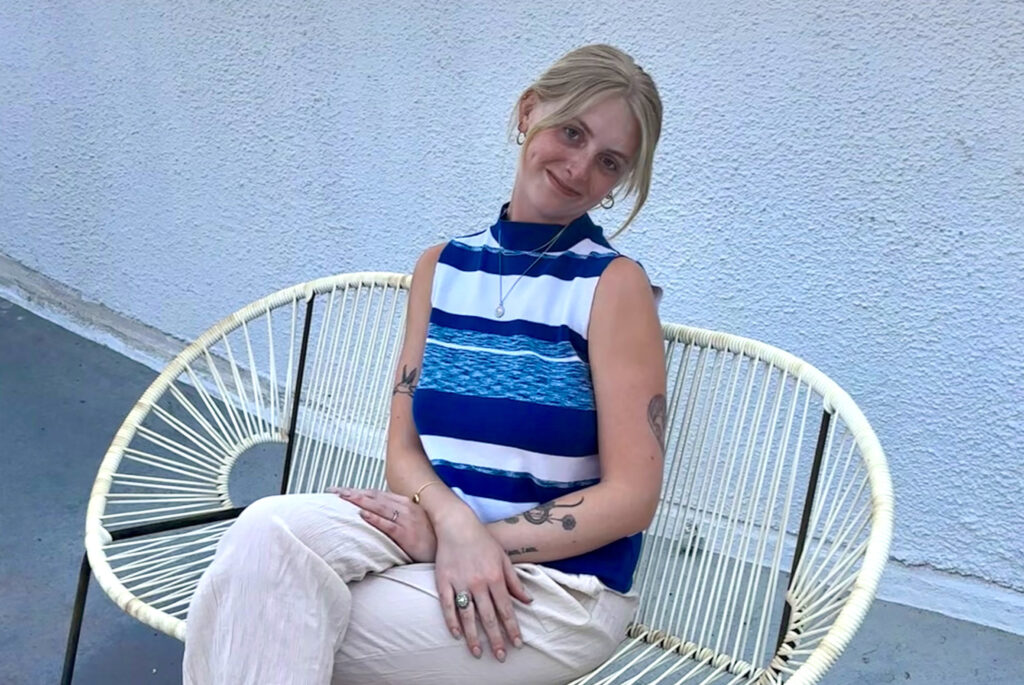
Brinn Wallin said one rewarding aspect of her research is the opportunity to build off of the work of other scholars while discovering her own unique place in the field.
| November 12, 2025
English major Brinn Wallin is in the midst of a research project that aims to shift the conversation around the 20th century author and poet Sylvia Plath — directing more attention to her life and legacy and not just her much-analyzed death.
Wallin, a transfer student on track to graduate in 2026, undertook the project with the support of the UCLA/Keck Humanistic Inquiry Undergraduate Research Awards program. Her paper is called “The Enduring Phantom of Sylvia Plath: Misrepresentation and a Life Survived by Death.”
In an interview with the UCLA Undergraduate Research Center for the Humanities, Arts and Social Sciences, Wallin spoke about her personal connection to the subject matter, her advice for other students who are considering research projects and what she hopes her the legacy of her research will be.
How did you first get interested in your project?
My discovery of and love for Sylvia Plath began at a quintessential time in my life, and one that I view as somewhat of a synchronicity. I first picked up her only novel, “The Bell Jar,” as I was being discharged from a mental health facility. Though the basis of my hospitalization was different from Plath’s, as well as Esther Greenwood’s in this novel, there were several poignant similarities in our struggles.
I started reading her poetry, specifically her earliest poems, which doubled my interest in her. However, I began to notice something while studying Plath and her work in academia: She was known, above all, by her suicide. This repeated focus on her death, more than her immense work and influence, spawned a desire in me to research this misrepresentation of her life, work and legacy. In doing so, my frustrations deepened as my passion grew.
When I transferred to UCLA, I applied to an introductory research program to legitimize what has now been my years-long research journey. This research has made up the most prized and essential part of my years as an undergraduate student.
What has been the most exciting aspect of your research so far?
Everything! If I had to narrow it down to one thing, though, I would say the most exciting aspect of my research is the same thing that overwhelms me: the endless rabbit holes of information, insight and inquiry that the process of researching yields.
I love learning; to me, research is, first and foremost, about learning and fostering personal — and social — growth.
What has surprised you about the research process?
I knew when I first started research what I was getting myself into. Nevertheless, you can never anticipate just how much or how little information you will discover, depending on what specific questions you are asking.
At certain points I have found an abundance of scholarly work to support my claims. At others, I could find near to nothing. This is the special part of research, however: the opportunity to build off of the work of previous researchers, while also discovering one’s own unique place within a particular area of scholarship.
What advice do you have for other UCLA students thinking about doing research?
First I would say: do it! But I would follow that by emphasizing the importance of loving what you research. If you take on a project just to say you did it, or because you view it as just another thing you have to do, I don’t think that it is reason enough to sign yourself up.
One of my favorite authors and artists, Anaïs Nin, writes that it is passion which lends us moments of wholeness. This, at least to me, is what sits at the core of research: moments, even if brief ones, that fuel our souls.
What effect do you hope your research has in your field, at UCLA, in your community or in the world?
Given that my project specifically addresses real-time changes that can be made in the discourse surrounding Sylvia Plath, I hope my research widens the academic lens focused on this larger-than-life — and death! — writer and woman.
I hope it allows for greater transformation in the ways we view and treat female artists altogether. And I hope my project positively impacts those who know of Plath, have read her work, or simply heard her name once in passing. In other words, I hope the love I have for her becomes contagious.
Learn more about research opportunities for humanities, arts and social sciences students at the Undergraduate Research Center.