
Brian Zamora trains a lens on Chicano photographers who capture everyday life in L.A.
Funded by a UCLA/Keck Humanistic Inquiry award, his work amplifies underrepresented viewpoints
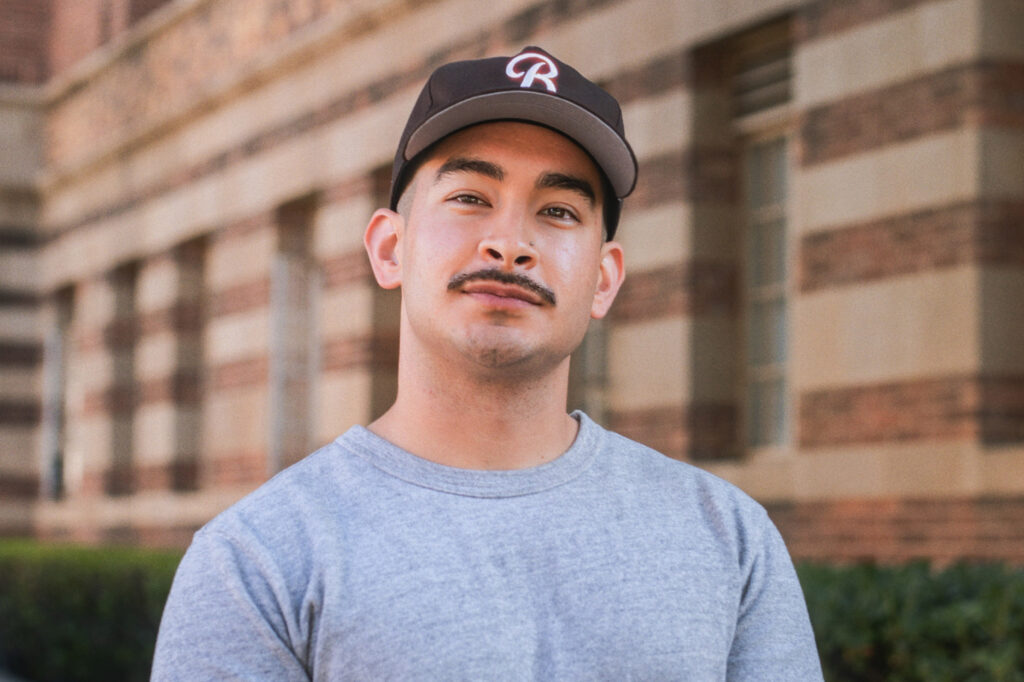
Brenda Lopez
By studying local photographers and other aspects of Chicano culture, Brian Zamora is aiming to better incorporate historically forgotten perspectives into academia.
| August 1, 2025
Shortly after Brian Zamora began his doctorate four years ago, he became interested in how photographers capture everyday life in their neighborhoods — and how their art contributes to their communities.
Zamora, a Ph.D. student in the UCLA School of Education and Information Studies, reached out to Chicano photographers in the Mar Vista neighborhood through social media, asking if he could shadow them while they worked. After connecting with seven or eight artists, he narrowed the group down to four and then began accompanying them through stretches of West Los Angeles. His goal: studying how learning practices emerged through the photographers’ work, and how “place” played a role in those practices.
Eventually, though, Zamora realized that directly asking artists about their creative process wasn’t the best way to glean that information.
“They told me, ‘All we really do is get a point-and-shoot camera in one hand, and a beer in another. We’re capturing everyday life right in the hood,’” said Zamora, whose project is supported by a UCLA/Keck Humanistic Inquiry Graduate Research Award. “So I flipped the script on how I approached data collection.”
Rather than only shadowing photographers while they were working, Zamora began hanging out with them when they were just living their lives — even running errands like copying keys for one of the artists and picking up a meal from McDonald’s for the daughter of another.
“Doing that gave me more insights about their learning, their sociality and their photographic practice more broadly,” he said.
It also humanized his subjects in a way that traditional anonymizing research methodologies don’t: The photographers were people, not just datapoints.
“Being able to slow down and give our participants time to think about what it is that we’re interested in can lead to some of the most fruitful insights — insights that we as Chicanos and other people of color have always known but have not always been fully understood in academia.”
For example, although Zamora recognized that the photographers he followed were motivated by issues like gang life, gentrification and masculinity, throughout the year he spent following them that they were more likely to draw inspiration from the everyday scenery and people surrounding them — the paletero pushing an ice cream cart on a summer evening or a lowrider parked on a neighborhood street, for example.
“One of the photographers told me, ‘I think this is important for me to do before all the neighborhood goes away,’” Zamora said. “They’re engaging in the act of breathing life, honor and beauty into these communities.”
Documenting those cultural practices among racialized communities is central to Zamora’s research. His faculty mentor, Distinguished Professor Teresa McCarty, praised his focus on people who are often overlooked as learners or teachers.
“Brian’s research brings to light the enormous intellectual and cultural assets in the everyday life of urban communities of color, captured through the lens of the photographers and the ethnographer, but often dismissed or misrecognized in schools,” said McCarty, UCLA’s George F. Kneller Professor of Education and Anthropology. “Brian’s work and that of the neighborhood-based photographers vividly illuminate those assets as vital resources for learning and teaching.”
Zamora, who was raised in the San Fernando Valley, said he considers his work to be a political act. He said he has felt acutely aware that many of his students don’t expect to see a Chicano scholar leading their seminars or discussion sections. But by incorporating neighborhood-based photography and other aspects of Chicano culture into his teaching and research, Zamora places historically forgotten perspectives into the academic foreground.
“There was so much more light and inspiration that came to me once I came across books and histories that have reinforced this thought I’ve always had: that my people, my community, have always been people worthy of study and high intellectual merit,” Zamora said.
After completing his doctorate, Zamora hopes to become a professor and to teach others how they, too, can draw important lessons from the seemingly ordinary and routine.