
How Brian Kim Stefans incorporates AI into his creative process
The English professor has experimented with ChatGPT and other platforms in his recent work
Courtesy of Brian Kim Stefans
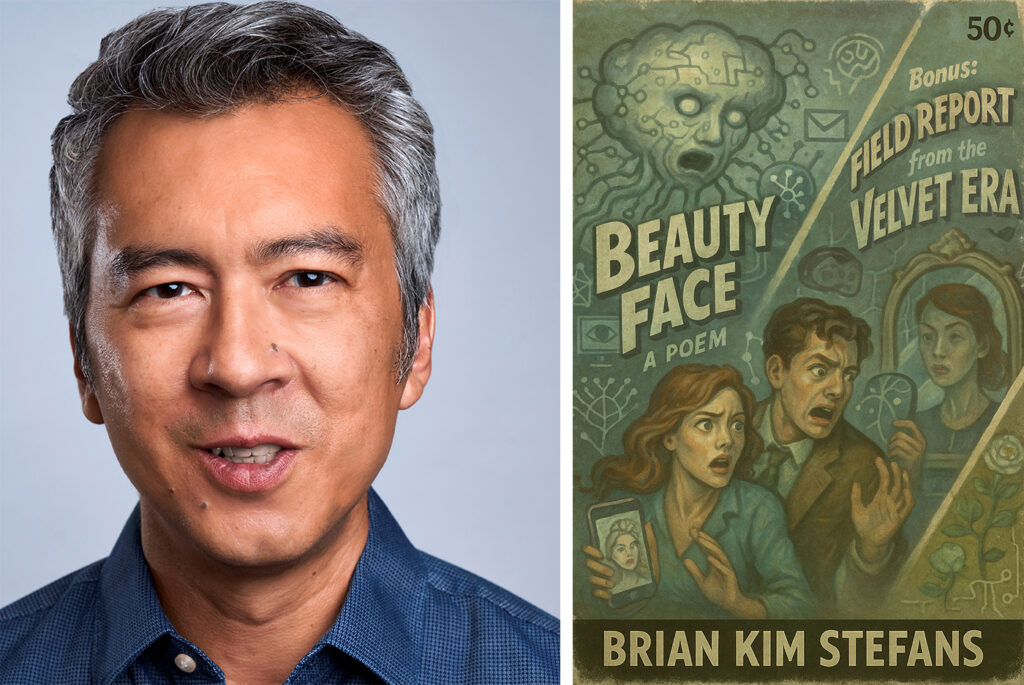
“Beauty Face: A Poem,” published in August, was Brian Kim Stefans’ first true collaboration with AI.
| December 16, 2025
This article is adapted from “AI For Good,” a special edition of the UCLA TDG Innovation Magazine. Read the complete feature.
Brian Kim Stefans has published several books of poetry and created works of digital literature since the late 1990s.
Lately, the UCLA English professor has been experimenting with ways to incorporate artificial intelligence into the creative process. Most recently, for an online anthology of Los Angeles poetry called “Extremes and Moderations,” which he expects to publish in 2026, he used AI to help design nearly 100 covers, primarily using the platform Midjourney.
“Midjourney is different because it’s not owned by one of the big AI companies,” Stefans said. “As a result, there is slightly more freedom and the quality of the images is higher, if not stranger. Every time you send in a prompt, it gives you four images that you can then create variations of through largely indirect methods.”
While AI automates some of the work, Stefans said the process still requires significant human input at every step.
“You just don’t type in something and get a perfect image,” he said. “It’s not like Photoshop, where you make very specific changes based on precise decisions. You can also have the image be inspired by other artists, and you can erase parts of it and have the AI fill it in and so forth. A lot of these covers would take hours.”
“Beauty Face: A Poem,” published in August, was Stefans’ first true collaboration with AI. To create it, he provided unused stanzas from another recent poem and prompted ChatGPT to write 100 stanzas in a similar style. Stefans kept revising the prompts until he was satisfied with the results and then swapped out stanzas here and there.
But it wasn’t just the text that was AI-generated. He also directed ChatGPT’s Dall-e image generator to create artwork to accompany each stanza and for the book cover design. The project took four solid days of work.
And the result? “I don’t think it’s a good poem that it came up with, but it’s a funny digital artifact,” he said. (Judge for yourself: The entire publication is downloadable for free from Stefans’ website.)
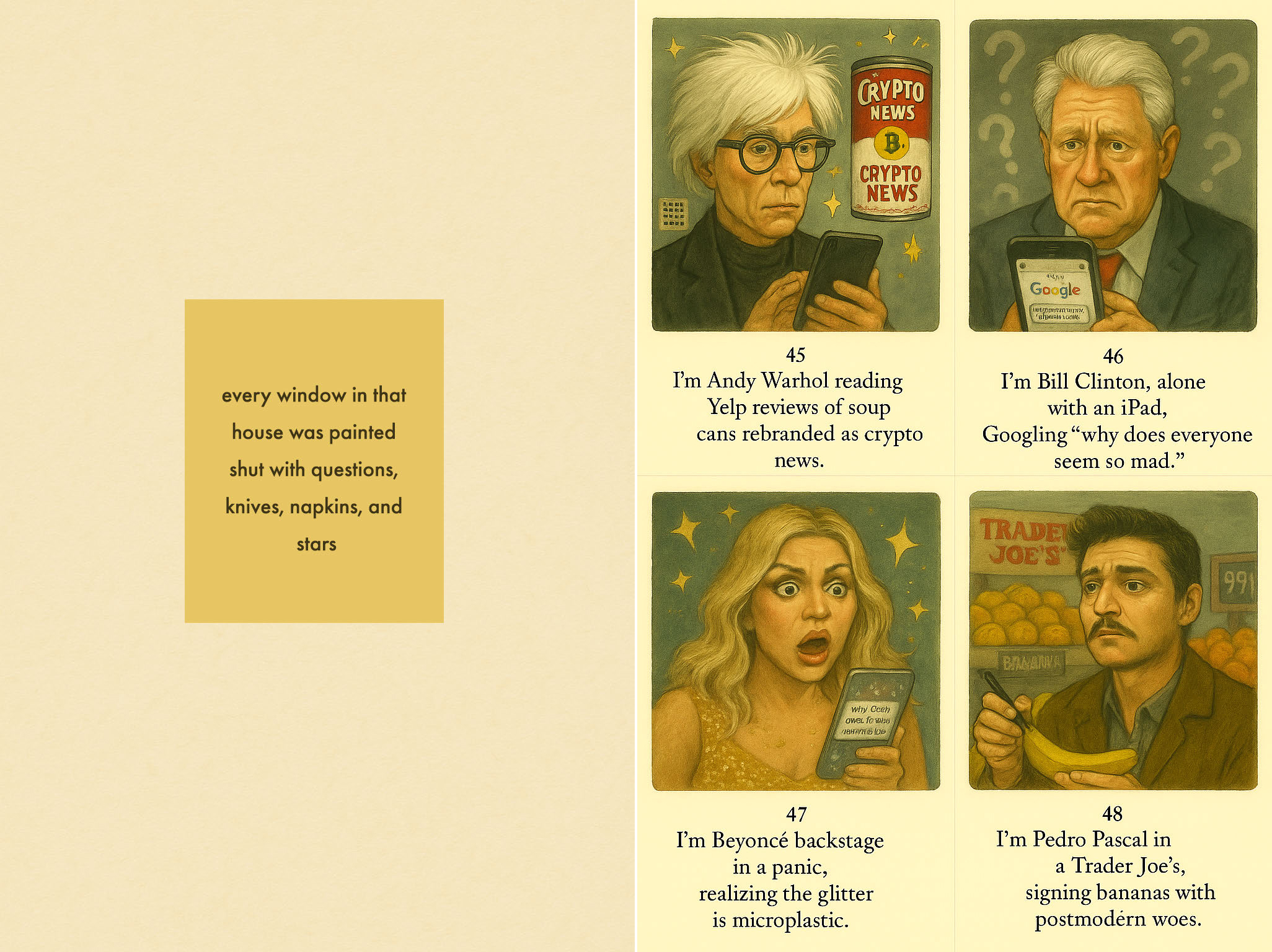
Pages from Brian Kim Stefans’ 2025 “Beauty Face: A Poem.”
Having tried out several platforms, Stefans said the quality of AI-generated content tends to be “pretty shallow,” unless the creator is actively engaged in quality control. In general, he said, the creative landscape is littered with “AI slop,” the popular term for the low-quality, low-effort, digital clutter produced by generative AI.
“My hope is that there’ll be a leveling mediocrity to which most people will become inured, to AI image, video and music generation that has been produced without genuine creative effort or insight,” he said. “With greater understanding in the general public of what AI slop looks like, the good stuff will rise to the top.”
Stefans has pondered the complex ethical issues that arise when generative AI uses other people’s art, and the possible ramifications of AI’s rise. He said corporations’ efforts to “soak the entire culture with AI” could actually cause people to move away from purely digital lifestyles and toward a greater appreciation for human contact — a notion supported by his observations of his UCLA students.
“My students generally do not like AI,” he said. “They would rather be in a classroom and interact with each other.”
As to whether AI will ultimately be a force for good for artists? “AI could stimulate new ideas,” Stefans said. “But not if you approach it like a content creator. Whether these tools can be useful to an artist, we’ll just have to wait, perhaps years, to answer that question substantially.”