
The ambassador of understanding
Benjamin Lewis is one of the faces of UCLA’s refreshed True Bruin Values
Amanda Friedman
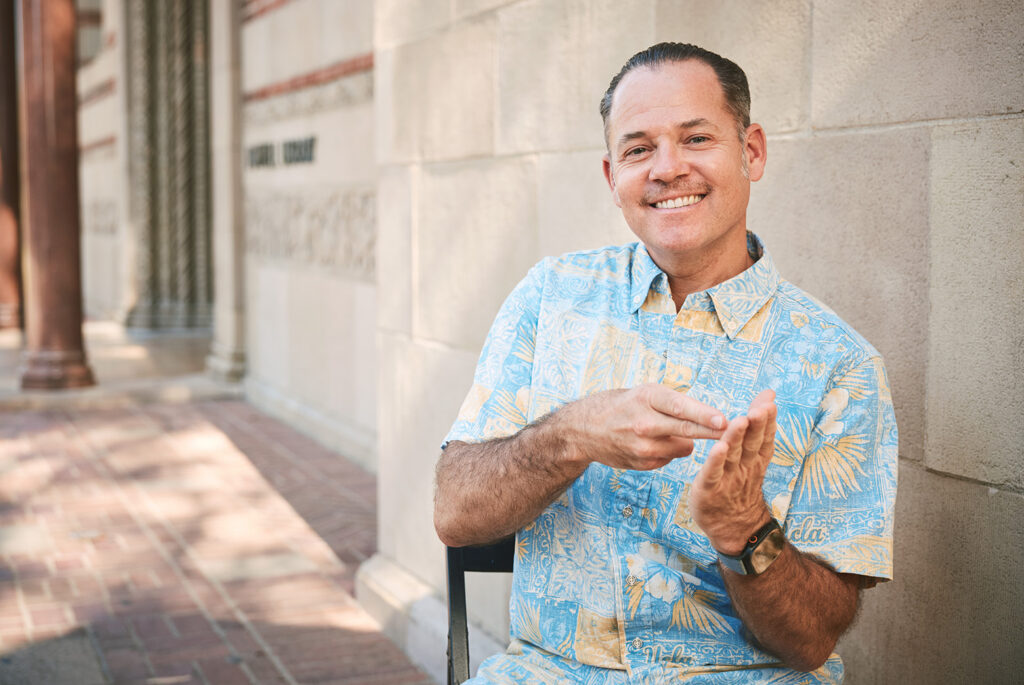
“I want every student to feel welcome,” says Benjamin Lewis, UCLA’s first American Sign Language instructor, “while also recognizing that they are entering a community with its own rich history, values and experiences.” Here, Lewis signs the word “integrity.”
| October 6, 2026
When UCLA first opened its doors as the Southern Branch of the University of California in September 1919, the inaugural student council established an honor code. The code, it was felt, would serve as a template — something akin to a North Star — for students’ scholarly and social conduct. It was an effort, and a successful one, to bolster the foundation of a fledgling institution that would go on to become, in short order, a world-class university.
Nearly a century later, at the start of the new millennium, UCLA formalized its inaugural set of “True Bruin Values” — respect, accountability, integrity, service and excellence — drawn from principles from the UC Office of the President. Now, 107 years after UCLA’s founding, these values continue to evolve.
Among the initiatives Chancellor Julio Frenk outlined in his “State of the Campus” address in May was a campuswide effort to shape a set of renewed, streamlined blue-and-gold values for UCLA’s second century, succinctly summed up in three words: integrity, excellence and belonging.
UCLA Magazine’s fall 2026 issue profiles three Bruins who exemplify those refreshed values, including Benjamin Lewis, a continuing lecturer of American Sign Language in the linguistics department, who was chosen to represent the value of integrity. The article also highlights Angela Deaver Campbell, assistant dean in the UCLA College Division of Undergraduate Education (for excellence) and Daniela Cortez Bravo, a two-time UCLA alumna who is now pursuing a doctorate in education (for belonging).
Read on for Lewis’ story, and read the full article on the UCLA Magazine website.
When Benjamin Lewis received the call in 2012 that he would be teaching at UCLA, he was floored. “I remember being shocked,” he recalls. “I couldn’t believe I would be working here.”
He saw the university as an exemplar of education. And he felt welcomed from the outset, as both he and his courses — such as American Sign Language 1 through 6 and others in Deaf history and culture — were warmly embraced. In and out of the classroom, Lewis has held himself to an honor code, guided by an unshakable moral compass and sense of integrity that have defined his teaching and life philosophy: “Learn the basics. Maintain eye contact. Be patient. And understand that recognizing the humanity of deaf individuals is a shared responsibility,” he reflects.
More than a decade later, his ASL courses continue to fill up seemingly within seconds. Whether students seek to satisfy graduation requirements or are curious to learn more about the third most commonly used language in the United States behind English and Spanish, countless Bruins have taken and been changed and empowered by his courses. But for Lewis, who is deaf, enrollment numbers are beside the point.
What matters is what happens once students walk through the door.
“I want every student to feel welcome,” he says, “while also recognizing that they are entering a community with its own rich history, values and experiences.”
As UCLA’s very first ASL instructor, Lewis has helped shape not just a curriculum but an entire community. Central to his approach is a simple but powerful idea: Learning ASL is not just about learning a language; it’s about using its lessons, its viewpoints, to reorient how one moves through the world.
In his classroom, students are asked to do more than memorize signs. They are encouraged to become thoughtful communicators, to engage with deaf culture on its own terms and to understand that deafness is not something needing fixing, but a lived identity to be understood and respected.
“Ultimately,” he says, “I hope my students carry forward the understanding that the goal is not always to fix differences, but to recognize, respect and value them.”
That philosophy is perhaps best captured in one of his favorite signs: community.
“The movement reflects people coming together and supporting one another,” Lewis explains. “It represents connection, shared understanding and collective strength in a way that feels deeply visual and powerful.”
For Lewis, that sense of shared understanding is the foundation of belonging — not just in his classroom, but across campus. Many of his students arrive with little or no prior exposure to deaf people and culture. Over the course of the quarter, they begin to see ASL differently: as something that extends beyond communication and allows for a means of connection shaped by context, culture and care. The impact of that shift often becomes visible long after the class ends.
“Watching former students soar in their own careers and continue their connection to the deaf community is incredibly gratifying,” he says.
Some have gone on to study at Gallaudet University in Washington, D.C., Lewis’ alma mater and a leader in ASL instruction; others have become advocates and attorneys working with the National Association of the Deaf or professionals collaborating with organizations like Deaf West Theatre. Across fields, they carry forward what they learned — that ASL is not just a language, but a whole new perspective, a worldview.
“As a teacher, there is no greater reward than knowing that the impact of your classroom extends beyond the quarter,” Lewis says. “What stands out most is not simply the growth in enrollment, but the growing number of students who become lifelong allies, advocates and contributors to the deaf community.”
After nearly 15 years at UCLA, Lewis is especially proud that with his own two hands — one sign at a time — he has taught students lessons that ripple throughout classrooms, professions and communities far beyond Westwood.
“I remain grateful,” he says, “for the opportunity to help students discover not only a new language, but a new way of seeing the world.”
This excerpt is adapted from a UCLA Magazine story. Read the complete fall 2026 issue here.