

Pourdavoud Lecture Series: Jake Nabel
April 22 @ 4:00 pm - 6:00 pm
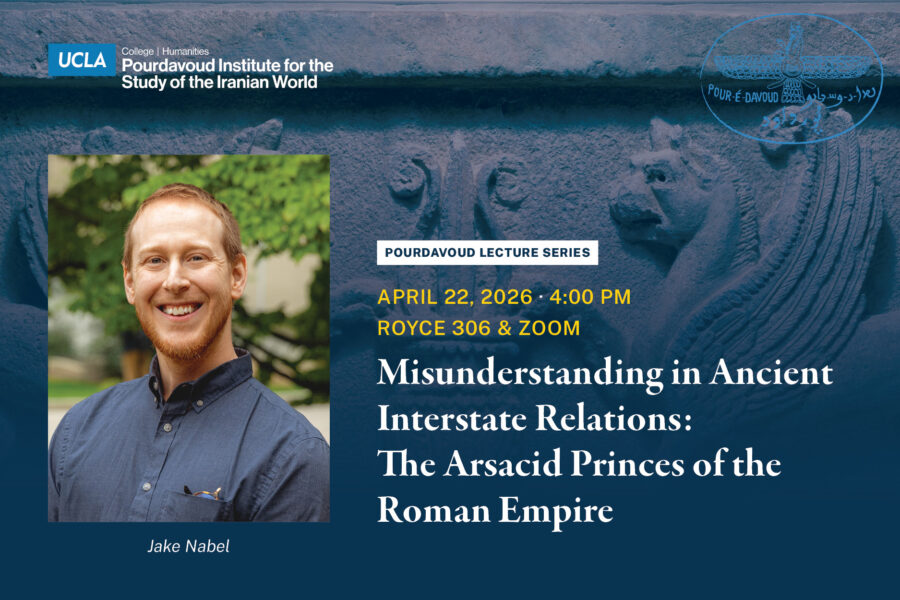
Misunderstanding in Ancient Interstate Relations
The Arsacid Princes of the Roman Empire
Jake Nabel (Pennsylvania State University)
Wednesday, April 22, 2026 at 4:00 pm Pacific Time
Royce Hall 306 and Via Zoom
Registration Link: https://forms.gle/ZFb7yBFBeEs2VfMt6
Zoom: https://ucla.zoom.us/j/92060104969
In the first century CE, several Arsacid princes from the Iranian empire of Parthia were sent to live at the court of the Roman emperor. While Roman authors called these figures “hostages” and scholars have studied them as such, this talk will employ Iranian and Armenian sources to argue that the Parthians would have seen them as the emperor’s foster-children. These divergent perspectives allowed each empire to perceive itself as superior to the other, since the two sides interpreted the transfer of royal children through conflicting cultural frameworks. Moving beyond the paradigms of anarchy and hierarchy, this focus advances a new vision of interstate relations with misunderstanding at its center. The talk is based on the book The Arsacids of Rome, which was recently published by the University of California Press in the Pourdavoud Institute’s Iran and the Ancient World series.
 About the Speaker
Jake Nabel is the Tombros Early Career Professor of Classical Studies and an Assistant Professor of Classics & Ancient Mediterranean Studies at Penn State. He is a historian of ancient Rome, pre-Islamic Iran, and the points of contact between the two. Jake has published on Roman-Parthian relations, Latin and Iranian literature, ancient political thought, and the Hellenistic east. His current book project is on the concept of freedom in late antique Iran.
 About the Book
A free ebook version of this title is available through Luminos, University of California Press’s Open Access publishing program. Visit www.luminosoa.org to learn more.
At the beginning of the common era, the two major imperial powers of the ancient Mediterranean and Near East were Rome and Parthia. In this book, Jake Nabel analyzes Roman-Parthian interstate politics by focusing on a group of princes from the Arsacid family—the ruling dynasty of Parthia—who were sent to live at the Roman court. Although Roman authors called these figures “hostages” and scholars have studied them as such, Nabel draws on Iranian and Armenian sources to argue that the Parthians would have seen them as the emperor’s foster-children. These divergent perspectives allowed each empire to perceive itself as superior to the other, since the two sides interpreted the exchange of royal children through conflicting cultural frameworks. Moving beyond the paradigm of great powers in conflict, The Arsacids of Rome advances a new vision of interstate relations with misunderstanding at its center.