
‘Sustained by the curiosity and joy that makes us human’
At the inaugural College Lecture Awards, Helen Deutsch recognized the power of overcoming challenges as a path toward hope
UCLA College
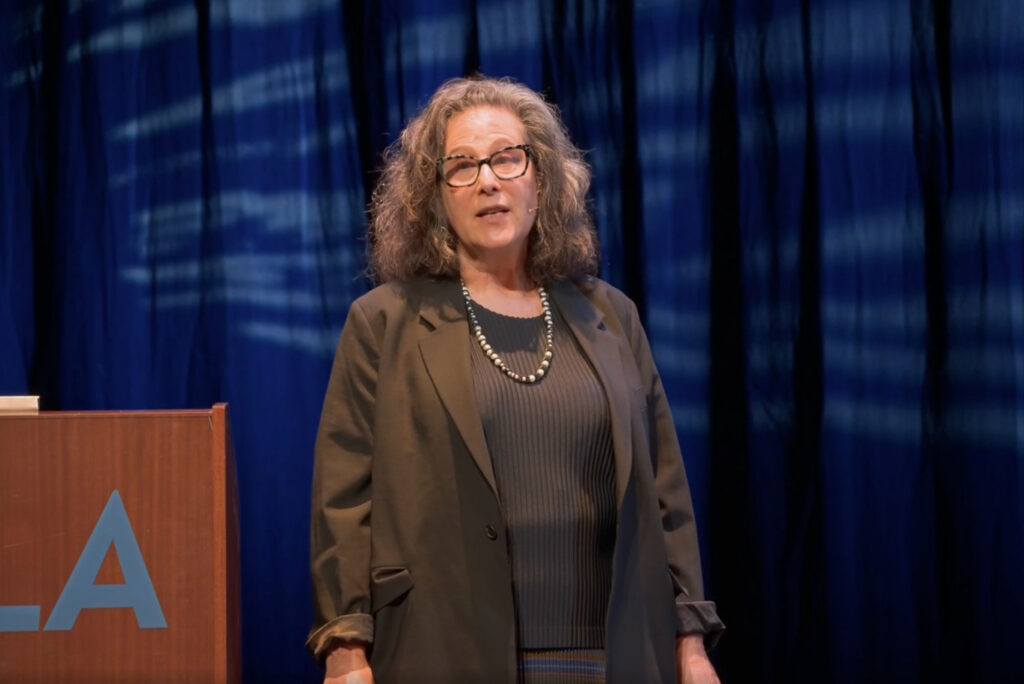
Helen Deutsch was one of five UCLA College faculty members to speak at the inaugural College Lecture Awards.
| October 29, 2026
At the inaugural College Lecture Awards, held Oct. 12 at Royce Hall, five UCLA College faculty members gave presentations highlighting unique aspects of their work and their shared commitment to advancing knowledge.
One honoree was chosen from each of the five divisions of the UCLA College; representing the Humanities Division was Helen Deutsch, professor of English and disability studies. Her moving remarks began with an appraisal of Jimothy, the raccoon with a curved spine who took the internet by storm earlier this year, and her observation that “disability and variability are at the heart of what it means to be human.”
Deutsch related the public’s fascination with Jimothy to her own appreciation of the writers Alexander Pope and Samuel Johnson, before sharing profound thoughts on how humanities scholars can resist the pervasive “cognitive surrender” of the artificial intelligence era.
An excerpt of Deutsch’s remarks follows. View her eight-minute talk on the UCLA College YouTube page, and read about the other College Lecture Awards presentations on UCLA Newsroom.
“Today, we are being told that AI is the future, as if we have no choice in the matter.
“AI propels us forward; it promises instant gratification, immediate answers, so that we can move on. The deadening ease of AI reminds me of Johnson’s moral tale ‘Rasselas,’ in which the protagonist, bored and trapped in a paradise in which all his needs are met, complains, “I have enjoyed enough. Give me something to desire.”
“As a humanist scholar, I am on the side of desire, of difficulty, of slowing down and struggling.
“In my classroom, we respond to the authors who speak to us from the past, who were embodied in unique and often painful ways, and whose words are enduring gifts. The first sentence I read in freshman English was the opening line of Samuel Beckett’s first novel, ‘Murphy’: ‘The sun shone, having no alternative on the nothing new.’ The arresting music and sly irony of these words remind us that the boring fact of the sun shining might also be a wonder.
“Equally wonderful, Beckett shows us how stopping, slowing our progress, taking a less easy path, can be a form of beginning.
“So perhaps people love that weird, disabled, elusive raccoon because he reminds us of the importance of struggle and resilience at a moment when many of us are tired and demoralized. We’re living with so many daily challenges, physically and psychologically, our resilience is constantly being tested. Seeing this creature in a body that might not be the easiest — although we don’t know what his experience is — who seems to be thriving on his own terms, is a very heartening thing.
“AI does not give us that kind of hope. In fact, it has recently been described as eliciting cognitive surrender. In my classroom, we resist. We keep our own pace, no matter how fast our modern world wants us to move, and we embrace the difficulty of the texts we encounter and our own embodied lives, sustained by the joy and curiosity that make us human.”
Read more about Helen Deutsch
‘What it means to be human’: Lessons from Jimothy, Seattle’s viral raccoon (2026)
Symposium on environmental illnesses highlights new multicampus research initiative (2023)