
Understanding the underworld in an underground speakeasy
Marissa Stevens is giving public talks about ancient Egypt as part of the Lectures on Tap series
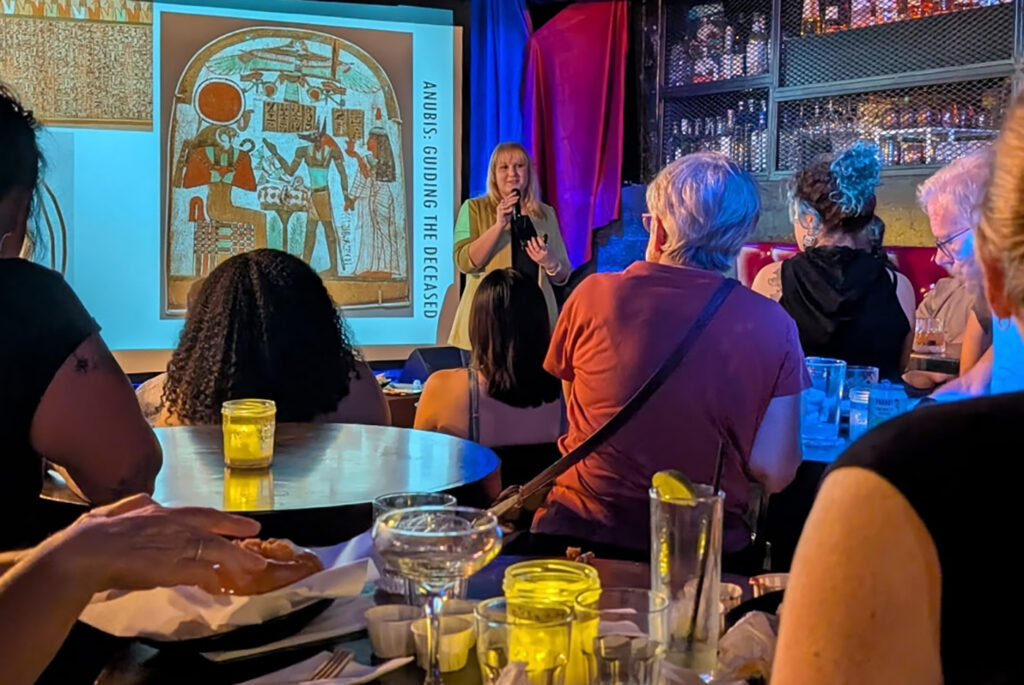
Courtesy of Marissa Stevens
Marissa Stevens speaking to a sold-out crowd at the Rhythm Room in August. She will lead two more Lectures on Tap events, on Oct. 1 and Nov. 30.
| September 30, 2026
What better place for a lecture on the Egyptian underworld than an underground speakeasy?
That was the unusual venue for a recent presentation by UCLA Egyptologist Marissa Stevens. Her lecture, to a sold-out audience of about 60 people, was held at a downtown Los Angeles nightclub called the Rhythm Room. The event was organized by an independent event producer called Lectures on Tap, which invites professors and other experts to discuss their scholarship with general audiences at bars, clubs and galleries in Los Angeles and other cities.
That first lecture, in late August, was such a success that Stevens will reprise it — this time at the Wonzimer art gallery in Lincoln Heights — on Oct. 1. Her talk draws from the Book of the Dead and related underworld texts to explore how myth, magic and religion shaped Egyptian funerary beliefs and practices.
Stevens, the managing associate director of the UCLA Pourdavoud Institute for the Study of the Ancient World, said speaking to an audience of non-Egyptologists was an invigorating change of pace.
“The thing that binds everyone in these audiences is curiosity,” she said. “They’re there to learn. So the most challenging thing is presenting enough basic facts about the topic, but also giving them something beyond what they might already know or challenging preconceived notions they’re bringing into the lecture.”
Lectures are 45 minutes followed by a question-and-answer period, and Stevens said she was pleasantly surprised by the thoughtful, nuanced queries from the audience. One guest, for example, asked what percentage of people would have actually engaged with funerary texts in ancient Egypt — surmising correctly, Stevens said, that literacy rates at the time were very low.
“The material we discussed is largely from tombs, which are incredibly restrictive spaces,” she said. “So it was a great parallel to today, because the majority of Egyptians, if they ever saw this material — perhaps in a family tomb that they had commissioned — would be engaging with it in the same way audiences do today, as people who were not literate in the language.”
Stevens said she strongly recommends the experience to other scholars. “I think it’s so important to share research with the wider public,” she said. “To share what you do with people that are passionate about it and care is very fulfilling, and I think the humanities in particular need to have more representation in these types of activities.”
Stevens’ Oct. 1 talk is already sold out. But she’s already scheduled for her third Lecture on Tap on Nov. 30 at Three Clubs Hollywood. She’s framing it as a crash course on hieroglyphs.
“I can’t promise literacy on hieroglyphs at the end of a 45-minute lecture,” she said, “but I think understanding the framework of language is a great way to understand a society.”