
Project led by Barbara Fuchs brings 17th-century drama to Spanish-speaking children
Courtesy of Universidad Autónoma de Nueva León
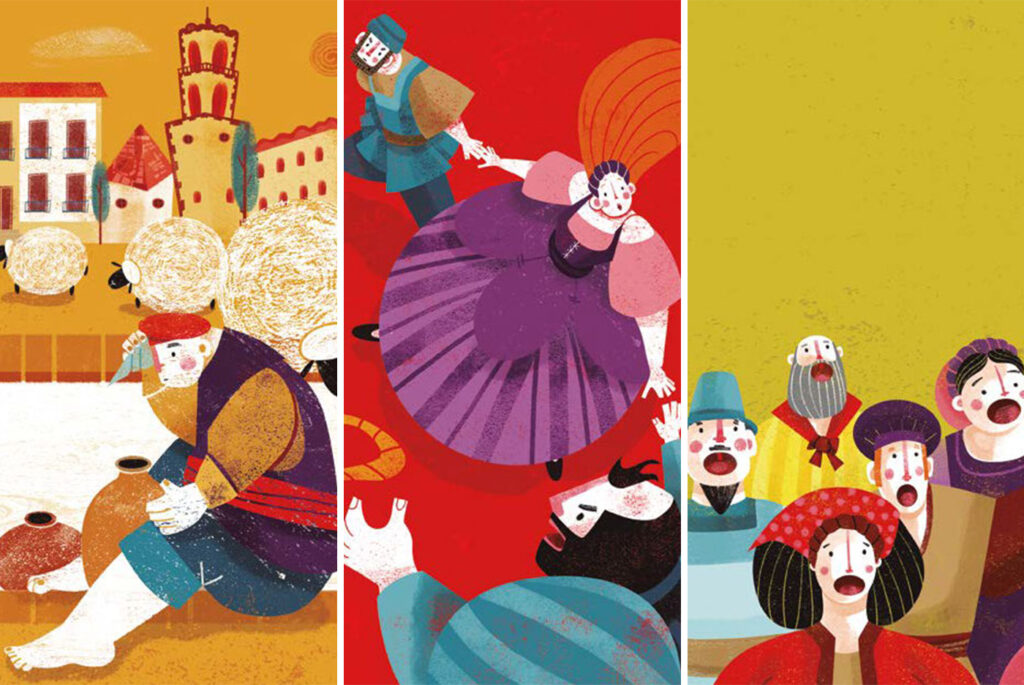
The storybook adaptation features colorful illustrations by Tania Recio.
| August 21, 2026
Barbara Fuchs, a UCLA distinguished professor of Spanish and Portuguese and of English, is aiming to introduce classical theater to young Spanish speakers across the U.S. and Mexico.
In collaboration with scholars from the Universidad Nacional Autónoma de Mexico, Fuchs and her team are adapting classical Hispanic plays into illustrated, Spanish-language storybooks for children ages six to 10. The project is under the auspices of UCLA’s Diversifying the Classics initiative, which promotes Spanish-language classical theater through adaptations, translations and academic research.
The project’s latest publication is an adaptation of “Fuente Ovejuna,” a 17th-century Spanish drama by Lope de Vega. The storybook features 48 pages of vibrant geometric illustrations by Mexican artist Tania Recio.
“We’ve been working on introducing Hispanic classical theater to audiences of all ages and at all stages,” Fuchs said. “But we realized that there were no kids’ versions of the plays we felt so passionately about.”
In the original “Fuente Ovejuna,” the villagers of the play’s namesake town come together to murder the town’s tyrannical ruler, el Comendador. Fuchs’ adaptation reworks that scene to minimize the more adult themes, and instead focuses on motifs such as collective action and justice.
Barbara Fuchs
“‘Fuente Ovejuna’ is very violent, but it has a clear through line of what is just and what is fair, which children recognize,” Fuchs said. “It teaches children solidarity, and that we can all stand up to a bully together.”
Of course, Fuchs’ adaptation also retains some language from the original. For instance, one of the first scenes in the book includes lyrics from a song performed by the villagers in Lope’s version.
“In order to keep a little bit of the flavor of the original play, we kept two or three lines here and there,” Fuchs said. “We wanted kids to be able to have a first exposure to the really beautiful language of the original.”
The adaptation also includes an invitation for young readers to actively engage with the work. At the end of the book, Fuchs condensed the play into a six-page script that children can act out with one another.
Fuchs’ work on “Fuente Ovejuna” also came to life beyond the pages of the new book. In January, a family-friendly version of the play, also adapted by Fuchs, was presented in a staged reading at the Folger Shakespeare Library in Washington, D.C. Fuchs spoke about the project — and about Spain’s Golden Age of Theater — in a Folger podcast.
The publication of the children’s book is in line with Diversifying the Classics’ broader goal of making classic Spanish-language plays like “Fuente Ovejuna” as ubiquitous as “A Midsummer Night’s Dream” or “Hamlet.” Several other adaptations are in the works.
Rachel Kaufman, a UCLA doctoral candidate in history and member of Diversifying the Classics, coauthored the second book in the series, an adaptation of Pedro Calderón de la Barca’s “La vida es sueño” (“Life is a Dream”) with Professor Gabriela Villanueva of UNAM. Kaufman has also co-led workshops for kids at LA Librería, a Spanish-language bookstore in the West Adams neighborhood.
“Our mission is to not only expand the canon of theater to practitioners, but also to students,” Kaufman said. “It’s really incredible to create these bilingual art-making spaces.”
The UCLA–UNAM partnership was funded through a grant from Alianza MX, a University of California initiative that supports UC scholars in their work with counterparts in Mexico.
“The goal for this project is to make sure that children’s theater comes in all flavors,” Fuchs said. “I really believe that the world would be a better place if more people were introduced to theater when little.”