

- This event has passed.
Biennial Yarshater Lecture Series: Frantz Grenet
March 4 @ 4:00 pm - 6:00 pm
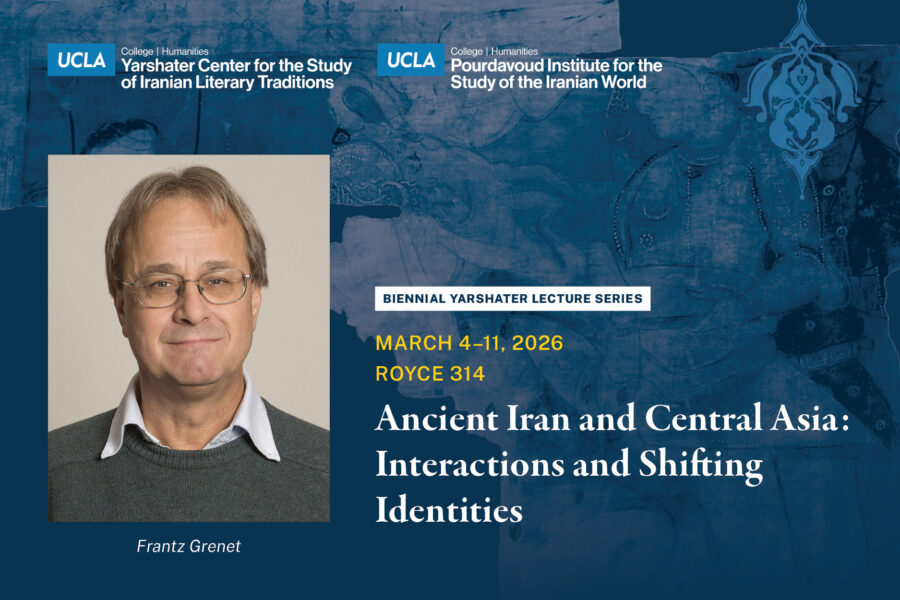
Ancient Iran and Central Asia: Interactions and Shifting Identities
March 4–11, 2026
A Series of Four Lectures at 4:00 pm
Royce Hall 314
RSVP Link: https://forms.gle/fiCSCpULf7H3nJ6H8
The Pourdavoud Institute and Yarshater Center welcome Frantz Grenet (Collège de France) in March to deliver the four-part Biennial Yarshater Lecture Series on the theme, “Ancient Iran and Central Asia: Interactions and Shifting Identities.”
Lecture 1: Wednesday, March 4, 4:00 pm PST
A World between Worlds: Geography, History, and Identity of the Early Kušāns (First Century CE)
This geographic and historical introduction to the Kušāns focuses on the multiple cultural affiliations and identities of the Kušān rulers and their empire, emphasizing the impact their neighbors had on identity formation and development.
Several vectors may have contributed to the development of Kušān identity. First, the historical heritage of the steppes prompts the question of the original language of the Yuezhi confederation, the cradle of the Kušān dynasty. This question is now being informed by the so-called “unknown script,” which has been deciphered and proven to be an early notation of the Bactrian language. Cultural interactions with their steppe neighbor to the north, the Kangju empire, certainly affected the Kušān worldview. This influence may be reflected in evidence such as their self-representation in the Khalchayan reliefs depicting a frontier war with the Kangju, whose own markedly bellicose identity is expressed on the Orlat bone plaque.
Second, the Hellenistic background of the Kušāns cannot be overlooked. The Kušāns experienced a unique mixture of steppe heritage (as seen at Tillia Tepe) and western influences through contact with the Roman East via maritime trade (as seen on Kujula Kadphises’s Augustan-style coinage).
Third, Hindu cults left a lasting impact on the Kušāns, which can be observed in the coinage of Vima Kadphises. Fourth, the relationship with the Parthians can be defined as one of “peaceful coexistence,” which was disrupted by the Sasanians’ rise to power, leading to territorial and commercial expansion that, however, had only limited effects in the religious sphere.
Lecture 2: Friday, March 6, 4:00 pm PST
Kušān Rulers: In Search of an Imperial Narrative (Second to Fourth Centuries CE)
Evidence such as coinage, the Rabatak inscription, the archaeological site of Surkh Kotal, and Huviška’s cotton painting sheds light on the political discourse of the Kušāns. Kaniška’s (r. 126–c. 150) ideological program focused on the following:
(1) abandoning the Greek script in diplomatic discourse, favoring an “Aryan” (that is, the Bactrian) language; and utilizing Indian titles (e.g., devaputra “son of god”) on the eastern side of the empire;
(2) incorporating Achaemenid formulaic language into the self-presentation of the sources of his power; and
(3) emphasizing a multicultural message rooted in religious plurality.
The latter point is evidenced by the observance of a specific iteration of Zoroastrianism, the patronage of multiple Indian cults (including Buddhism, though primarily at a local Indian level), and support for a more elaborate form of syncretism through the promotion of two specific religious figures: Wēš, a version of the god Vayu addressing the Shivaites, and Manāvagh, a version of Vohu Manah addressing the Vishnuites.
These tendencies were further developed under the successor dynasty of the Kušāno-Sasanians (c. 280–400 CE). Such actions served to consolidate Kušān rule, foster a shared cultural identity across the vast empire, and facilitate the spread of ideas along the Silk Road.
Lecture 3: Monday, March 9, 4:00 pm PDT
Diplomatic discourse furthered the ideological construction of a (pan-)Iranian identity, but literature, particularly the mytho-epic traditions, also contributed to this process. References to the Kayanids existed in Kušāno-Sasanian royal onomastics before they appeared in Sasanian royalty. Clusters of Kayanid toponyms are attested in eastern Bactria, and may also date to the Kušāno-Sasanian period. Early literary evidence for the Šāhnāme includes references to a “proto-Šāhnāme” of which a Sogdian fragment containing an episode of Rostam bears witness. The first pictorial representation of a Šāhnāme episode anywhere in the Iranian world appears in a mural painting at Kuh-e Ḵvājah, dating to the fifth or sixth century. In the later period, four Šāhnāme or peri-Šāhnāme episodes have been identified, some very recently, in Sogdian paintings of the eighth century. Interestingly, these paintings attest to a self-identification of the Sogdians as Iranians, rather than Turanians, during this early phase in the development of the Šāhnāme.
Lecture 4: Wednesday, March 11, 4:00 pm PDT
Philhellenism among the Hunnic Elites (Fifth to Seventh Centuries CE)
Although the Kušāns construed a (pan-)Iranian identity as evinced by geography, shared historical and cultural backgrounds, imperial discourse, language choice, religious pluralism, and literary culture, some of the post-Kušānites (e.g., the Huns, Hephthalites), however—both in reaction to this model and in order to forge a specific counter-identity—had recourse to Greek cultural practices (including imagery and possibly theatrical performances) to underscore their own identities vis-à-vis the Sasanian/Iranian world. Silverware, the most prestigious and politically controlled artistic product of the period in Bactria-Gandhara (and eventually Sogdiana), offers a broad repertoire of Greek subjects but never any allusion to the Iranian heroic cycle then in the process of formation, as may be seen in extant wall paintings. Some Jewish elites were also part of this cultural orientation. Images of the “Roman wolf” on coins and wall paintings in the seventh and eighth centuries bear witness to a “Philoroman” (in fact, Philobyzantine) tendency, consistent with the attested diplomatic contacts of the time.
After the completion of the Muslim conquest in the second half of the eighth century, the Bactrian and Sogdian languages ceased to be in use (with the exception of Sogdian in merchant colonies and in Christian and Manichaean communities). References to the Hellenistic culture were thereafter limited to the spheres of science and philosophy (as in other parts of the Islamic West). Iranian traditions carried forward by the milieu of the dehqāns were hardly able to retain eastern Iranian specificities: they merged into the al-‘Ajam, Iranian culture lato-sensu, whose literary languages were Arabic and later Persian. Emerging local dynasties forged Sasanian pedigree and did not claim links to earlier local polities (with the exception of Khorezm).
About the Speaker
 Frantz Grenet has been Professor at the Collège de France since 2013 and currently holds the chair of History and Cultures of Pre-Islamic Central Asia (Histoire et cultures de l’Asie centrale préislamique).
He studied at the École Normale Supérieure, Paris (1972–1977), focusing on the history and archaeology of Central Asia and the history of Zoroastrianism as his main fields of research. From 1977 to 1981, he was deputy director of the French Archaeological Delegation in Afghanistan (FADA) and participated in the excavations at Ai Khanum under the directorship of Paul Bernard. From 1981 to 2013, he was a research fellow at the Centre National de la Recherche Scientifique (CNRS), Paris.
Professor Grenet serves as director of the French-Uzbek Archaeological Mission in Sogdiana (1989–2014, and again since 2021), working mainly at Samarkand. Before taking up his position at the Collège de France, he was professor at the École Pratique des Hautes Etudes (1999–2014), holding the chair of Religions of the Ancient Iranian World. Professor Grenet is a member of the Académie des Inscriptions et Belles-Lettres (inducted 2022), a member of the American Philosophical Society (joined 2017), a fellow of the Institute for the Study of the Ancient World (member of the Advisory Board, 2013–2017), and a board member of the Corpus Inscriptionum Iranicarum. He is also an honorary citizen of Samarkand (naturalized in 2018). Professor Grenet served as president of the scientific committee of the exhibition Splendeurs des oasis d’Ouzbékistan (Louvre, November 23, 2022 – March 6, 2023).
His main publications include: Les pratiques funéraires dans l’Asie centrale sédentaire de la conquête grecque à l’islamisation (Paris, 1984); A History of Zoroastrianism, vol. 3, Zoroastrianism under Macedonian and Roman Rule (Leiden, 1991; with Mary Boyce); La geste d’Ardashir, fils de Pâbak (Die, 2003); and The Golden Journey to Samarkand (selected articles translated into Chinese; Guilin, 2017). He has most recently collaborated with Nicholas Sims-Williams on The ‘Ancient Letters’ and Other Early Sogdian Documents and Inscriptions (2023), and Bactrian Documents IV (2025) as part of the Corpus Inscriptionum Iranicarum. He has produced seven edited or coedited collective volumes and approximately 200 articles in peer-reviewed journals, published in French, English, Russian, Persian, Chinese, and Japanese.