
He wrote the book on Michael Jordan’s cultural influence
Sean Brenner/UCLA Humanities (Bradley), iStock.com/artisteer (basketball court), Daniel Saunders/UCLA (composite)
Adam Bradley, a renowned chronicler of American popular culture, said “Air Jordan” is “almost like a shadow biography” of the basketball legend.
| October 31, 2025
Adam Bradley was with his daughters at Legoland one day this summer when he noticed a familiar image seemingly everywhere he looked — on the shoes, clothing and even tattoos of people across age, race and gender lines.
The image? Nike’s Jumpman logo, the silhouetted representation of NBA Hall of Famer Michael Jordan leaping through the air, legs splayed wide, a basketball in one hand extended upward.
It would make sense that Bradley, a UCLA professor of English and African American studies, was attuned to all things Jordan during his Legoland excursion. He had, after all, just completed work on a coffee table book called “Air Jordan.” Published this month by Assouline, the volume explores Jordan’s life, legacy and cultural influence.
Jordan is still thought by many to be the greatest basketball player of all time and his on-court achievements are legendary. But his athletic exploits alone don’t explain his continued status as a cultural icon. Bradley said the fact that consumers still gravitate toward a decades-old logo, one inspired by an athlete who played his last professional game 23 years ago — an eternity in pop-culture years — demonstrates Jordan’s unique and enduring impact.
Unique but universal
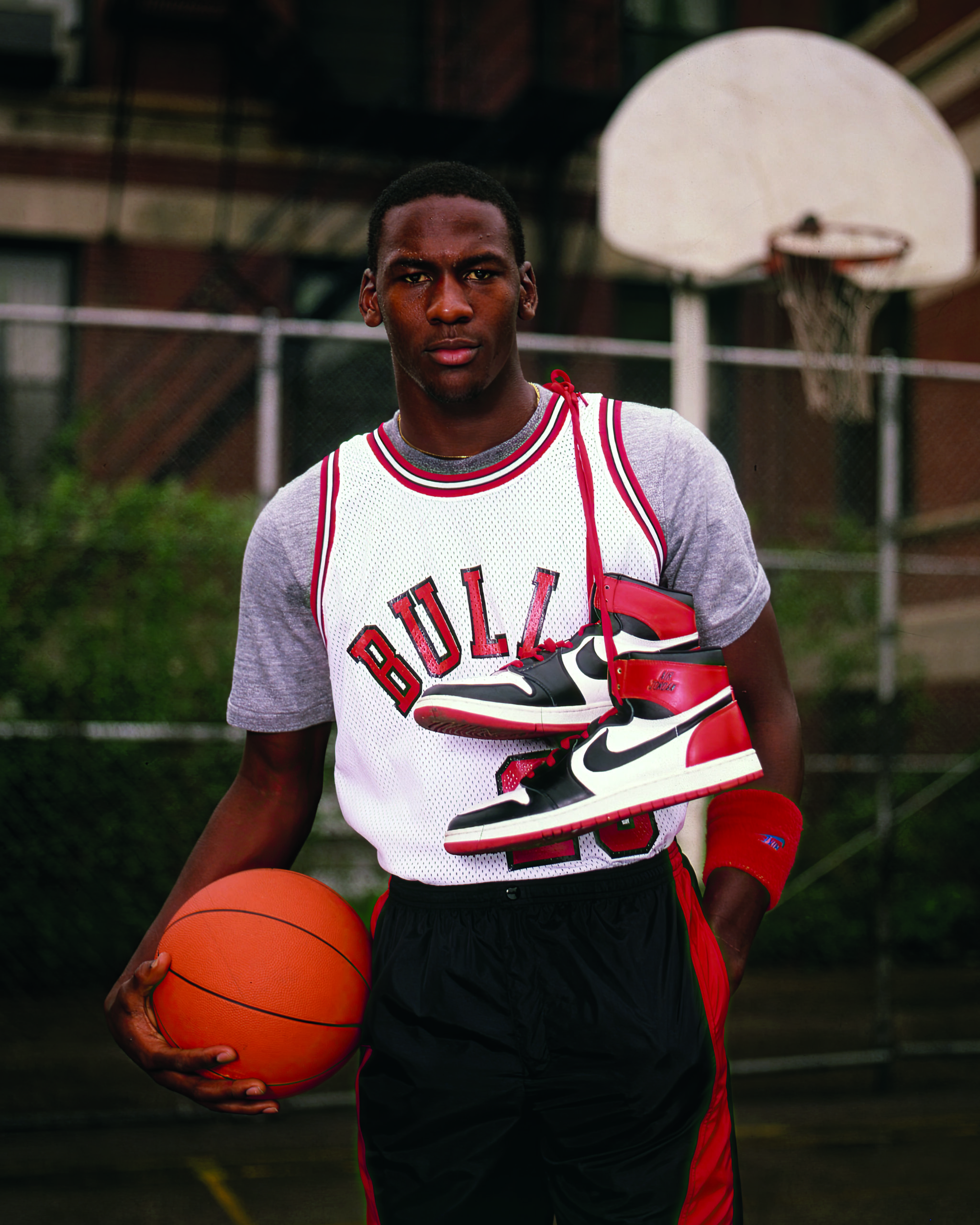
Michael Jordan in the 1980s with a pair of the original Air Jordan basketball shoes.
“The defining difference of Michael Jordan is that he’s one of the last remaining figures of the monoculture,” Bradley said. That is, at the time of his 1990s athletic apex, well before the internet and social media splintered global attention, Jordan achieved a level of worldwide fame that now seems almost unattainable.
“He emerged at a time in which it was unheard of for a Black American public figure to be the face of major advertising campaigns. He presented himself unabashedly, without compromise, as who he was — yet he was also universal.”
To Bradley, that achievement alone brought to life themes explored by some of the giants of 20th century American literature.
“There had been this sense that no matter how exceptional the Black individual might be, the individual could never be seen as a universal representative of the human condition,” he said. “But that was what Ralph Ellison was writing his way to in ‘Invisible Man,’ and it’s the same thing Toni Morrison was doing in ‘The Bluest Eye,’ which was to say, ‘I’m going to tell a particularly Black experience, and in doing so, connect to the broader themes of what it means to be human.
“Whether he would have articulated it in precisely those terms or not, that’s precisely what Michael Jordan was doing.”
In addition to photographs of Jordan throughout his life and career, “Air Jordan” features insights from designers, teammates and friends, and images of previously unseen objects from Jordan’s personal archives. (One example: a perfect-attendance certificate from Jordan’s grade school years in Wilmington, North Carolina.)
“It’s not a book about basketball,” Bradley said. “It’s almost like a shadow biography of Michael Jordan, told through these images and the words that I was able to write addressing those images.”
The text reflects Bradley’s expertise not only as a chronicler of American popular culture, but as a leading scholar of hip hop. For one gatefold, Bradley collected dozens upon dozens of rap lyrics mentioning Jordan — or his signature Air Jordan basketball shoes — by artists from around the world.
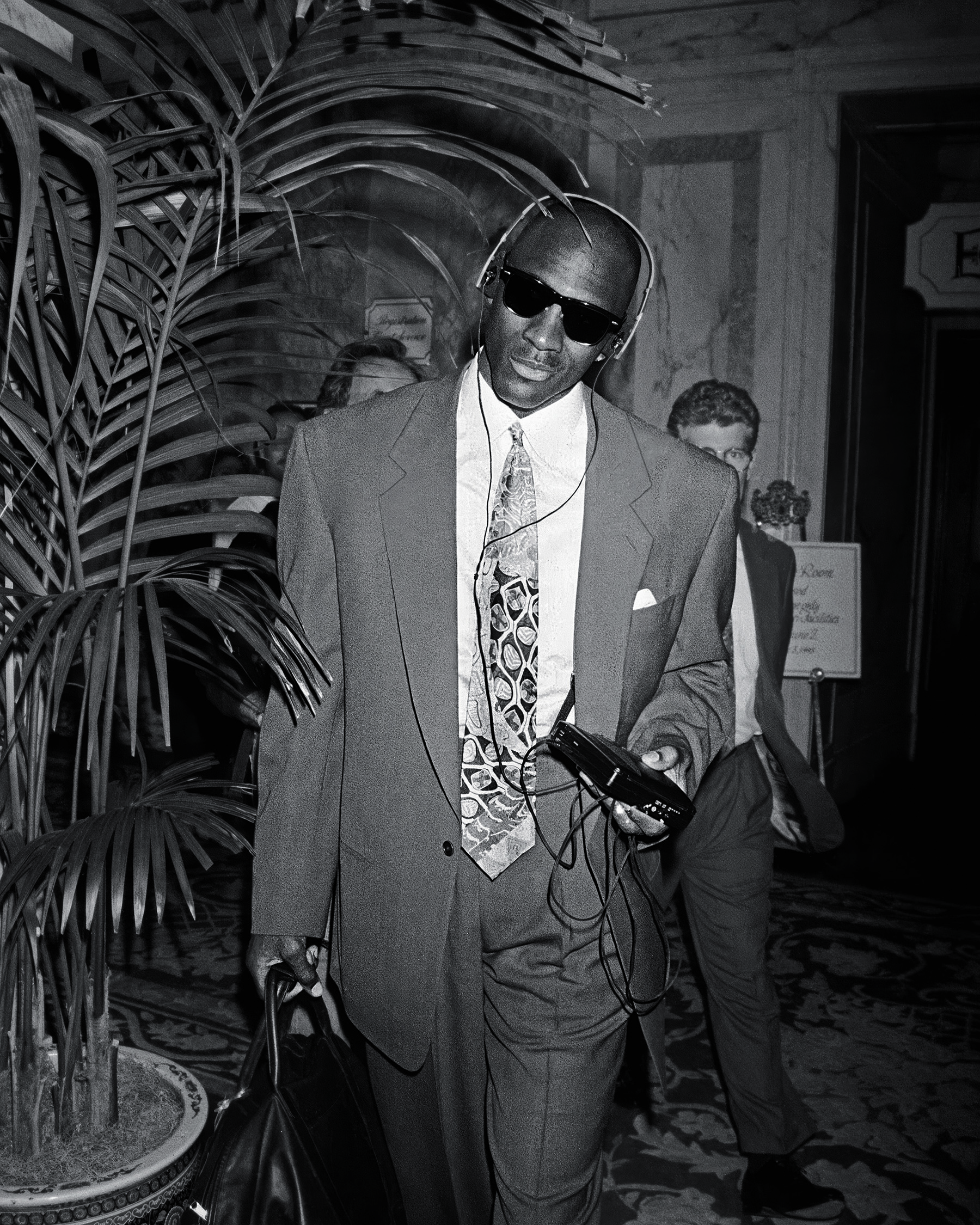
Beyond the basketball court, Jordan became a global style icon in the 1990s.
Bradley’s connection to his subject is more than academic. Having grown up in Salt Lake City rooting for the hometown Utah Jazz, Bradley was nevertheless a devoted Jordan fan. “It was a powerful thing for me, as a Black and white kid, to see Michael Jordan on television selling Gatorade with that ‘Be Like Mike’ jingle,” he said. “Even when he came to town and beat my hometown Jazz, I still looked up to him.”
(One of the most memorable moments of Jordan’s career was the game-winning shot he made against the Jazz in the 1998 NBA Finals to help seal the Chicago Bulls’ last championship.)
‘Future ancient artifacts’
While working on the book, Bradley said, it became clear that the caretakers of the Jordan brand are particularly thoughtful — in a way humanists and historians might appreciate — about preserving its longevity.
Jason Mayden, the brand’s chief design officer, told Bradley that when it comes to designing each new Jordan shoe, the mission is to create “future ancient artifacts.”
“I loved that phrase,” Bradley said. “The idea, the way Jason describes it, is that several hundred years from now, these shoes we wear today will help open up a conversation across history. Sometimes, a shoe is precisely the kind of thing that opens up a point of entry into understanding who people were, the things they valued, the way they chose to adorn themselves.
“And that’s why I think even the early Air Jordan shoes from 40 years ago have such currency today, because they connect us to the past, even as they show a continuity with the present.”
Related
In the news: Adam Bradley on Tyler, the Creator in the New York Times