
7 new faculty bring diverse range of interests, expertise to Humanities
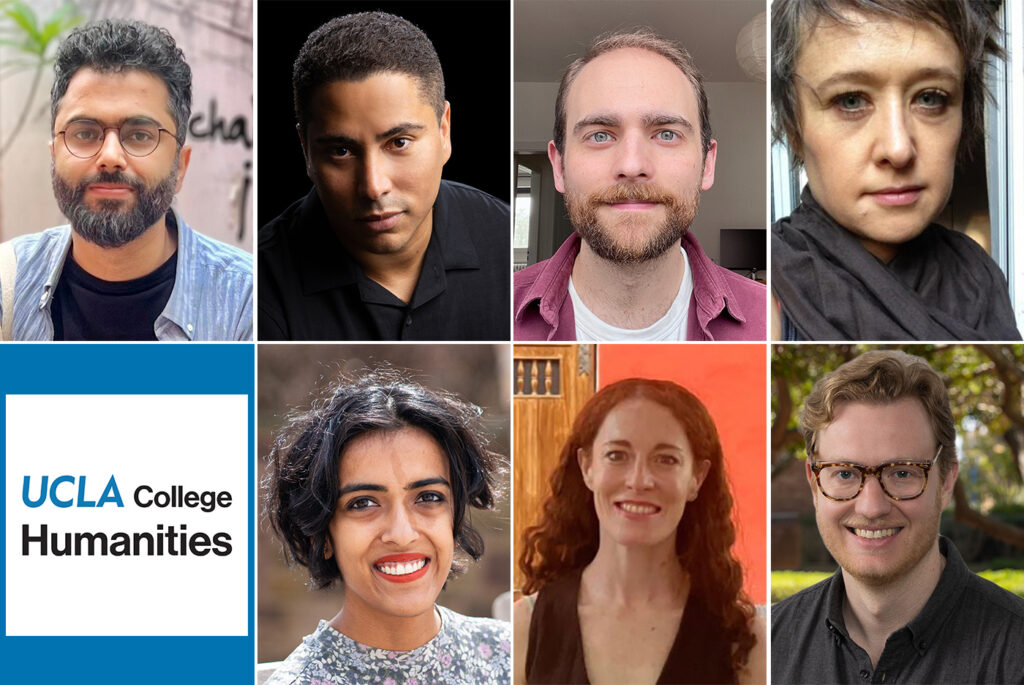
Courtesy of the subjects
Joining the Humanities faculty this fall are (top row, from left) Aditya Bahl, Alejandro Castro, John Duff and Karolina Hübner, and (bottom row, from left) Aliya Ram, Ana Ugarte and Jonathan Winnerman.
| September 10, 2025
Seven scholars whose research interests span centuries, languages, cultures and continents have joined the Humanities Division faculty for the 2025–26 academic year.
As we welcome our newest professors, here are profiles of their areas of inquiry and a preview of the courses they plan to teach.
Aditya Bahl, English, works at the intersections of literary studies, political economy and anthropology, with a particular interest in the longue durée of South Asia. His current project recovers the lost fragments of small and underground magazines published in Punjab (India) during the Cold War. Against a global backdrop of U.S.-Sino-Soviet confrontations, it traces how a fugitive laboratory of world literature came to surface in a postcolonial landscape dotted with seed farms, literary contact zones and prisons. He plans to teach courses on ghazals, Marx, love, Bombay and colonialism.
Alejandro Castro, Spanish and Portuguese, is a scholar of contemporary Latin American, Caribbean and U.S. Latinx literature, with a focus on queer theory, visual culture and the politics of the body. Castro is also an award-winning poet, and his creative and academic work often intersect. He enjoys teaching courses that explore Latin American and Latinx intellectual and artistic traditions.
John Duff, Linguistics, studies the process of language comprehension, using experimental methods to explore how humans go from sequences of words to an understanding of what a speaker was trying to communicate. He has a particular focus on how we accomplish this task differently across the world’s languages, and he frequently collaborates with speakers of Zapotec languages in California and Oaxaca. He will teach undergraduate and graduate courses on psycholinguistics.
Karolina Hübner, Philosophy, works primarily in the history of metaphysics and the history of philosophy of mind, and she is particularly interested in the history of idealism, intentionality and panpsychism. She is currently finishing a monograph on Spinoza’s philosophy of mind. Her publications have focused on early modern philosophy, including Spinoza, Cavendish and Descartes, but she also has had long-standing interests in late 19th- and early 20th-century Idealism and phenomenology, continental philosophy generally, philosophy of art and philosophical theology.
Aliya Ram, English, studies the connections between social coercion and aesthetic innovation, especially in the modern literatures and cultures of the Global South. She is currently working on one project on literary address and another on the emergence of the refugee as an exemplary narrator. Her research centers the complexities of social identity, narratability and intersubjectivity as illuminated by acts of linguistic concealment. She will teach courses such as Narrating the Refugee; Other Englishes; Non-Reproductive Futures; and Opacity, Ambiguity, Misdirection. Ram is on leave for the 2025–26 academic year.
Ana Ugarte, Comparative Literature, examines the intersections between Health Humanities and Caribbean and Latin/x American studies. She analyzes literary and cultural representations of illness and disability through biopolitical theory and posthumanism. She looks forward to teaching introductory courses in health humanities and critical theory.
Jonathan Winnerman, Near Eastern Languages and Cultures, studies kingship and sacred power in ancient Egypt and from a comparative perspective. He specializes in the texts and visual culture of the New Kingdom through Late Periods, and teaches all phases of the ancient Egyptian language, including Greco-Roman and Enigmatic hieroglyphs. As associate director of Global Antiquity, he is interested in the application of humanistic modes of inquiry to ancient worlds and their relevance today, and he organizes and teaches interdisciplinary courses on ancient topics, such as foundation myths and ancient engineering.