
Doctoral student produces documentary on humanitarian crisis in Nigeria
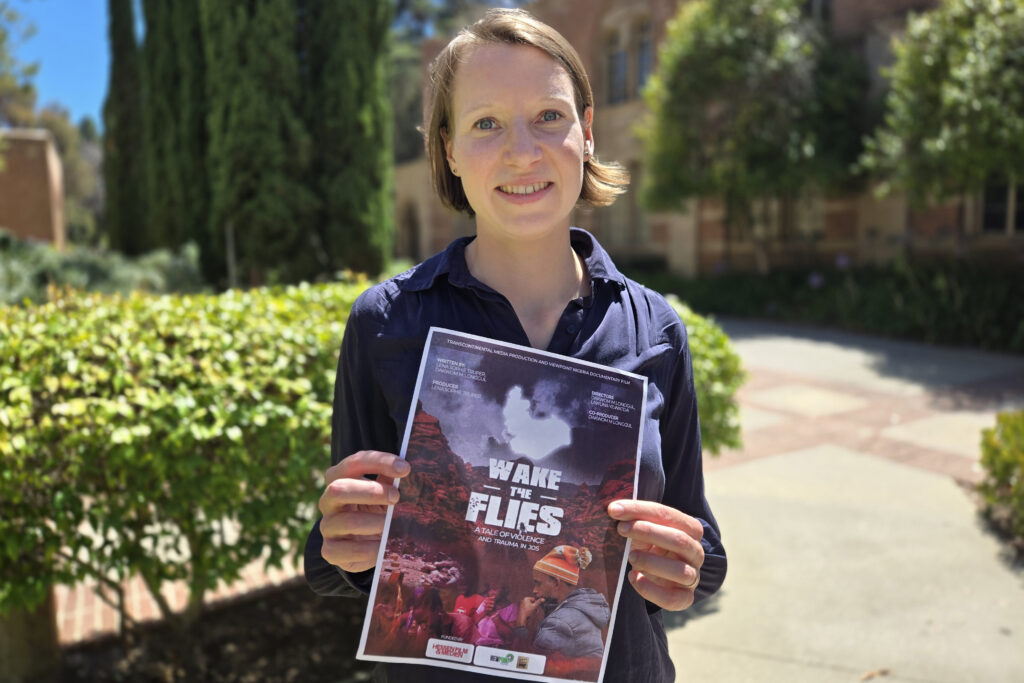
Sean Brenner/UCLA Humanities
Lena Trüper first learned about the conflicts in Jos, Nigeria, after giving a fly-themed presentation at an academic conference in Germany. The metaphor carried through to the documentary film she produced.
| July 30, 2025
Lena Trüper arrived from Germany to begin her doctorate at UCLA in 2020, her scholarly focus on art and technology movements of the 1960s.
At the time, she had never heard about a two-decades-long humanitarian crisis in Jos, Nigeria. And making a documentary film was decidedly not on her to-do list.
Five years later, Trüper is not only nearing the completion of her Ph.D., but she also can now call herself a film producer. “Wake the Flies,” a 26-minute documentary she helmed, explores violence, displacement and trauma in Jos, a city of roughly 900,000 in central Nigeria.
The film was completed in April; since then, it has been screened in Nigeria and Germany, and by Trüper’s UCLA home department, European Languages and Transcultural Studies. Trüper and her colleagues are now submitting it to film festivals and are planning to discuss the project at a conference in Germany this fall. (Watch the “Wake the Flies” trailer here.)
A complex conflict
Home to more than 50 ethnic groups, Jos has been wracked by violent conflicts that have killed thousands of people since 2001. The clashes have involved a wide range of local groups as well as outside interests, and the fighting has been spurred by an array of issues — over territory and natural resources as well as religious and political differences.

“In the Western media, they say it’s between Muslims and Christians, but it’s actually much more complicated,” Trüper said.
Through dozens of new interviews, as well as historical film and drone footage, “Wake the Flies” offers a multifaceted view of the crisis, which has been fueled by climate change, social polarization and colonial legacies.
Filming was conducted entirely in Nigeria by a team of about 20 people, many of whom were already part of an independent news collective. While Trüper handled administrative and editorial responsibilities from Germany, the crew sometimes faced daunting challenges simply to conduct interviews — some of the filming took place in villages where armed groups had previously attacked civilians.
“A lot of the money went actually into security,” Trüper said. “The film team had to be accompanied when they were going into the villages because there was a chance that there would still be groups with weapons there.”
Unexpected journey
Trüper’s path to producing the film began at a 2023 conference in Frankfurt, Germany, where she presented a performance piece about which scholars are given a voice in academia. As part of the presentation, Trüper pantomimed a fly trapped in flypaper.
That presentation caught the attention of Longgul Makpring Dakwom, a University of Jos lecturer who was attending the conference. Their shared interest in the symbolism of the fly — as both a harbinger of death and a borderless observer — sparked a collaboration.
“The fly was our connection point from the beginning, our idea how to connect to the audience across different continents,” Trüper said.
Dakwom told Trüper about the situation in Jos and after a series of conversations over the next few months, the two began collaborating with cinematographer and co-director Lawunna Yilwada on an outline for the film.
Trüper helped develop the film’s concept and secured a crucial 25,000 euro grant from a German foundation, Hessen Film & Medien.
Dakwom said Trüper’s contributions to the project were substantial. “Outside of her producer’s role, she served as our language expert, collaborating with me to revise the screenplay, editing the subtitle text, and offered perspectives on artistic and aesthetic choices,” he said. “Even the title of the film was inspired by her research.”

Lena Trüper (right) in Germany at a discussion about “Wake the Flies” with her filmmaking colleagues Lawunna Yilwada (left) and Longgul Makpring Dakwom.
Trüper and her colleagues didn’t always see eye to eye during production; gender representation was one sticking point. While several of the interview subjects were women who were victims of the conflict, most of the talking-head experts were men.
“My job was to make the film work for Western audiences, and having a broad range of voices was important because we wanted people to connect to the film, no matter which angle they were seeing it from,” Trüper said.
Igniting a conversation
The filmmakers are hoping that the documentary not only encourages dialogue about Jos within Nigeria — “For the region, it’s a very important thing just to get the conversation about these conflicts started,” Trüper said — but also about the universal issues it raises.
“The film ends with the sentence, ‘This is also a story of the world,’” Trüper said. “We wanted to spur discussions not only about this specific conflict, but about this broader problem that we see globally, of increasing polarization, especially through social media.”
Trüper said the experience won’t sway her to leave academia for a career in film — after she completes her doctorate, she hopes to teach — but it did build her resolve for sharing stories about important issues.
“I think it convinced me,” she said, “that it’s important to speak about topics that, especially in Europe, are not really on the agenda.”